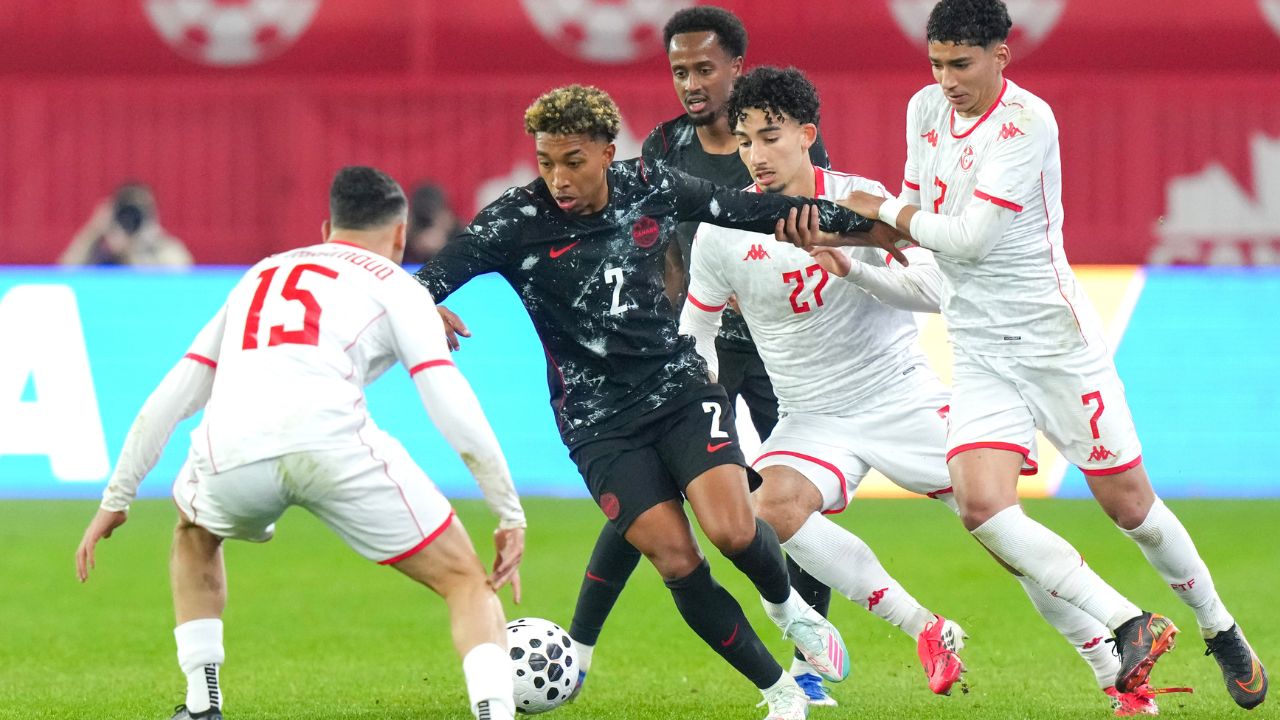

Lack of scoring touch forces Canada to settle for draw against Tunisia
TORONTO – The Canadian men’s team showed plenty of attacking impetus, but ended up settling for a 0-0 draw against Tunisia on Tuesday to close out March’s international window.
Fresh off a 2-2 draw versus Iceland last week, Canada was hoping to end this month on a more positive note, only to be let down by a lack of finishing in front of goal against the African nation.
While it wasn’t quite the result that Jesse Marsch was after, the Canadian coach was still pleased with the tenacity and spirit that his side displayed as it inches closer towards co-hosting this summer’s FIFA World Cup.
“Guys are really willing to sacrifice themselves to do whatever to help the team be successful,” Marsch said. “It’s a pleasure to be their coach. We’ve got some tough decisions coming up over the next eight weeks, but I really like our team, I really like our chances.”
Canada is 30th in the current FIFA world rankings, 14 spots above Tunisia, which will compete in its seventh World Cup this summer.
Here are three key takeaways from Canada’s draw against Tunisia:
Goals still hard to come by for Canada
Tuesday’s goal-less stalemate means Canada has recorded four clean sheets in its last five outings. Marsch’s men also are unbeaten in five games.
While the defence is holding steady, the offence has had issues.
Canada has now failed to score from open play in six of its last seven matches – and has no goals from open play in the last four games at Toronto’s BMO Field, where it will open its World Cup campaign on June 12 versus. Bosnia and Herzegovina. The Bosnians stunned Italy in penalty kicks on Tuesday to qualify.
The Canadians fervently attacked in waves on Tuesday, putting Tunisia under constant pressure while carrying the bulk of play and enjoying a 6-2 edge in shots on target. Canada looked dangerous in attack, but the final product was often lacking. And if not for a pair of penalties converted by acting captain Jonathan David last week versus Iceland, Canada would have failed to score across this month’s pair of friendlies.
Yet, Marsch maintains the goals will come for Canada at the World Cup.
“We would have liked to score more goals, but I think we were creating chances. We’re dangerous throughout games. We’re controlling matches. We’re playing against good opponents, so I’m not going to get negative or down on this group,” Marsch said.
“I know we have quality in the team, and I know that we can score goals. teams are defending harder against us; they’re taking us more seriously. They understand that when you come and play us, that it’s a talented group with a lot of speed and power. So, they know they have to be organized defensively and deep often and not give much away.”
Marcelo Flores shines in his first start
If anybody has used this international window to play his way onto the roster for the World Cup, it’s Marcelo Flores.
Flores, a 22-year-old born in Georgetown, Ont., is a dual national who had been capped for Mexico but had his one-time international switch approved by FIFA in February. Flores plays for Tigres UANL in Liga MX, the Mexican first division.
He earned his first cap for Canada when he came off the bench in the 63rd minute for Ali Ahmed last week versus Iceland and did enough to earn his first start on Tuesday.
Flores was one of Canada’s best performers, his speed, quick feet and trickery on the ball down the left side and while drifting into the middle caused Tunisia problems all night.
Canada’s best attacking moments flowed through Flores, who routinely found open spaces to exploit via his dynamic movements with the ball, while also playing his teammates into dangerous scoring positions. The fearlessness with which he plays is something that Canada’s attack could use more of as it heads into the World Cup.
“We have a lot of guys that are athletic and play with power, and he has a little something different. He’s clever, he’s quick, he moves around in the game. He can help see final plays. He did so many good things tonight, and now we’ve got to continue to work with his ability to understand how to see and play with the guys around him,” Marsch offered.
Liam Millar’s amazing defensive play
With no goals between the two sides, highlight-reel moments were few and far between. But Canadian winger Liam Millar managed to come up with an amazing defensive play that instantly went viral.
Canada was pressing for the opening goal late in the first half when a mistake by defender Joel Waterman deep inside Tunisia’s half allowed the visitors to launch a quick counterattack spearheaded by Elias Saad and Sayfallah Ltaief.
Saad looked poised to score from a tight angle on a two-on-zero breakaway after rounding Canada goalkeeper Maxime Crépeau, only to be thwarted at the very last second by a sliding block from Millar, who made a lung-busting recovery run from deep inside of his half to deny the visitors a sure goal.
Millar furiously pumped his first after making the stellar defensive play, while Marsch emphatically celebrated on the sideline as if Millar had scored the game’s opening goal. Millar’s amazing hustle to track back exemplifies the spirit with which Jesse Marsch wants to see his side play.
“We talk about having 100 per cent recoveries; when we do get broken down in transition moments, that we have a team that sprints back and gives everything to defend our own goal. I don’t know if I’ve ever seen a play like [that] and how far he ran. … You’d have to go back to where he started and where he ended to see how much he invested into protecting our goal. An amazing play and a defining play for what we’re trying to be,” Marsch said.
Another defensive injury for Canada
Canada’s depth at the back was tested during this international window and a defensive injury crisis appears to have deepened.
Alistair Johnston and Moïse Bombito were involved in this Canadian camp but only as training players as they are still regaining their fitness from long-term injuries. Missing from the team altogether due to injuries were fullback Alphonso Davies, and defenders Alfie Jones, Zorhan Bassong and Jamie Knight-Lebel. Youngster Luc de Fougerolles was in camp but didn’t play as he was dealing with an ankle injury, while fellow centre back Derek Cornelius saw limited minutes across the two games as he’s just coming back from a muscle injury.
This month’s games offered a chance for centre back Ralph Priso to step up in a big way. Priso, 23, has impressed for the Vancouver Whitecaps ever since last season when he was converted from a midfielder into a central defender, with many pundits believing he’s shown enough to earn a call-up for this summer’s World Cup.
Priso earned his first official cap against Iceland when he came off the bench and Marsch trusted him enough to start him against Tunisia. Priso started off on the right foot, displaying genuine intelligence in his positioning before a hamstring injury knocked him out of the game after only 26 minutes.
“We’re hopeful it’s not too bad. Maybe a couple weeks would be the best-case scenario,” Marsch said when asked about the prognosis on Priso.
Editor’s note
John Molinaro is one of the leading soccer journalists in Canada, having covered the game for over 27 years for several media outlets, including Sportsnet, CBC Sports and Sun Media. He is currently the editor-in-chief of TFC Republic, a website dedicated to in-depth coverage of Toronto FC and Canadian soccer.