

Cuban president says U.S. talks were to resolve differences
He did not elaborate on those factors, or provide any details about the talks
Author of the article:
Published Mar 13, 2026 • 2 minute read
Article content
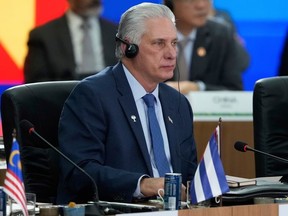
HAVANA (AP) — Cuban President Miguel Diaz-Canel said Friday that his government has held recent talks with the U.S., marking the first time the Caribbean country confirms such speculation.
Advertisement 2

Article content
He said the talks “were aimed at finding solutions through dialogue to the bilateral differences between our two nations. International factors facilitated these exchanges.”
Article content
Article content
He did not elaborate on those factors, or provide any details about the talks.
Diaz-Canel said no petroleum shipments have arrived on the island in the past three months, which he blamed on a U.S. energy blockade.
Cuba’s western region was hit by a massive blackout last week, leaving millions without power.
He said that Cuba, which produces 40% of its petroleum, has been generating its own power but that it hasn’t been sufficient to meet demand.
He said the lack of power has affected communications, education and transportation, and that the government has had to postpone surgeries for tens of thousands of people as a result.

Your Midday Sun
Article content
Advertisement 3
Article content
“The impact is tremendous,” he said.
Diaz-Canel said more than 115 bakeries across the island have been converted to run on firewood or coal.
He added that 955 solar panels have been installed in rural homes and social centers, and that more solar systems will come online before the end of March that will add 100 megawatts to Cuba’s crumbling electric grid.
“Even with everything we’re putting together, we still need oil,” he said.
Diaz-Canel noted that production output also has dropped: “Without energy, no country can produce at normal levels. All of this has meant making adjustments to employment.”
Last month, Cuba implemented austere fuel-saving measures.
Diaz-Canel said that the purpose of the talks was to identify “bilateral problems that require solutions based on their severity and impact” and find solutions to them.
Advertisement 4
Article content
The president added that the aim was “to determine the willingness of both parties to take concrete actions for the benefit of the people of both countries. And in addition, to identify areas of cooperation to confront threats and guarantee the security and peace of both nations, as well as in the region.”
He noted that Cuba is willing to carry out the process on the basis of equality and respect for the countries’ political systems and for Cuba’s “sovereignty and self-determination.”
Critical oil shipments from Venezuela were halted after the U.S. attacked the South American country and arrested its leader.
The most recent blackout was blamed on a broken boiler at a thermoelectric plant that forced the shutdown of Cuba’s power grid.
Authorities have noted that some thermoelectric plants have been operating for over 30 years and receive little maintenance given the high cost. U.S. sanctions also have prevented the government from buying new equipment and specialized parts, officials say.
Article content