We Review Viltrox’s First L-Mount: AF 16mm F/1.8 L, a Large Aperture Full-Frame Ultra-Wide Angle Lens | Fstoppers


The L-Mount Alliance was first unveiled at Photokina 2018. It was positioned as a long-term ecosystem play—one that harmonized multiple brands and prioritized system longevity over short-term competition. For years, the alliance remained relatively compact, dominated mainly by lens options that often leaned toward the premium end of the market, produced by brands that pioneered the alliance, such as Leica, Panasonic, and Sigma. 

With Viltrox joining the alliance as its 10th member in September last year, it aims to broaden the alliance’s lens collection by bringing its technology to deliver quality lens choices that are more accessible to creators using L-Mount cameras. The latest Viltrox AF 16mm f/1.8 L represents Viltrox’s first serious step into this space: a large-aperture, ultra-wide angle lens designed to meet the practical needs of photographers and filmmakers who want performance without the traditional L-Mount price premium.

Speaking of which, the timing of Viltrox’s official entry into the alliance is also a strategic one, coinciding with the recent growth of L-Mount users and the demand for full frame lenses. This allows the brand to have the legal rights to use the mount’s underlying technology when producing lenses. More importantly for end users, this legitimacy allows for the highest level of compatibility, reliability, and firmware integration across camera bodies—something not commonly shared in the camera industry. With that context in mind, I was pleased to see how Viltrox’s first L-Mount offering would perform when tested in a real-world environment, especially in an ecosystem known for its demanding standards.

Build Quality

Picking the Viltrox AF 16mm F/1.8 L right out of the box, the first thing I noticed was how dense this lens feels. Measuring Φ85.2 × 103 mm and weighing approximately 550 g, it features an all-metal barrel construction with an aluminum-alloy mount and rubber gasket, promising extensive weather sealing for a lens in this price range. In fact, it does provide a premium feel in use. I also appreciate that the lens markings appear to be lightly laser-etched onto the barrel rather than merely painted on top, ensuring they will last longer and further reinforcing that premium experience. You can also find a USB-C port at the bottom of the mount for future firmware updates, helping ensure long-term compatibility. Viltrox also claims the lens features a high-grade internal dust-sealing construction, which, when combined with its internal focusing design, should improve durability and provide better protection against dust entering the lens, as there are no external moving parts.

Rubber gasket and USB-C port at the lens mount.

The front element has the typical convex shape found on most wide angle lenses, but thankfully it does not protrude beyond the filter thread, making it possible to use standard 77mm filters. It is coated with a water-repellent, smudge-resistant coating, which helps make cleaning the lens on location easy—an important consideration for landscape photographers working in challenging environments. On the lens barrel, Viltrox includes a generous array of physical controls. You will find a wide, textured metal focusing ring (covering almost 30 percent of the barrel), a small information display in the middle, an AF/MF switch with two Fn buttons on the right, and a de-clickable aperture switch on the left. Personally, I found the two Fn buttons positioned a little too low and somewhat awkward to use; I would have preferred them swapped with the de-clickable aperture switch.

The front element does sit quite close to the filter thread, a protection filter is recommended when in use.


De-clickable aperture switch.

The focusing ring is wide enough and provides adequate traction for comfortable manual focusing, though it can feel a little loose if you are accustomed to traditional mechanical focus lenses. The focus-by-wire mechanism is responsive enough that making fine adjustments is not an issue. In terms of focus throw, it takes roughly five to six rotations to move from the minimum focusing distance of 0.27 m to infinity, which I found slightly excessive. The digital focusing scale is divided into 20 equal sections, though the distance from 1.75 m to infinity is compressed into the final two segments, making precise manual focus beyond 1.75 m more difficult at wider apertures. Better spacing here would have been beneficial. That said, this is not a major practical concern, as at f/5.6, anything from approximately 2 m onward falls within the hyperfocal distance. More frustrating is the absence of a hard stop at either end of the focus ring, an unavoidable limitation of the focus-by-wire design.

Having a physical aperture ring with the option to be de-clicked is especially useful for video work. When de-clicked, the ring maintains a satisfying level of resistance, though not enough to fully prevent accidental adjustments. Keeping it in the clicked mode alleviates this issue. The aperture ring clicks in 0.3-stop increments and features a soft stop before entering “A” (auto) mode to be controlled from the camera. It is worth noting that rotating the aperture ring with the camera powered off does not physically change the aperture, as control remains electronic. As a result, users who rely on strict aperture consistency may still encounter some variance during continuous shooting.

Aperture marking at every 0.3 stops. Also notice the green dot showing preset focus distance and yellow scale showing hyperfocal focus distance.

The lens also features a 160 × 80-pixel RGB IPS display that shows focus distance, focus mode, depth-of-field scale, aperture value, and Fn button indicators. This is a genuinely useful feature when working in low light, though the screen can appear overly bright in dark environments. An option to disable or dim the display would be welcome. From a design standpoint, some may dislike the flat screen mounted on an otherwise round barrel, as it slightly disrupts the seamless aesthetic. Personally, it did not bother me and instead gave the lens a distinctive visual identity.

Features

The Viltrox AF 16mm f/1.8 L is part of Viltrox’s DF/RBW (Digital Fullframe / Real Beam Waveguide) lens series, referring to lenses designed for full frame cameras that use a specialized multi-coating process to enhance image quality. Optically, the lens employs a complex design consisting of 15 elements in 12 groups, including four extra-low dispersion elements and three aspherical elements. These are combined with Viltrox’s HD nano multi-layer anti-reflection coatings to control chromatic aberration and maintain edge-to-edge clarity—two areas where ultra-wide angle lenses often struggle.

On a full frame camera, the lens offers a 105.6-degree angle of view and, combined with its bright f/1.8 to f/22 aperture range, makes it well suited for landscape, architecture, astrophotography, and immersive environmental work. The nine-blade aperture produces sunstars with double the number of points, which may appear overly complex for some tastes. That aside, the 16 mm focal length strikes a practical balance, allowing for dramatic framing while still keeping perspective distortion manageable with careful composition. Personally, 16 mm is the widest focal length I would regularly choose to use.

Autofocus-wise, it uses a more budget-friendly Stepping Motor (STM) to drive its autofocus, which Viltrox claims delivers fast, accurate and quiet performance. This choice aligns well with the lens’s video-oriented positioning. While STMs are known to be cheap, they are typically also favored in video work for their smoother focus transitions and reduced operational noise. The focus breathing of the lens is also surprisingly low, allowing photographers and videographers to maintain their frames during focus pulls or focus stacking, a rather practical design consideration for creators. 

The Viltrox AF 16mm F/1.8 L also has a minimum focusing distance of 0.27 meters and a maximum magnification of 0.1x, which does sound pretty close, but at 16mm focal length, it is really not much at all, totally logical, as this lens is not designed for close-up work. As we have discussed earlier, while the focus by wire mechanism does pose some challenges when manual focusing, having the ability to utilize the Fn2 button to set up to 2 focus points (A&B) with the combination of digital focus scale display may change your traditional workflow in approaching night landscape photography. Imagine setting up the focus properly before the sky is dark, and all you need to do is wait for the night to fall to shoot your set of focus-stacked photos without second-guessing the focus again. Thankfully, the lens does remember the saved settings even after powering off—a huge plus point. Though do take note that this mode only works in manual focus, and do make sure that there is a green indication on the distance scale indicating a successful save of the focus distance. Besides, you can also customize the extra Fn1 button to whatever you like in your camera—further streamlining your workflow.

Real-World Usage and Examples

Since the Viltrox AF 16mm F/1.8 L is already available on other mounts previously, I do believe to a certain extent that this lens shares the same optical formula with the other versions. The differences would primarily come from the mount integration and firmware behavior. In real-world use, the lens does behave as expected for a fast ultra-wide prime at this price range. If anything, it does seem to punch above its category. Sharpness across the frame is generally good, with excellent center acuity that holds up well even wide open. Performance towards the edges is not as strong, and some post-sharpening is also needed to bring them closer in line—particularly for landscape or architectural work where edge detail matters. That said, once stopped down, corner performance improves noticeably. In my testing, sharpness across the frame looked best between f/5.6 and f/7.1, and it held up reasonably well until around f/11, where diffraction starts to take a visible toll on the overall sharpness for anything past f/16.

Distortion is surprisingly well controlled for a 16mm lens. In fact, it is not something that will immediately draw your attention in real-world shooting—possibly corrected with the pre-loaded lens profile. Straight lines near the edges show slight curvature, but nothing unexpected for a lens at this focal length, and it is easily corrected in post if needed. From my research, laboratory measurements from other mounts show only modest barrel distortion, around -1.1 %, which I would assume is the same as what we have here. Overall chromatic aberration remains well controlled, especially with profiles applied; there is very minimal fringing even in high-contrast edges—though a tiny amount may still be visible toward the extreme corners of the frame in some scenes.

Flare control is decent in most cases, though not outstanding. Especially in certain situations with direct lighting, you are going to get some reddish/magenta ghosting with green flares, possibly from the anti-reflective coating. On the positive side, color and contrast are generally still well maintained on the rest of the frames. Therefore, using the lens hood is highly encouraged, especially when shooting into challenging light sources. Vignetting is something that does not fully disappear on its own. It is quite strong wide open, and while stopping down to around f/4 brings it to its most manageable level, some residual corner shading remains and will need to be addressed in post-processing. I would say the overall image rendering is pleasing. Images are sharp, colors look natural, and contrast holds up well in most scenarios. If I have to nitpick, the out-of-focus rendering in the mid-range can appear a little “nervous”, which I am personally not a fan of, but given the focal length and practicality, this might be the last thing that will bother you.

Autofocus performance via the STM motor is fast, quiet, and in practice does keep up well for both stills and video. Though at 16mm, focusing speed is rarely a limiting factor, as most of the things will be in focus anyway. Focus breathing is minimal, which makes focus stacking easier and is a welcome trait for video shooters who need consistent framing during focus pulls. While it performs well in the autofocus department, the focus scale can be tricky to get precise focus for anything past 1.75 m when you are shooting wide open. Stopping down a little will help, as given how wide this lens is, you will reach hyperfocal distance by f/2.8. 

On the aperture ring. If you prefer to control aperture from the camera body, setting the ring to “A” works as intended. However, I do wish there were a lock mechanism when in this position, as the ring can occasionally slip into a manual aperture setting during transportation.

Finally, something important to take note of. While the excellent mid-frame sharpness did encourage me to try this lens on APS-C L-Mount bodies, I did encounter aperture inconsistency that causes exposure issues when used with my Leica CL. Viltrox has also confirmed this compatibility issue with me and states that it’s not an issue with any full frame cameras, given that this is a full-frame lens. Logically, this behavior should not exist within the L-mount alliance, and I do hope it gets addressed through future firmware updates, but for now, it is something to take note of if you plan to use this lens on APS-C L-Mount cameras.

Summary

What I Liked

  • Physical aperture ring with the ability to de-click for video use
  • Functional Fn buttons, adding useful custom control on the lens itself
  • Digital focus scale display, providing quick visual feedback without relying on the camera body
  • Large f/1.8 maximum aperture, expanding low-light and creative shooting possibilities for an ultra-wide lens
  • Strong center sharpness that holds up well in real-world use
  • Competitive pricing, especially within the L-Mount ecosystem
  • Weather sealing adds confidence when shooting in less-than-ideal conditions

 What Could Be Improved

  • No hard stop on the focusing ring, limiting precision for manual focus
  • Focus throw could be shortened for more responsive manual focus adjustments
  • Flare control could be better, particularly in direct or strong backlighting
  • Ability to store more focus points, rather than being limited to just two (A and B)
  • Option to switch off the digital display when it is not in use, or to dim it in the dark
  • Reduction in size and weight would be welcome
  • More balanced focus scale, as distances become too compressed from around 1.75 m onward
  • Firmware update to fix aperture inconsistency on APS-C L-Mount cameras
  • Add a lock for the aperture ring in “A” mode

Final Closing Thoughts

The Viltrox AF 16mm F/1.8 L is a meaningful addition to the L-Mount ecosystem, bringing a combination of accessibility, functionality, and performance that has historically been limited within this system. Even at this price range, it delivers strong real-world image quality where it matters most and doesn’t seem to hold anything back in physical design. While it has some minor drawbacks, it succeeds at what it sets out to do. That said, at $580, the Viltrox AF 16mm f/1.8 L is a lens worth considering for photographers and filmmakers looking for a practical and affordable ultra-wide angle lens.


Hubble Captures Star Formation in Motion: Inside Lupus 3 and NGC 1333


Hubble Captures Star Formation in Motion: Inside Lupus 3 and NGC 1333

Star formation begins inside cold molecular clouds, where gravity slowly overwhelms thermal pressure and turbulence. These environments remain difficult to study because dust absorbs visible light and hides the earliest stages of stellar evolution. Space-based telescopes with high spatial resolution and multiwavelength capability, therefore, play a critical role in understanding how stars form and evolve. The Hubble Space Telescope continues to make a decisive contribution in this area.

Two recent Hubble observations focus on nearby star-forming regions within the Milky Way. One image targets the Lupus 3 molecular cloud. The other examines NGC 1333 in the Perseus molecular complex. Although these regions differ in structure and density, both reveal active stellar nurseries. Together, they provide a detailed view of early stellar evolution across multiple stages. These observations resolve circumstellar disks, trace stellar variability, and show how newly formed stars interact with their environment. As a result, they strengthen current models of star formation and help connect theory with observation.

Lupus 3: A nearby laboratory for low-mass star formation

Lupus 3 lies approximately 500 light-years from Earth in the constellation Scorpius. It forms part of the larger Lupus molecular cloud complex. Compared to massive star-forming regions, Lupus 3 appears relatively sparse. However, this apparent simplicity makes it an ideal target for studying low-mass star formation.

Hubble’s image reveals a diffuse cloud threaded with dark dust lanes. Embedded within this structure are numerous young stars. Most belong to the T Tauri class. These stars have already emerged from their natal envelopes but have not yet reached the main sequence. Their ages typically remain below ten million years.

T Tauri stars continue to contract under gravity. At the same time, they accrete material from surrounding disks. This accretion process drives variability in both brightness and spectral output. Hubble resolves these stars individually, allowing astronomers to study them in context rather than isolation.

Meanwhile, illuminated gas highlights regions where stellar radiation interacts with the cloud. In contrast, opaque dust marks areas of higher density. These dense pockets may collapse in the future, extending star formation within Lupus 3. The image, therefore, captures both current activity and potential future evolution.

A seemingly serene landscape of gas and dust is hopping with star formation behind the scenes in the Lupus 3 region. Credit: NASA, ESA, and K. Stapelfeldt (Jet Propulsion Laboratory); Processing: Gladys Kober (NASA/Catholic University of America)

Photometric variability and the nature of stellar youth

The Lupus 3 observation places particular emphasis on stellar variability. Many of the T Tauri stars in the region show irregular changes in brightness. These variations arise from multiple physical processes acting simultaneously.

First, rotating starspots modulate visible light output. Second, episodic accretion events deposit energy onto the stellar surface. Third, circumstellar material intermittently obscures the star. Each mechanism leaves a distinct observational signature.

Hubble’s stability allows astronomers to measure these effects precisely. Over time, such data improve constraints on stellar rotation rates and magnetic field strength. They also clarify how mass transfer from disk to star proceeds during early evolution.

Importantly, these processes influence disk survival. Strong magnetic activity and stellar winds can erode circumstellar material. As a result, they affect the window of opportunity for planet formation. Lupus 3 provides insight into how young stars shape their own planetary environments.

Close-up (cropped view) of a dark dust cloud in the Lupus 3 region. Credit: NASA, ESA, and K. Stapelfeldt (Jet Propulsion Laboratory); Processing: Gladys Kober (NASA/Catholic University of America)

NGC 1333: Multiple phases of stellar birth

NGC 1333 lies deeper within the Perseus molecular cloud at a distance of roughly 950 light-years. Unlike Lupus 3, this region contains a dense concentration of young stellar objects. Hubble’s image reflects that complexity. Within a single field of view, the observation captures protostars, pre-main-sequence stars, and variable young objects. The most striking feature is a deeply embedded protostar surrounded by a thick circumstellar disk.

This disk blocks direct starlight and casts pronounced shadows into the surrounding nebula. These shadows confirm the disk’s geometry and orientation. They also indicate a substantial mass reservoir feeding the growing star.

At the same time, outflows emerge from the protostar’s poles. These jets clear cavities in the surrounding cloud. Light escapes along these channels and scatters off dust grains. The result is a structured reflection nebula shaped by stellar feedback. This interaction between inflow and outflow defines the protostellar phase. NGC 1333 provides a direct observational window into one of the most critical stages of star formation.

A bright reflection nebula shares the stage with a protostar and planet-forming disk in this Hubble image of NGC 1333. Credit: NASA, ESA, K. Stapelfeldt (Jet Propulsion Laboratory) and D. Watson (University of Rochester); Processing: Gladys Kober (NASA/Catholic University of America)

Disks and jets: The regulators of stellar growth

Circumstellar disks play a central role in early stellar evolution. They regulate angular momentum and control accretion. Without them, stars could not form efficiently. The NGC 1333 image highlights these disks through both direct and indirect signatures.

Disk shadows offer one of the clearest indicators. They require a disk thick enough to block light and extended enough to influence the surrounding cloud. Observing these features helps constrain disk mass and vertical structure.

Jets and outflows provide the counterbalance. They remove excess angular momentum and limit stellar mass growth. They also inject energy into the cloud, altering local conditions. In some cases, this feedback may trigger additional star formation nearby.

Hubble’s resolution allows astronomers to disentangle these competing effects. By observing multiple objects within NGC 1333, researchers compare how similar processes unfold under slightly different conditions.

The two stars, HBC 340 (lower) and HBC 341 (upper), unleash stellar winds, or material flowing from the surface of the star, that clear out the cavity from the surrounding molecular cloud over time. Credit: NASA, ESA, K. Stapelfeldt (Jet Propulsion Laboratory) and D. Watson (University of Rochester); Processing: Gladys Kober (NASA/Catholic University of America)

Multiwavelength imaging and the role of dust

Dust governs much of what Hubble observes in these regions. While dust obscures visible light, it also reflects and scatters it. This dual role shapes the appearance of both Lupus 3 and NGC 1333. Hubble combines visible and near-infrared data to overcome these limitations. Near-infrared light penetrates deeper into dusty regions. Visible light traces reflection, nebulosity, and ionized gas. Together, these wavelengths reveal a layered structure.

In Lupus 3, this approach highlights diffuse clouds and exposed young stars. In NGC 1333, it reveals embedded protostars and disk shadows. The same technique thus adapts to different environments.

Observations of nearby stellar nurseries test theoretical models. Simulations predict how clouds fragment, how disks evolve, and how feedback shapes environments. Hubble’s images offer real benchmarks against which these predictions must align. Lupus 3 supports models of low-mass star formation in relatively calm environments. NGC 1333, in contrast, illustrates clustered formation with strong feedback. Together, they show the diversity of star-forming conditions within the same galaxy.

An actively forming star called a protostar casts its glow on the surrounding gas and dust. Credit: NASA, ESA, K. Stapelfeldt (Jet Propulsion Laboratory) and D. Watson (University of Rochester); Processing: Gladys Kober (NASA/Catholic University of America)

Clear skies!


Video of Cat’s Daily Ritual With Dad Melts Hearts – CatTime


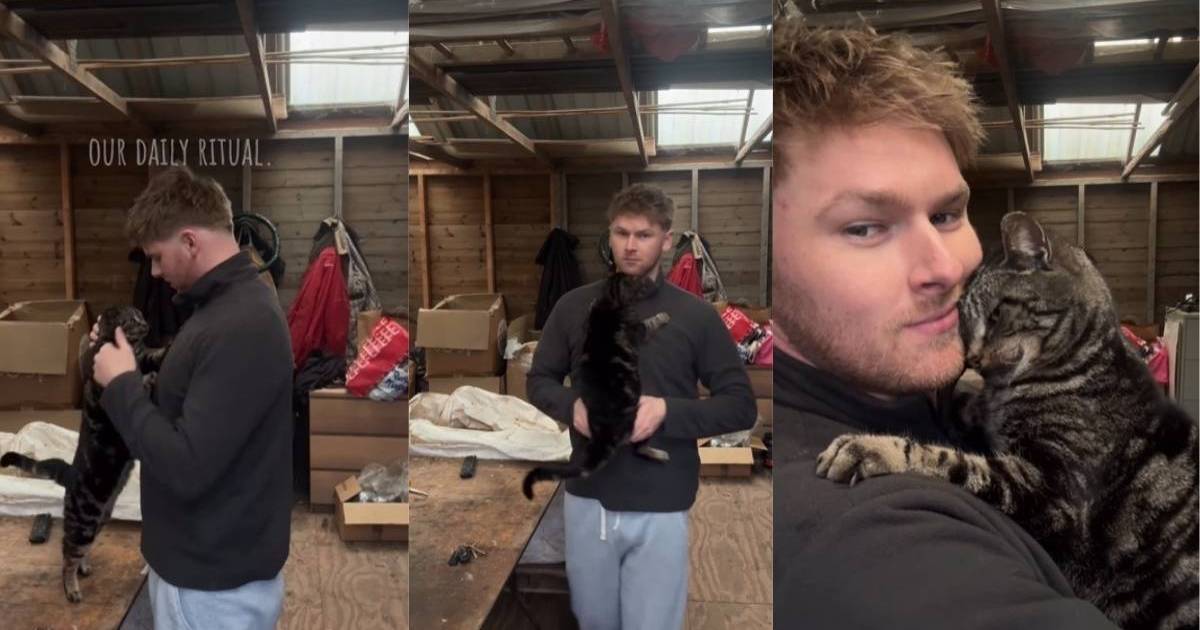
In an adorable Instagram video from user @harryandlippy, a tabby cat named Lippy demands hugs from her dad in the sweetest way possible, and who can deny such an opportunity? The cat starts her routine perched on a table. Amid a chaotic background, Lippy focuses on her dad, her human being, whom she wants to cozy up to.

Cat can’t stop hugging dad in adorable video

As soon as her dad steps in front of her in the adorable video, the cat lifts both front paws into the air and leans forward. Before you know it, she jumps up into her human’s arms. Then, Lippy wraps her paws around her dad’s neck and settles her whole body against his chest, purring loudly as if she is trying to drown out the rest of the world.

The on-screen caption calls it “Our daily ritual,” and the video shows why. Lippy rubs her face against her dad’s face, keeps purring, and even receives a soft kiss without moving an inch. And then her eyes start to droop. Still hugging on tight and purring as adorably as a cat could, she drifts into a comfortable sleep right there in her owner’s arms.

The video’s caption highlights, “The way she starts going to sleep in my arms ??”

Lippy’s body language says a lot: when cats press their faces into someone, they often do it for comfort and to share scent, which is basically their unique way of saying, “You’re mine, and I feel safe here.” And purring is more than just an adorable sound. Many cats use it to settle themselves down when they feel calm and secure.

Viewers couldn’t get over this sense of calmness and security. One person noted, “The paws round the neck,” while another wrote, “This warms my heart,” adding that it was “Just unconditional love at its purest.” And judging by the cat’s daily ritual with her dad in the video, it is, in fact, love that they share.


Orange Cat Dad Helps Care for Kittens After Leaving the Streets, and His Wish Comes True with Two Kittens


An orange cat dad helped care for kittens after leaving the street life. His wish came true with two kittens by his side.

Orange Cat Dad Helps Care for Kittens After Leaving the Streets, and His Wish Comes True with Two Kittens Harry and MerleTails of the Forgotten Paws

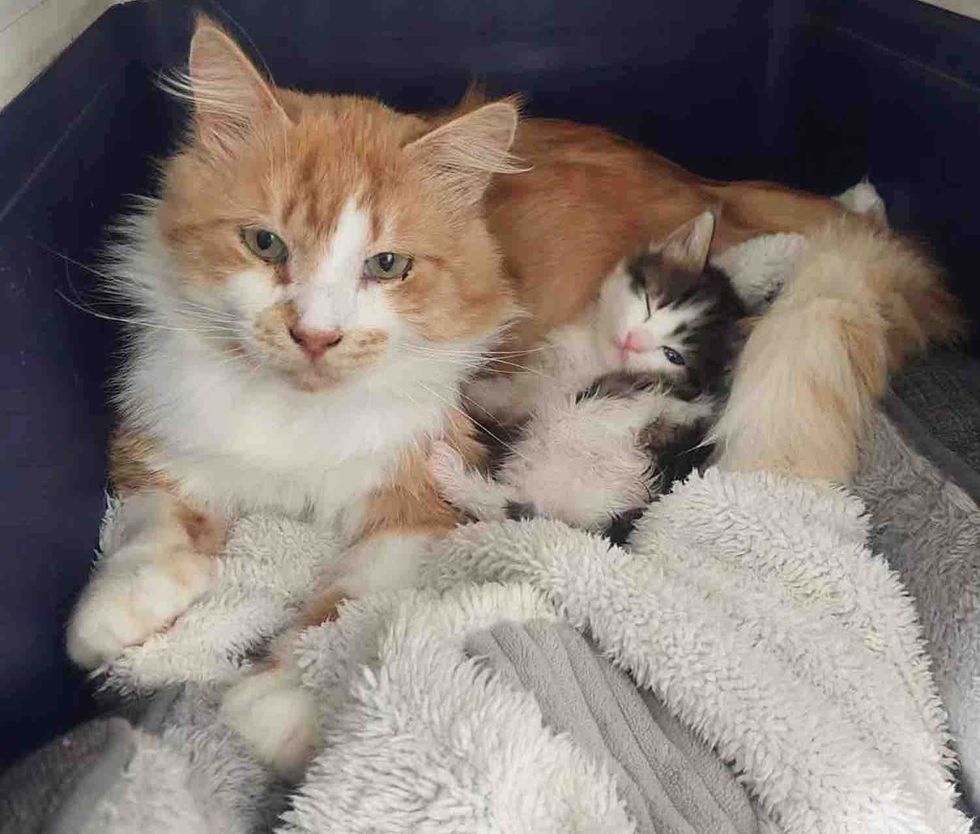
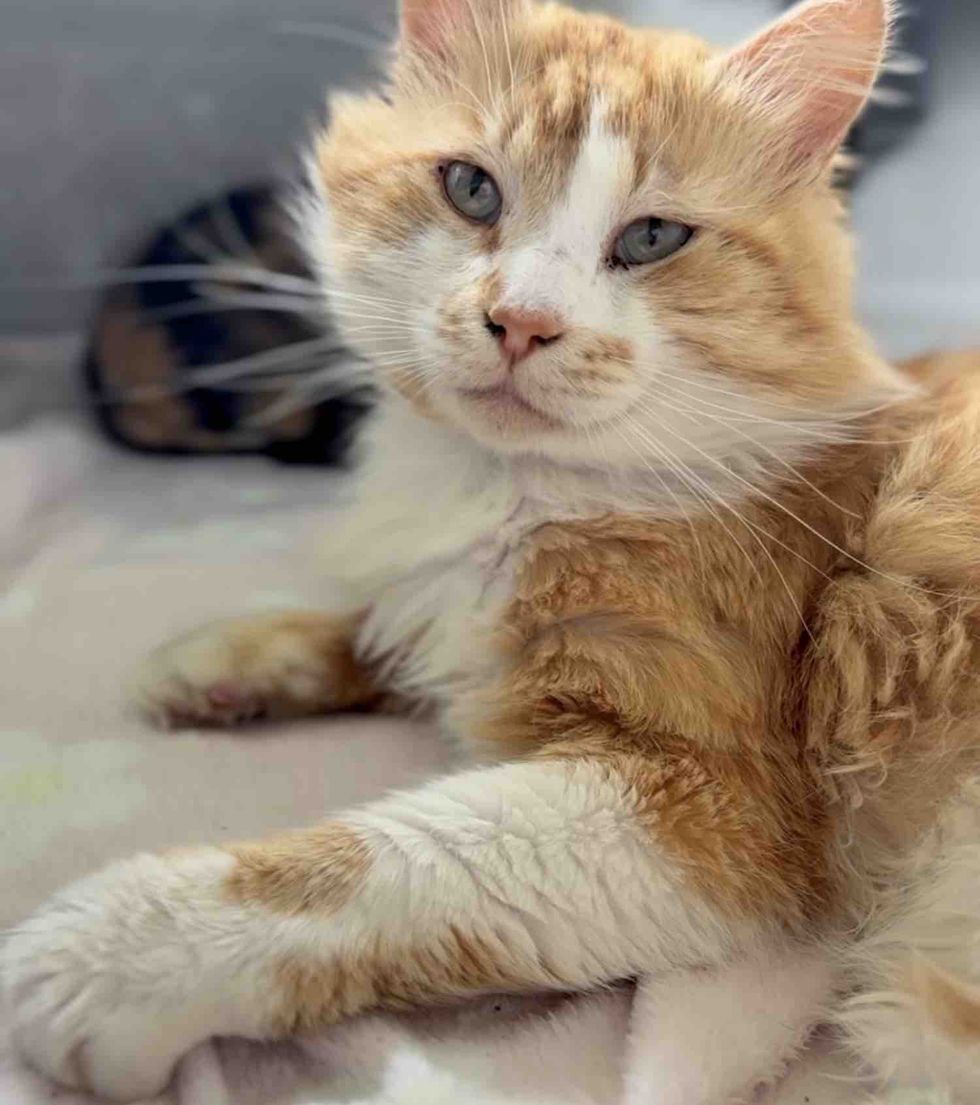
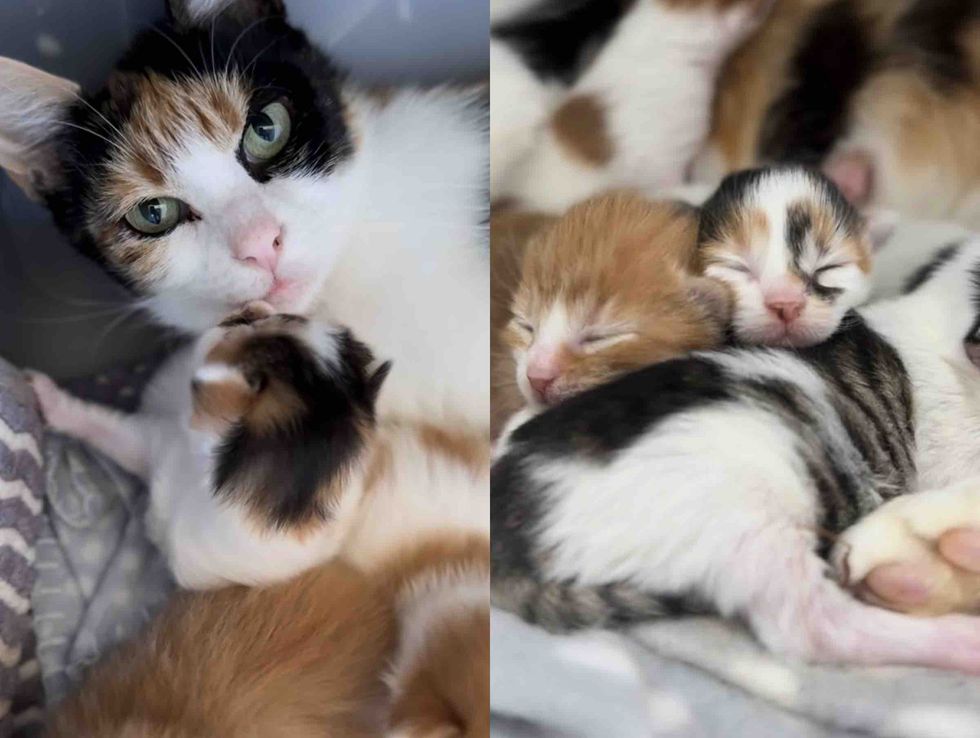
After wandering the streets for some time, an orange cat named Harry was finally rescued, alongside a heavily pregnant calico named Reba.

Amber, an experienced foster volunteer with Tails of the Forgotten Paws, prepared a quiet, cozy space for the pair. While Reba was shy and reserved, Harry quickly warmed up to Amber, greeting her with loud purrs and affectionate snuggles.

Once cleaned up and fed, Harry kneaded his blanket with joy and filled the room with his contented purrs.

orange cat gentle paws Amber

Harry was likely once someone’s pet, but somehow ended up unwanted and left behind. Given a second chance, he regained his trust in people and touched everyone he met with his gentle, loving nature.

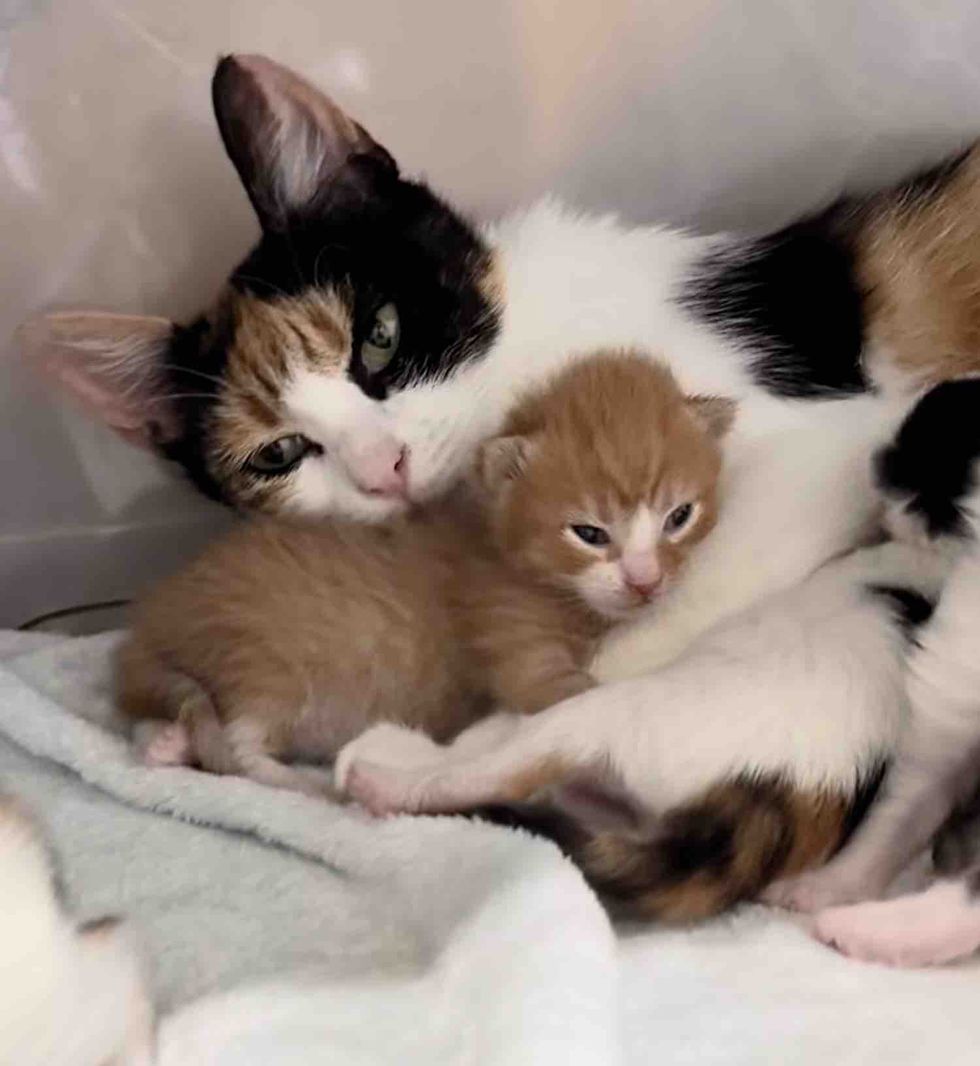
A few days later, Reba welcomed five healthy kittens into the world: two calicos, two gingers, and one white with tabby markings. She immediately embraced motherhood, feeding, cleaning, and showering her babies with love.

calico cat mother kittens Amber

While nestled close to their mom, the bolder kittens turned into tiny lion cubs, hissing their fiercest little hisses at unfamiliar scents. Harry, believed to be the kittens’ father, was soon neutered. He respectfully gave Reba the space she needed while quietly keeping her company.

When the kittens were upgraded to a larger playpen, they began waddling around. During one of Reba’s breaks, Patsy, one of the calicos, made a beeline for Harry and curled up beside him.

orange cat calico kitten Harry and PatsyAmber

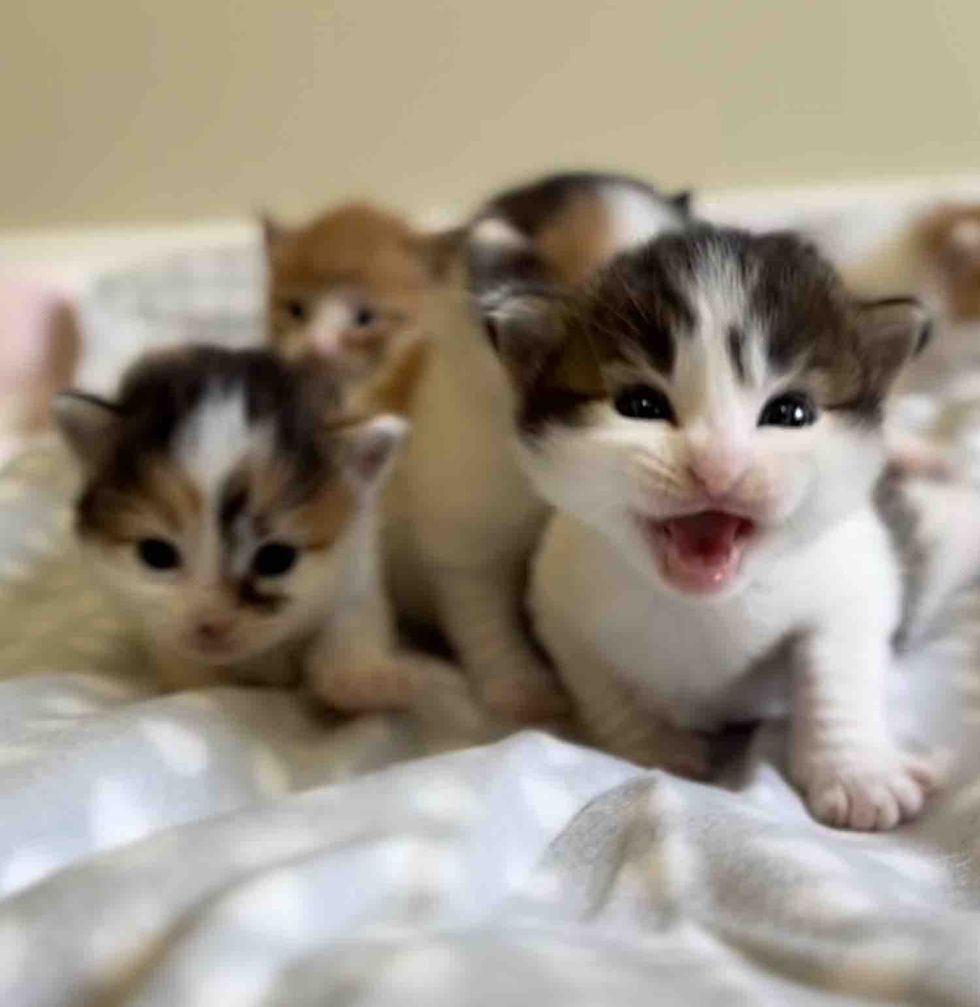
Within weeks, the kittens’ eyes were wide open, and their curiosity soared.

As soon as they found their footing, they toddled around the nest, setting off on tiny adventures. Fully convinced they were sprinting at top speed, the kittens crept across the room in slow motion.

kittens walking meowing Amber

As the kittens grew more playful and independent, Reba started taking more time for herself. But the moment she heard their cries, she chirped back, prompting them to gather around her for another round of nursing.

No longer timid or wanting to hide, Reba began seeking affection, leaning into chin scratches and happily accepting pets from ears to tail.

calico cat mother hugs kitten Amber

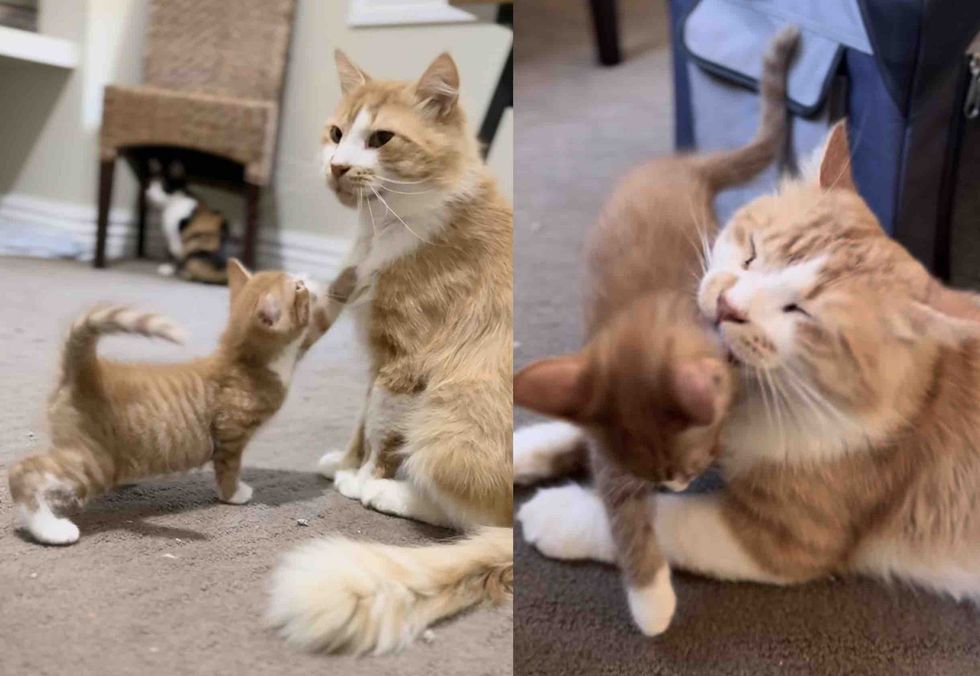
The kittens blossomed into confident, mischievous youngsters. Their boundless energy and playful antics awakened the inner kitten in Harry. He happily joined in their games, shared toys, and watched the little ones fall asleep mid-play.

While Reba enjoys some well-earned me-time, Harry doesn’t mind the kittens climbing all over him for attention. They race around the room, keeping him fully entertained.

orange cat kittens Amber

Kenny is Harry’s little mini-me and greets him with gentle paws. She’s always nearby, ready to play and soak up his affection.

When adoption time arrived, three of the kittens (Patsy, Hank, and Lainey) quickly found their forever families. An adopter named Julie came to meet Harry when she learned that his two other kittens (Kenny and Merle) were still waiting for a home.

orange cat dad kitten Kenny and HarryAmber

“I couldn’t believe it when Julie told me she wanted to adopt all three,” Amber shared. “I don’t dance and have never done a happy dance in my life, but I did yesterday.”

As Harry and all the kittens prepare for their forever homes, Reba can finally focus on herself. “This will give her a chance to shine all on her own. She’s a beautiful, quiet girl who will flourish given some one-on-one time. Then we can find Reba her fabulous forever home as well.”

kittens siblings carrier They will be spayed or neutered before embarking on their new journeyAmber
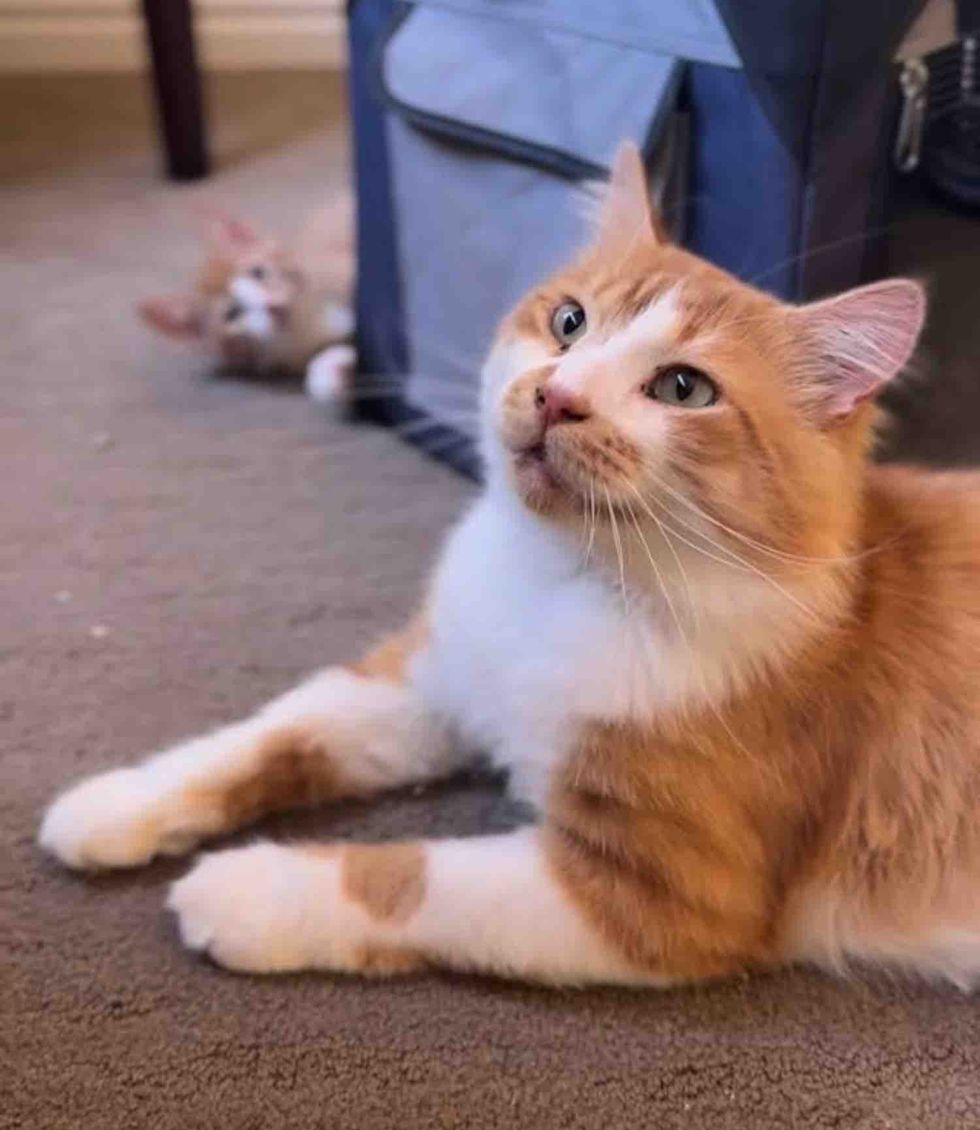
Harry is thriving with his little ones racing around him, and there’s never a dull moment. He’s been an incredible dad and a loyal companion, and now he’ll get to spend the rest of his life with his daughter and son.

orange cat happy Amber

Share this story with your friends. More on Amber’s fosters on Instagram @kitty_fostering_oz and Tails of the Forgotten Paws @tailsoftheforgottenpaws_au.

Related story: Cat Arrives at Doorstep, Starts Delivering Kittens, Minutes After Being Inside, Her True Self Comes to Life


Ant Farm Kit for Beginners: Start Your Tiny Empire Today!


Understanding Ant Farm Kits: The Foundation of Your Myrmecological Adventure

Ant farm kits for beginners represent a fascinating intersection of education, entertainment, and naturalistic observation. These carefully curated ecosystems provide novice myrmecologists—ant enthusiasts—with everything necessary to establish a thriving colony within their homes. Unlike traditional pet ownership, ant farming offers a unique glimpse into one of nature’s most sophisticated social structures.

A comprehensive ant farm kit typically includes a transparent habitat, nutritional gel medium, observation tools, and detailed instructions. The formicarium—the technical term for an ant habitat—allows you to witness the intricate tunneling patterns, hierarchical behaviors, and collective intelligence that define these remarkable arthropods. For pet owners accustomed to conventional companions, ants present an entirely different caregiving experience that requires minimal daily intervention yet provides maximum educational value.

The appeal extends beyond mere observation. These miniature ecosystems demonstrate principles of architecture, social organization, and environmental adaptation. Children and adults alike develop appreciation for complex biological systems while maintaining a low-maintenance pet alternative that fits seamlessly into busy lifestyles.

Essential Components of Quality Ant Farm Kits

Habitat Design and Materials

Premium ant farm kits feature crystal-clear acrylic or polycarbonate construction that withstands daily handling while providing unobstructed viewing angles. The substrate material—whether traditional sand, proprietary gel, or hybrid mediums—directly impacts colony development and tunneling patterns. Gel-based formicaria offer several advantages for beginners: they eliminate the need for separate water sources, reduce maintenance requirements, and create distinctive blue or green aesthetic appeal.

Ventilation systems deserve particular attention when selecting your kit. Microscopic air holes prevent condensation buildup while maintaining proper humidity levels. Poor ventilation can lead to mold development or colony collapse, making this feature non-negotiable for successful ant farming.

Nutritional Support Systems

Quality kits incorporate nutritional gel that serves dual purposes: structural medium for tunneling and complete dietary source. This innovative approach eliminates the complexity of feeding schedules while ensuring consistent nutrition. The gel contains carbohydrates, proteins, and essential minerals required for healthy colony development.

“The nutritional gel medium revolutionized beginner ant farming by simplifying care requirements while maintaining optimal colony health conditions.”

Some advanced kits include supplementary feeding stations for introducing variety into the ants’ diet. Fresh fruits, honey drops, or specialized ant foods can enhance the viewing experience while supporting colony growth.

Choosing the Right Ant Species for Beginners

Species selection significantly impacts your myrmecological journey’s success and enjoyment. Harvester ants (Pogonomyrmex species) represent the gold standard for novice ant farmers due to their robust nature, impressive digging capabilities, and moderate activity levels. These industrious creatures create extensive tunnel networks that showcase their remarkable engineering abilities.

Pavement ants offer another excellent option for beginners. Their adaptability to various environments and consistent activity patterns make them ideal for educational purposes. Unlike some species that exhibit nocturnal behaviors, pavement ants remain active during daylight hours, maximizing observation opportunities.

Avoid carpenter ants or fire ants as initial species choices. These varieties require specialized care conditions and may present safety concerns for inexperienced handlers. Stick with recommended species until you develop confidence in colony management techniques.

Setting Up Your First Ant Colony

Initial Preparation Steps

Location selection proves crucial for colony success. Choose a stable surface away from direct sunlight, heating vents, and high-traffic areas. Ants prefer consistent temperatures between 65-75°F and minimal vibrations that might disrupt their construction activities.

Before introducing ants to their new habitat, allow the setup to reach room temperature. Temperature shock can stress or harm ants during the transition period. Prepare your observation tools—magnifying glass, notebook, and camera—to document the fascinating establishment process.

Introducing Ants to Their New Environment

Most beginner kits arrive with ants in temporary containers. The introduction process requires patience and gentle handling. Create small access holes in the gel medium if not pre-made, allowing ants to enter naturally without forcing the process.

Initial activity may appear chaotic as ants explore their new environment and establish territorial boundaries. Within 24-48 hours, organized digging patterns typically emerge as the colony begins creating their subterranean network.

Daily Care and Maintenance Protocols

Ant farming demands minimal daily intervention, making it perfect for busy pet owners seeking low-maintenance companions. Primary responsibilities include monitoring colony health, maintaining proper environmental conditions, and documenting behavioral observations.

Maintenance Task Frequency Duration
Visual health check Daily 2-3 minutes
Habitat cleaning Weekly 10-15 minutes
Gel replacement Monthly 20-30 minutes

Temperature monitoring ensures colony comfort and productivity. Sudden temperature fluctuations can trigger defensive behaviors or reduce activity levels. Room temperature generally suffices, but extreme seasonal variations may require minor adjustments.

Observe for signs of mold growth, particularly in humid environments. White or green fuzzy growths indicate moisture problems requiring immediate attention. Prevention through proper ventilation surpasses treatment in maintaining healthy colonies.

Educational Benefits and Learning Opportunities

Ant farms transform abstract biological concepts into tangible, observable phenomena. Children witness firsthand the principles of cooperation, division of labor, and environmental adaptation. These living laboratories demonstrate scientific concepts more effectively than textbooks or digital media alone.

The mathematical precision of tunnel construction reveals geometric principles in action. Ants instinctively create efficient transportation networks that minimize energy expenditure while maximizing structural integrity. Engineering students often find inspiration in these natural construction techniques.

Social behavior observation provides insights into communication methods, hierarchical structures, and collective problem-solving. Watching ants navigate obstacles or respond to environmental changes develops appreciation for adaptive intelligence in seemingly simple organisms.

Troubleshooting Common Challenges

New ant farmers frequently encounter predictable obstacles that simple interventions can resolve. Inactive colonies often result from temperature stress, inadequate ventilation, or overcrowding. Adjusting environmental conditions typically restores normal activity levels within days.

  • Ensure proper temperature ranges between 65-75°F
  • Verify adequate ventilation without creating drafts
  • Check for overcrowding if using multiple colonies
  • Monitor humidity levels to prevent mold development
  • Provide consistent lighting cycles mimicking natural patterns

Gel degradation represents another common concern. Quality nutritional gels maintain consistency for 4-6 weeks under normal conditions. Premature breakdown suggests environmental issues requiring attention before complete replacement becomes necessary.

Expanding Your Myrmecological Interests

Successful initial experiences often spark deeper interests in ant biology and behavior. Consider upgrading to larger habitats, experimenting with different species, or joining local entomological societies. Advanced hobbyists frequently maintain multiple colonies representing various species and geographic regions.

Photography presents an engaging extension activity. Macro lenses reveal intricate details of ant anatomy and behavior invisible to naked eye observation. Time-lapse photography captures tunnel construction progress over extended periods.

Research projects emerge naturally from careful observation. Track tunnel development patterns, document behavioral changes, or investigate responses to environmental modifications. These activities transform passive observation into active scientific inquiry.

Ant farm kits for beginners open doorways to understanding complex natural systems through accessible, engaging formats. Whether pursuing educational goals or seeking unique pet alternatives, these remarkable ecosystems deliver lasting value that extends far beyond initial investment costs. Start your myrmecological adventure today and discover the fascinating world thriving beneath our feet.


California Fish And Game Commission To Vote On Mountain Lion Protections, Feb. 11–12 – World Animal News


California Fish And Game Commission To Vote On Mountain Lion Protections, Feb. 11–12 – World Animal News


For the first time in decades, California’s mountain lions in Southern California and the Central Coast may finally receive official state protections. The California Fish and Game Commission is scheduled to vote on February 11–12, 2026, on whether to list these populations as threatened under the California Endangered Species Act.

This vote follows a detailed status review by the California Department of Fish and Wildlife, completed in December 2025, which confirmed that six mountain lion populations, including those in the Santa Monica Mountains, Santa Ana Mountains, San Gabriel and San Bernardino Mountains, Central Coast, Santa Cruz Mountains, and Eastern Peninsular Ranges, are at serious risk. Scientists cited habitat loss, fragmentation, vehicle collisions, and human-wildlife conflict as major threats pushing these iconic big cats toward decline.

According to the Mountain Lion Foundation, the recommendation stems from a 2019 petition filed by the Foundation and the Center for Biological Diversity documenting six genetically distinct populations at risk of extinction. The petition triggered emergency protections in 2020 while CDFW conducted its review.

If the Commission approves the listing, it would mark a major victory for wildlife in California, potentially safeguarding critical habitats, reducing conflicts with humans, and preserving the genetic diversity of these crucial apex predators.

Conservationists and animal lovers alike are watching closely. Mountain lions are vital to California’s ecosystems, and protecting them now is critical, not just for the lions themselves, but for the health and balance of the landscapes they sustain.

The outcome of the vote will shape the future of mountain lion conservation in California for years to come. Residents are encouraged to stay informed and support efforts to protect these magnificent big cats.

Speak up for Central Coast and Southern California mountain lions HERE!


Wearing Smart Glasses in Uniform? The US Air Force Says Think Again


Wearing Smart Glasses in Uniform? The US Air Force Says Think Again

If you thought smart glasses were the next big wearable for everyday use, the US military’s latest guidance may give you pause. 

The US Air Force recently updated its uniform and appearance policies to prohibit service members from wearing Meta, or any other smart glasses with cameras or recording technology, while in uniform, according to a report by the Military Times. 

The move reflects deep‑rooted concerns about operational security and the potential for sensitive information to be captured and transmitted often without the wearer’s knowledge. This change puts smart glasses alongside other devices previously restricted due to security vulnerabilities and highlights how new technologies can clash with military requirements for safety and information control.

Air Force smart glasses ban

Why Smart Glasses Sparked Security Concerns

The January 9 memo from the Air Force did not spell out every reason for the ban, but an Air Force spokesperson explained to The Military Times that the change is being made for operational security purposes. 

Smart glasses, like Meta AI‑equipped models, pose risks because they can continuously capture audio and video data and store or transmit that information without the user knowing. Such data, if stored or sent in unauthorized environments, could be exploited by adversaries.

Smart glasses from companies like Meta include built‑in cameras, microphones, always‑on sensors, and cloud connectivity. While those features can be convenient for capturing images, accessing information, or staying connected, they also present challenges in secure environments.

In military contexts, these devices can inadvertently record and transmit operational details, locations, personnel activities, or other sensitive information that should not be shared outside controlled channels.

The Air Force’s concern mirrors earlier restrictions placed on wearable devices. Over the past few years, services have barred the use of smart electronics such as fitness trackers and devices that rely on geolocation. The Pentagon noted that the rapidly evolving market of devices with location capabilities presents a significant risk to personnel and operations.

Hand holding small gray DJI Spark compact drone with teal accent stripe outdoors, propellers spinning, natural blurred green background, demonstrating portable palm-sized aerial photography quadcopter size and design.

Example Of A Previous Tech Ban: DJI Drones

A useful comparison is the long-running US restrictions on DJI drones, which were not limited to military use but gradually expanded across government and civilian technology policy. 

Concerns centered on data security, surveillance risk, and the possibility that images, metadata, and flight logs could be accessed or transmitted through foreign-controlled infrastructure, particularly given DJI’s China-based ownership. 

These concerns first surfaced publicly in 2017, when the US Army halted the use of DJI drones due to cybersecurity risks, and later spread to other federal agencies, including the Department of the Interior, which grounded its DJI fleet in 2020.

By 2024 and 2025, those concerns had moved firmly into civilian regulatory space. US lawmakers pushed for broader restrictions through the National Defense Authorization Act, triggering a formal security review of DJI by the Federal Communications Commission. In December 2025, the FCC placed DJI on its “Covered List,” effectively blocking authorization of new DJI drone models for sale or import in the US, while stopping short of banning drones already in use.

meta

The DJI case shows how a device widely praised by photographers and filmmakers can still be treated as a national security risk when it records, stores, or transmits visual data at scale, a logic that now extends well beyond drones.

If you use or enjoy smart glasses in civilian life, you will want to be mindful of how these devices are viewed within military contexts. The policies highlight the tension between cutting‑edge consumer technology and the strict security requirements of military operations. 

Understanding these differences helps you navigate both worlds responsibly and stay informed about how wearable tech is regulated in uniformed service.

[Images via DJI, Meta]


Owner’s Search for Deaf Cat in the House Ends With an Endearing Surprise – CatTime


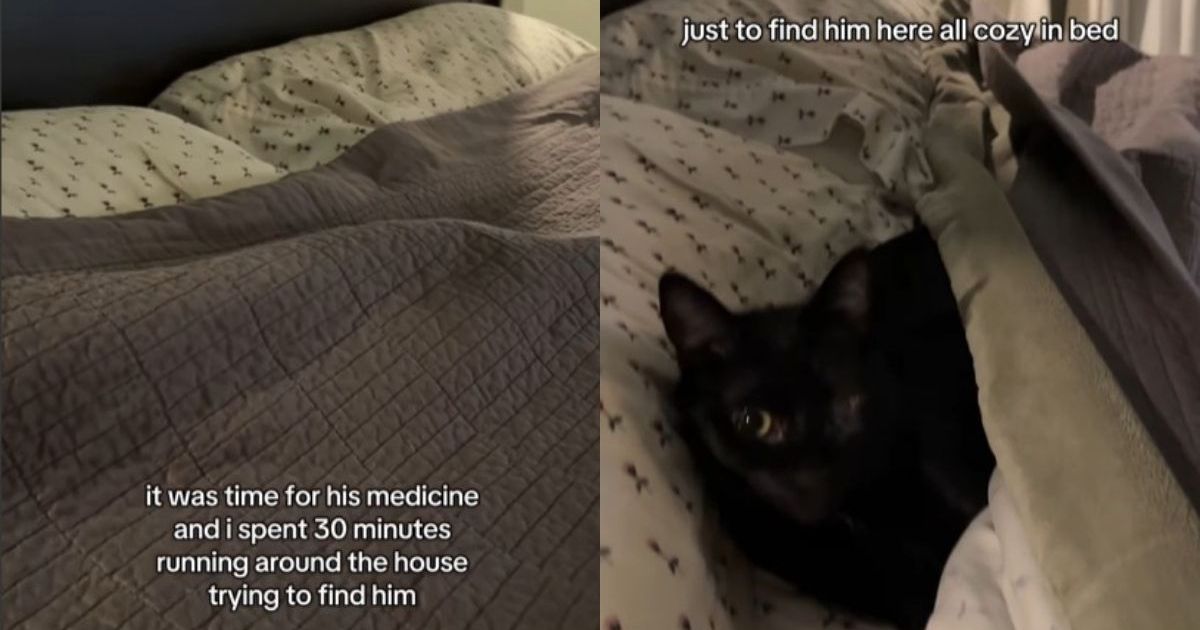
In an Instagram video from the user @iamgooseontheloose, Otter’s owner explains that their cat is deaf, which turns a normal “Where did he go?” moment into something much more stressful. Otter usually isn’t hard to locate, but this time, he was nowhere in sight. But what his owner found was unexpected and lowkey hilarious, given that it started out with a lot of stress.

cat got cozy under the blanket, while owner looked for him

In the video, the on-screen text explains that the owner is trying to find their deaf cat while the camera points toward a neatly made bed with a gray quilt. Nothing looks out of place. In fact, there’s not even a suspicious bump, just an empty bed that gives absolutely nothing away.

As the on-screen caption explains, the owner spent 30 minutes searching the house. But the scary part is that you can’t just call a deaf cat and listen for a response. Deaf cats often rely on routines and visual cues instead of sound. So, if they tuck themselves away in some unknown spot, they might not notice you looking, especially if they are asleep.

But then comes the reveal. The owner pulls back the covers, and there he is. Otter, fully tucked in underneath like he doesn’t have a care for the world. He blinks up from his cozy hiding place, looking completely unbothered by the chaos, though unbeknownst to him, he caused.

The video’s caption notes, “life with a deaf cat. he was just trying to be cozy ?”

In the comments, people related hard, because cats, deaf or not, love a blanket hideout. One viewer joked, “Lol. It’s always the lump in the bed?” Another called him “Just a comfy little guy,” while others shared practical ideas for the next time Otter goes missing. Many suggested using an Air Tag, while another wrote, “Get one of those back massagers, turn it on, and put it to the ground. Then when he notices it give him a treat… Then when you can’t find him just do that and he should come running every time!!!”

And for anyone who has ever searched a home top to bottom, only to find your cat cozying up, this video will speak to you.


Dog Swung in the Air by Collar and Thrown Off Cliff Miraculously Survives | The Animal Rescue Site


Dog Swung in the Air by Collar and Thrown Off Cliff Miraculously Survives

*warning: graphic video showing abuse

Ukraine is full of homeless and abandoned animals due to the war. Krystina and fellow rescuers continue to receive calls for help for these animals, as well as for ones being abused by cruel individuals.

A heartbreaking abuse video was shared showing a person swinging a small dog by his leash and collar in circles before throwing him off a cliff.

The cruelty was witnessed by the entire family who can be heard laughing in the video. This reached rescuers who took swift action to save the dog. 

Miraculously the dog survived the fall with only minor scrapes and was rescued along with other mistreated and malnourished dogs on the property. 

Photo: Under the Sun (dog on left thrown off cliff)

Krystina shared that the person shown in the video showed no remorse when rescuers arrived to take the dogs and said he would do it again. Police were notified and she hopes that they will act against such cruelty to animals. 

Photo: Under the Sun

All the dogs are underweight and scared of humans. They cower in fear when Krystina tries to pat them. They have never known a kind touch, until now. 

Photo: Under the Sun

They are finally safe but have a long road to recovery ahead to regain their health and trust in mankind. Donate today to help Krystina care for them and hundreds more that reside at her rescue, Under the Sun.

Andrea PowellAndrea Powell

Andrea Powell is an animal enthusiast who resides in West Michigan. When not writing, she is exploring the great outdoors with her dogs and horses.

Read more articles by Andrea Powell.