The rescue operation was initiated in late December 2024, when the Ashtabula County Commissioner’s Office requested the assistance of Humane World for Animals after the owner of Grand River Fur Exchange died, escalating an already-dire animal welfare crisis on the property.
Humane World for Animals responders found foxes, raccoons, wolf-dog hybrids, skunks, opossums, and coyotes living in filthy wire-bottom cages with little to no protection from the frigid conditions. Some animals had missing toes, ears, tails, and limbs, likely caused by a combination of their living conditions, proximity to other wild animals, or being captured in excruciating leghold traps. Many were emaciated and severely dehydrated, and several animals were deceased, covered in snow and frozen to their cages when responders arrived.
The animals were being raised and slaughtered for their fur, bred for sale as exotic pets, and held captive for urine farming. As detailed in the documentary, predator urine is advertised for use in hunting, trapping, dog training, and, ironically, as a “humane” wild animal deterrent for gardeners.
“The suffering and terror on that property was among the most horrific situations imaginable. It’s haunting, even after a year,” said Adam Parascandola, vice president of Humane World for Animals’ Animal Rescue Team. “Seeing the survivors recover and thrive has been incredibly healing. The foxes—once trapped in tiny, frozen cages awaiting a brutal end—now playing with each other in spacious habitats. The skunks, foraging in grass and exploring their new world. So many organizations stepped up and worked together to make this happen.”
“My heart still breaks thinking about the generations of animals who suffered and died at Grand River Fur Exchange. Their plight and the incredible resiliency of the survivors should inspire change,” said Mark Finneran, Ohio state director of Humane World for Animals. “It’s concerning that the state of Ohio has not taken action to fix the broken licensing system that allowed such wanton cruelty to slip through the cracks for years. The owner of this facility held a Commercial Propagating License, which was in good standing with the state until the day he died. Ohioans overwhelmingly oppose animal cruelty, and we need laws and regulations that reflect those values.”
More than 300 animals from the property were placed with wildlife facilities and sanctuaries, with Ohio wildlife officials managing the placement process.
Following the rescue operation, Humane World for Animals continued to support the animals by funding their veterinary treatment, transportation, enrichment supplies, food, and the construction of new and upgraded enclosures at the sanctuaries and facilities the animals now call home. Among the dozens of organizations that opened their doors to help these animals, Wildlife Rescue and Rehabilitation, Inc. provided a permanent home for approximately 40 skunks, coyotes, and foxes.
Background on the fur trade
Animals in the fur trade suffer immensely, both in their daily lives and when they are killed, often through methods such as gassing, anal electrocution, or clubbing, which can result in slow, painful deaths, and are commonly used on fur farms because they prevent damage to their pelts.
In the U.S., there are no federal regulations concerning the welfare, care, or slaughter of animals farmed for their fur. While Grand River Fur Exchange was licensed by the Ohio Department of Natural Resources, Ohio does not have laws or standards of care for fur farming or slaughter. In fact, New York’s ban on anal and genital electrocution of foxes is the only state-level law on fur farm welfare, aside from California’s prohibition on the sale of new fur products, which took effect in 2023. Humane World for Animals is urging other states to follow their lead.
In Massachusetts, pending legislation H.990 andS.551 would end sales of new fur products from animals confined in fur factory farms. A similar bill, S.2221, was recently introduced in Rhode Island. In New York, A.3065 would clarify state law to ensure municipalities have the ability to prohibit the sale of new fur products. Across the U.S., 16 localities have implemented such measures.
As rescuers celebrate a happy ending for survivors of Grand River Fur Exchange, a sobering reality remains: each year, tens of millions of animals are bred and killed to supply the fashion industry with fur coats, fur trim for hooded jackets, and fur pompoms used on hats, gloves, shoes, and a range of other clothing and accessories. The public can play a critical role in helping the millions of animals languishing in similar circumstances by supporting legislation to protect these animals, committing to a fur-free wardrobe, and avoiding the purchase of predator urine.
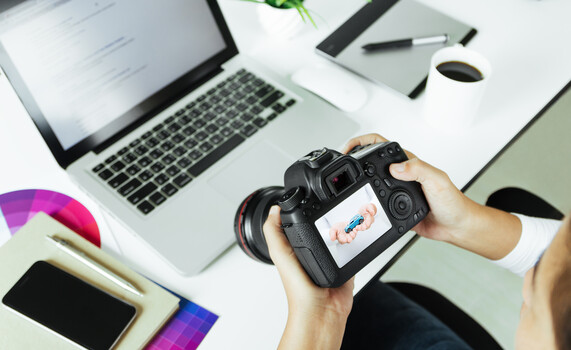
Every photographer makes decisions about file formats constantly, yet most of us operate on habit, hearsay, or whatever our camera defaulted to when we first pulled it out of the box. The problem is that choosing the wrong format at the wrong stage of your workflow can quietly destroy your editing flexibility, balloon your storage needs, break compatibility with clients and labs, or degrade your images in ways you won’t notice until it’s too late. This guide breaks down what each major format actually does under the hood, what it preserves, what it throws away, and when you should reach for each one across capture, editing, delivery, and long-term archiving.
Understanding What Formats Actually Control
Before diving into specific formats, it helps to understand the fundamental variables that differentiate them. Compression is the big one, and it comes in three flavors. Uncompressed formats store every pixel at full fidelity, resulting in the largest possible files but zero quality degradation. Lossless compression uses mathematical tricks to reduce file size while preserving the ability to reconstruct the original data perfectly, similar to how a ZIP file works. Lossy compression permanently discards information the algorithm predicts you won’t miss, trading quality for dramatically smaller files.
Bit depth determines how many distinct tonal values each color channel can represent. 8-bit files offer 256 levels per channel, which translates to roughly 16.7 million possible colors and is perfectly adequate for final delivery. 16-bit files provide 65,536 levels per channel, giving you vastly more headroom for aggressive edits before you start seeing banding or posterization. The difference between 8-bit and 16-bit is invisible in a finished image, but it becomes critical the moment you start pushing shadows, shifting white balance, or doing heavy color grading.
Color space embedding determines whether a file carries information about how its colors should be interpreted. Formats that properly embed ICC profiles ensure your colors display consistently across different software and devices. Formats that strip or fail to preserve color profiles can cause unpredictable color shifts that seem to appear out of nowhere. Metadata preservation covers everything from EXIF data recording your camera settings and capture date to IPTC fields for copyright and captions to XMP sidecars tracking your edit history. Some formats preserve all of this faithfully while others strip it partially or completely.
Raw Files: Your Digital Negatives
Raw files aren’t images in any conventional sense. They’re the unprocessed data your sensor captured before the camera applied demosaicing, white balance, tone curves, or color processing. This makes them maximally flexible because no interpretive decisions have been baked in yet. Every manufacturer uses their own proprietary raw format, which is why you see .CR2 and .CR3 from Canon, .NEF from Nikon, .ARW from Sony, .RAF from Fujifilm, and so on.
What raw preserves is substantial: the full bit depth your sensor captured (typically 12 to 14 bits), linear or near-linear tonal data before any curve is applied, white balance stored as adjustable metadata rather than a permanent conversion, and the maximum dynamic range and color information your camera recorded. This is why raw gives you so much latitude to recover highlights, lift shadows, and shift colors without the image falling apart.
Raw files are the go-to for editing.
The tradeoffs are equally real. Raw files are large, often 25 to 60 megabytes or more depending on your camera’s resolution and the compression setting you choose. They require raw processing software for full-quality rendering and editing. Your operating system may display previews through built-in codecs, but these are limited and inconsistent across camera models, and they don’t give you access to the actual editing latitude raw provides. They’re completely unsuitable as delivery formats because clients, labs, and social platforms can’t use them. And the proprietary nature of each manufacturer’s format raises legitimate archival concerns. Will the software ecosystem still support your files in 30 years? Nobody knows for certain.
Many cameras offer lossless compressed raw, which shrinks files significantly without any quality penalty. Others provide only lossy compressed options, which sacrifice a small amount of data for even smaller files. In practice, the quality difference from lossy raw compression is rarely visible, but if storage isn’t a constraint and your camera offers both, lossless is the safer choice. Uncompressed raw is almost never worth the storage penalty for working photographers. Shoot raw for everything if your workflow supports it, keep your raw files as archival masters, but never attempt to deliver raw to anyone.
DNG: Adobe’s Answer to Format Fragmentation
Adobe created the Digital Negative format to solve the problem of dozens of proprietary raw formats that might become unreadable as software evolves. DNG is an open specification, meaning its structure is publicly documented and theoretically any developer can build tools to read it without licensing fees or reverse engineering.
The critical thing to understand about DNG is that it comes in several flavors with very different characteristics. Camera Raw DNG files are converted directly from proprietary raw formats and maintain essentially the same editing latitude as the original. Linear DNG files contain demosaiced data, making them slightly less flexible but still high quality. Lossy DNG files apply compression that discards some information, resulting in smaller files but reduced editing headroom. Knowing which type you’re creating matters enormously.
The archival case for DNG is straightforward: an open specification is less likely to become unreadable than a proprietary format tied to a single manufacturer’s continued support. DNG also embeds XMP metadata directly inside the file, eliminating the risk of losing sidecar files that travel separately from your images. You can even embed the original proprietary raw inside the DNG as a backup, though this obviously increases file size.
The arguments against DNG conversion are worth considering too. Converting adds time to your ingest workflow. Some photographers are uncomfortable with Adobe being the steward of the “open” specification. There’s a small but nonzero risk of conversion errors. And certain editing software handles native raw files better than converted DNG. If you trust your proprietary format’s longevity and your software works well with native raw, skipping DNG conversion is a reasonable choice. If you’re archiving for decades and want maximum insurance against format obsolescence, DNG conversion makes sense. The middle ground is making an archive of JPEGs.
JPEG: Universal but Unforgiving
JPEG remains the universal language of digital images. Every device, browser, application, and operating system can open a JPEG without any special software or extensions. This ubiquity comes from a compression scheme that uses discrete cosine transform to divide your image into 8×8 pixel blocks and then discards high-frequency detail the algorithm predicts you won’t perceive. In mainstream photography workflows, JPEG is effectively 8-bit only, though the underlying standard does include higher bit depth modes used in some industrial and medical imaging contexts.
Many export tools use a quality scale from 0 to 100, though the exact mapping varies by encoder. As a rule of thumb, settings between 80 and 90 are usually visually transparent for web delivery. Below 70, compression artifacts become increasingly obvious depending on the content. Even maximum quality settings apply some compression. Lossless JPEG variants exist in the specification, but they’re not what cameras produce or what most software expects, so for practical purposes, standard JPEG is always lossy.
Use JPEG for delivery.
A less visible setting called chroma subsampling can significantly impact quality in ways most photographers never notice. At 4:4:4 subsampling, full color resolution is preserved. At 4:2:0, which many cameras and applications use by default, chroma is stored at quarter resolution relative to luminance. This is usually fine for continuous-tone photographs but can show up on sharp color edges, graphics, and text.
The generation loss problem is perhaps JPEG’s most important limitation. Every time you open a JPEG, make changes, and save it again, you’re recompressing already-compressed data and losing additional quality. The solution is simple: always edit from raw or lossless sources and export fresh JPEGs as needed. Never treat JPEG as a working format where you edit, save, edit again, and save again.
JPEG supports embedded color profiles, and sRGB remains the safest default for web delivery. It preserves EXIF, IPTC, and XMP metadata, though some social platforms and web services strip metadata on upload. Use JPEG for web delivery, client galleries, email attachments, social media, and any situation demanding universal compatibility. Avoid JPEG for working files during editing, for archiving masters you might want to re-edit later, and for anything requiring transparency.
TIFF: The Professional Interchange Standard
TIFF is a flexible container format that has been the standard for high-quality image interchange for decades. Many print labs and publications accept it, some prefer it for fine-art and prepress work, and it moves reliably between most major applications without quality loss.
The format supports multiple compression options. Uncompressed TIFF offers maximum compatibility but the largest files. LZW compression is lossless, widely supported, and provides moderate size reduction. ZIP compression is also lossless and slightly more efficient than LZW but occasionally causes compatibility problems with older software. JPEG compression inside a TIFF container exists but completely defeats the purpose of using TIFF in the first place.
TIFF supports both 8-bit and 16-bit depth. For working files you’ll continue editing, always use 16-bit to preserve maximum headroom. Drop to 8-bit only when creating final deliverables if file size is a concern. TIFF can also preserve Photoshop layers if you enable that option when saving, though this creates very large files. For complex layered work, PSD is usually more practical.
Color space embedding in TIFF is reliable, making it appropriate for color-managed print workflows. Labs typically expect TIFF files in sRGB or Adobe RGB depending on their specifications. Metadata support is comprehensive. Use TIFF for delivering to print labs and publications, for archiving processed masters alongside your raw originals, for moving files between applications when quality must be preserved, and for any workflow requiring 16-bit depth or guaranteed lossless quality. Avoid TIFF for web delivery since browsers won’t display it and files are unnecessarily large.
PNG: Built for Graphics, Not Photographs
PNG was designed for web graphics, not photographs. It uses lossless compression and supports transparency natively through an alpha channel, making it essential for logos, interface elements, and composites where you need to preserve edges against variable backgrounds.
PNG comes in several bit depth configurations. PNG-8 supports only 256 colors like GIF, producing tiny files but with severely limited usefulness for photographic content. In common usage, people often refer to “PNG-24” for standard RGB images and “PNG-32” for RGBA images with an alpha channel for transparency, though these aren’t official format designations. PNG also natively supports 16 bits per channel, which is why it sees use in VFX and 3D workflows where lossless high-bit-depth output matters.
The fundamental problem with using PNG for photographs is that lossless compression is inefficient for complex photographic detail. A photograph saved as PNG will be dramatically larger than the same image saved as a high-quality JPEG with no perceptible quality benefit. While PNG does support 16-bit depth and major applications like Photoshop handle it correctly, browser support for 16-bit PNG remains inconsistent, and many web-focused pipelines will downconvert to 8-bit silently. PNG does support embedded color profiles and metadata, but handling varies significantly across browsers and applications. Many assume sRGB regardless of what’s embedded, and many web services strip metadata on upload regardless of format.
Use PNG for logos, graphics, screenshots, and web images requiring transparency. Use it for interface elements and illustrations with sharp edges and flat colors where JPEG artifacts would be visible. Do not use PNG for delivering photographs, archiving photos, or print delivery.
HEIF: The Modern Compression Champion
High Efficiency Image Format uses HEVC video compression technology to achieve roughly 50 percent smaller files than JPEG at equivalent quality. Apple adopted it as the default capture format on iPhones, and it’s gradually appearing in other devices and platforms.
Beyond size efficiency, HEIF supports 10-bit color depth compared to JPEG’s 8-bit ceiling, can store image sequences and depth maps in a single container, and technically supports transparency in some implementations. On Apple devices, HEIF typically uses the Display P3 color space, which is wider than sRGB and can cause oversaturation when images are viewed in applications that don’t handle color management properly.
HEIF is gaining popularity.
The compatibility situation is HEIF’s Achilles heel. Windows requires installing extensions to open HEIF files. Older software may not support the format at all. While Safari and some browsers can display HEIF natively, cross-platform support and downstream pipeline acceptance remain the real pain points. Many print labs, stock agencies, and clients simply cannot accept HEIF deliverables. If your iPhone captures in HEIF, that’s fine for personal use and situations where you control the entire pipeline. For professional delivery, convert to JPEG or TIFF before sending files to anyone else until wider adoption is achieved.
Emerging Formats: WebP and JPEG XL
Google’s WebP format offers both lossy and lossless modes with roughly 25 to 35 percent smaller files than equivalent JPEGs. It supports transparency and has achieved good browser support. Traditional photo-editing software support remains weaker. WebP makes sense for web delivery when you control the platform and file size is a priority.
JPEG XL is perhaps the most promising next-generation format, supporting lossy, lossless, and progressive decoding along with HDR, wide gamut, and high bit depth. It can even losslessly recompress existing JPEG files to smaller sizes without additional quality loss. The browser situation is mixed: Chrome added and then removed JPEG XL support, but Safari 17 includes native support across iOS 17, macOS Sonoma, and even older macOS versions like Ventura and Monterey that can run Safari 17. Given Apple’s significant presence in photography workflows, this isn’t a dead format, but adoption remains fragmented.
Practical Recommendations by Workflow Stage
For capture, shoot raw whenever possible. Use JPEG only when you need maximum burst speed, your camera lacks raw capability, or you’re absolutely certain minimal editing will be needed. For editing and working files, always start from raw. If you need to move files between applications, use 16-bit TIFF with LZW compression or PSD if layers matter. Never use JPEG as a working format.
For web and client delivery, JPEG remains the correct choice: universal compatibility, reasonable file sizes, and sufficient quality. Export in sRGB at quality 80 to 90, sized appropriately for intended use. For print delivery, use TIFF unless your lab specifically requests JPEG. Follow their color space specifications and provide full resolution files. For archiving, keep your original raw files as master negatives, optionally convert to DNG for format longevity insurance, and consider archiving finished TIFF masters alongside raw. Never archive only JPEGs because you’ll have eliminated all editing headroom forever.
Understanding what each format actually does removes the mystery from these decisions. Match the format to the task, preserve maximum flexibility for as long as possible in your workflow, and convert to delivery formats only at the final step. If you want to dive deeper into raw processing workflows, Fstoppers offers comprehensive tutorials on both Mastering Adobe Lightroom and The Complete Capture One Editing Guide that cover everything from import to export.
In 2026, imperfect photos are reshaping what it means to make meaningful imagery.
The sharp, polished aesthetic that dominated social feeds and studio galleries for years is giving way to images that feel raw, human, and distinctly real. This shift shows up in blurred motion, candid expression, unpolished lighting, and visual storytelling that values authenticity over technical perfection.
The Photography in Design Trend Report for 2025 report even highlights this movement toward candid and less perfected styles as a defining trend, showing that audiences now crave honesty and personal connection in images over staged, flawless results.
Real Moments Resonate With Viewers More Strongly
One of the most consistent reasons imperfect photos are winning is that audiences connect with them on an emotional level. Photos that catch natural expression and unguarded moments often feel more relatable than images that are carefully posed or heavily edited.
The Photography Trends 2025 report notes that candid photography is trending because it feels genuine and immediate, creating a sense of trust with viewers.
You might notice this when a slightly out‑of‑focus image makes you feel like you were there, capturing that moment exactly as it happened. These imperfections, once seen as technical flaws, are now part of how stories are told visually.
With smartphone feeds overflowing with polished images, a raw, unfiltered moment stands out and creates deeper engagement. That emotional resonance is becoming a key factor in how photographers approach image capture and presentation.
Imperfect Techniques Create Stronger Visual Character
In 2026, photographers are intentionally using what were once considered mistakes to add style and character to images.
Motion blur, grainy textures, and even overexposed highlights are showing up more often because they convey mood and movement in ways that crisp images cannot.
These visual imperfections help communicate a sense of place and moment that polished imagery often suppresses. A handheld shot in low light that introduces blur can express chaos, energy, or spontaneity. Grain can lend a mood that feels tactile and emotional. These techniques are not errors but tools for creative visual communication.
Social Platforms Reward Unrehearsed Imagery
Social media platforms continue to influence what kinds of photography get the most attention. Algorithms do not explicitly prefer imperfection over perfection, but they do reward engagement. Candid, imperfect photos tend to generate more comments and shares because they feel relatable and authentic.
When you post a spontaneous image with emotional depth, people are more likely to respond because they see themselves in those moments. These images often invite personal conversation, making them perform better than slick, overly produced shots that can feel distant or impersonal.
Because feeds move quickly, images that feel genuine are more likely to pause a viewer’s scroll and invite a tap or comment. As photography trends shift, unpolished aesthetics are part of how creators build visual connections online and distinguish their work from highly edited content that blends into the background.
Imperfection Reflects Cultural Shifts In Storytelling
Photography trends reflect broader cultural movements, and in 2026 those movements favor honesty and complexity. People increasingly reject highly staged, artificial presentations in favor of representation that feels true to life.
Audiences today are surrounded by polished content everywhere they look. In response, photographers are embracing imperfection as a visual language that feels more aligned with personal experience. Whether you are documenting ordinary life, editorial subjects, or travel stories, images that feel candid tell a narrative that is more human and emotionally resonant.
This shift also shows up in the rising popularity of styles such as abstract texture and dark, moody imagery, which emphasize design and atmosphere over perfect exposure or symmetrical composition. These techniques signal a desire to go beyond the surface and explore deeper layers of visual expression.
Imperfect Photos Help Define The Photographer’s Voice
In a world where many images now look technically similar because of powerful lenses and advanced processing, imperfection becomes a way for photographers to develop a distinct visual voice.
You can use blur, dynamic range quirks, off‑center composition, and raw color to communicate your artistic identity in a way that stands apart from purely technical achievement.
Instead of uploading flawlessly edited photos that could be mistaken for any other photographer’s work, capturing images that reflect your personal perspective helps you build a recognizable style. Imperfect photos can showcase the narrative you want to tell, grounded in your experience and creative intent.
This trend toward creative imperfection is not about rejecting skill. Instead, it is about using skill to shape imagery that feels intentional and expressive. Photographers increasingly use their understanding of light, framing, and timing to create images where imperfection enhances meaning rather than detracts from quality.
Imperfect Imagery Encourages Creative Risk‑Taking
Finally, embracing imperfection encourages you to take creative risks that elevate your work. When perfection is not the only goal, you are freer to explore unusual angles, spontaneous moments, and experimental techniques that might otherwise be dismissed as mistakes.
For example, capturing motion blur in low light or using flare and grain as compositional elements can lead to images that feel fresh and unexpected. These choices expand your visual vocabulary and help you develop new ways of seeing.
The acceptance of imperfection as a trend opens the door for photographers to innovate, break rules, and push boundaries. This experimental mindset is key to evolving your art form and connecting with audiences who are drawn to imagery that feels genuine, expressive, and emotionally rich.
Imperfect Photos Are Redefining Excellence In 2026
In 2026, imperfect photos are winning because they reflect how people want to see and share visual stories. They resonate emotionally, stand out on social platforms, and allow photographers to express creativity beyond technical precision.
As photography continues to evolve, embracing imperfection can help you tell stories that feel real and memorable. Imperfect photos are definitely not a sign of lack of skill. If anything, they are a deliberate choice that reflects your perspective and intention.
In a world full of flawless visuals, imperfect imagery often feels more human, more evocative, and ultimately more powerful.
A tongue-in-cheek take on Cinco de Mayo (which commemorates Mexico’s victory against France at the Battle of Puebla in 1862), Cinco de Meow is a party with a purr-pose. This pet holiday shines a spotlight on cat adoption, with many animal shelters and rescue organizations holding cat adoption specials to celebrate!
Download this coloring page
When is Cinco de Meow?
Like the holiday for humans that acted as its inspiration, Cinco de Meow takes place each year on May 5th.
Facts about Mexico’s Bond with Cats
Here are a few interesting facts about Mexico’s Love of our feline friends.
A colony of cats have been a fixture at the National Palace in Mexico City since the 1970’s, and in April 2024 Mexico’s President Andres Manuel Lopez Obrador declared that the 19 friendly feral cats who presently live on the prestigious premises are “living fixed assets” of the government, which makes them fixed for life! The cats are cared for by the treasury, receive care from their very own veterinarian, and are considered a symbol of the historic edifice.
If you travel to Mexico you might hear a cat referred to as “Michi.” This is due to the fact that “mishi” was a word that the Inca Indians heard Spaniards use when calling to a cat.
Created by Mexican artist Pedro Linares Lopez in the 1940s, alebrije (spirit animals) carvings have become a beloved part of Mexican culture. Each spirit animal guards its person from evil, and each holds a spiritual meaning. The cat alebrije symbolizes wisdom, freedom and independence.
Although known as the Mexican Hairless Cat, this breed of feline actually originated in New Mexico.
Although made in America, the 1960s cartoon Top Cat has long been popular in Mexico. The former Saturday morning show would go on to have its own feature film made in Mexico (Don Gato y Su Pandilla— or Top Cat and His Gang) which had the highest-grossing opening weekend ever for any Mexican-made movie in Mexico.
While a cat’s meow may sound the same throughout the world, did you know that the word for “meow” is different in other countries? The Spanish word for a cat’s utterance is “miau.”
Travelers who are fortunate enough to book a stay at the El Dorado Royale in Mexico’s Riviera Maya have the opportunity to meet the five-star resort’s purr-manent residents, a clowder of 15 community cats who dine at their own “cat cafe” and live on the grounds in cat bungalows specially-made to mirror the look of the resort!
More May Cat Days
Founder at CatTipper
Paris Permenter is an award-winning author of 35+ pet and travel books. Along with her husband John Bigley, Paris is the founder and publisher of CatTipper & DogTipper. Paris and John share their home with three cats and two dogs.
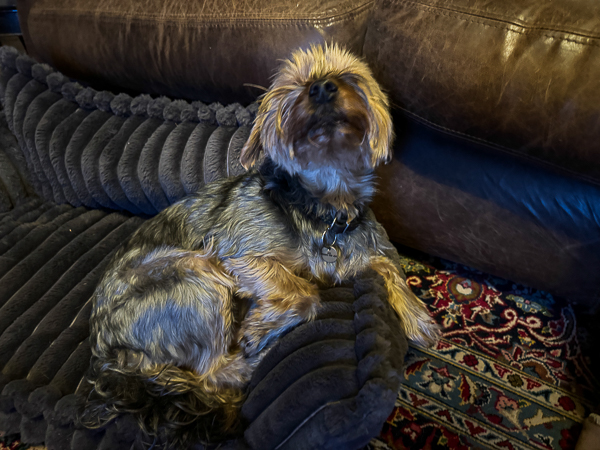
A few days ago, there was the most God-almighty full on dog fight. It was not pretty and both dogs were equally to blame. Apparently, it was about the new dog-bed and it’s accompanying little cushion. Pepper would not give up or let go while Ted gave as good as he got. Luckily, there were no injuries and, once separated, I shouted at both of them until they understood that this behaviour was totally unacceptable. I then ignored them for the remainder of the day disgusted at what had gone on. To be fair, they did each apologise.
Anyway, this has resulted in a rather strained relationship between Pepper and Ted, while we all watch who has the bed and for any grumbling about it.
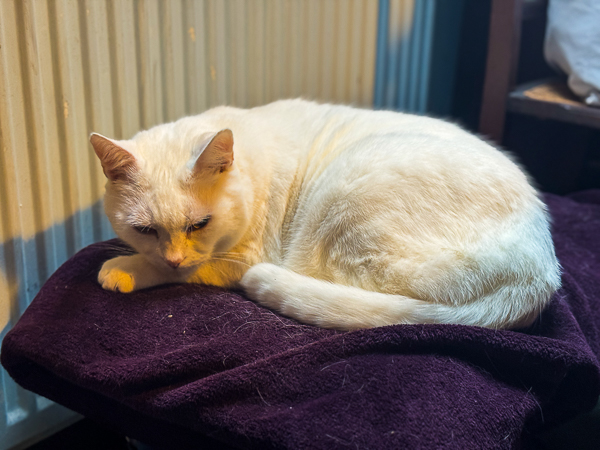
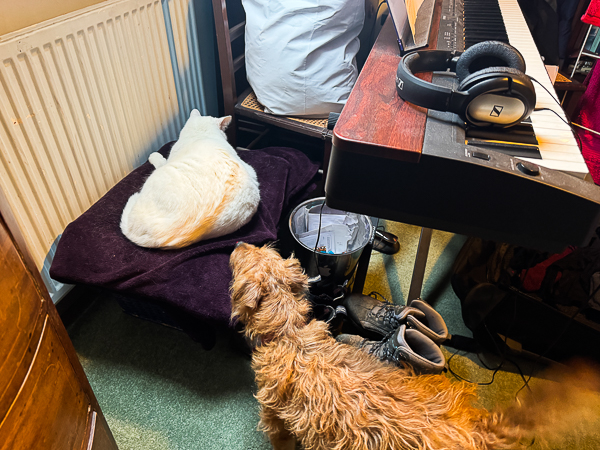
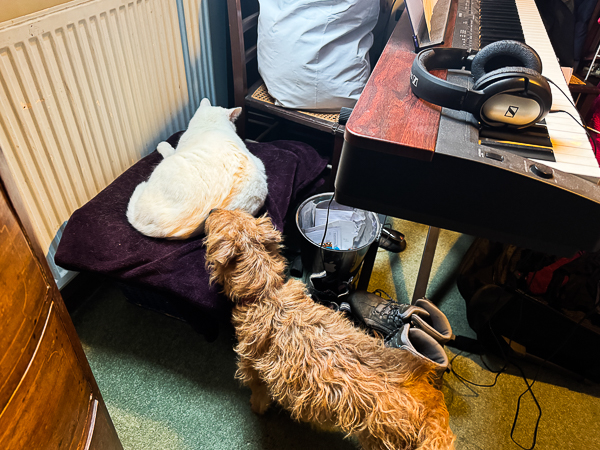
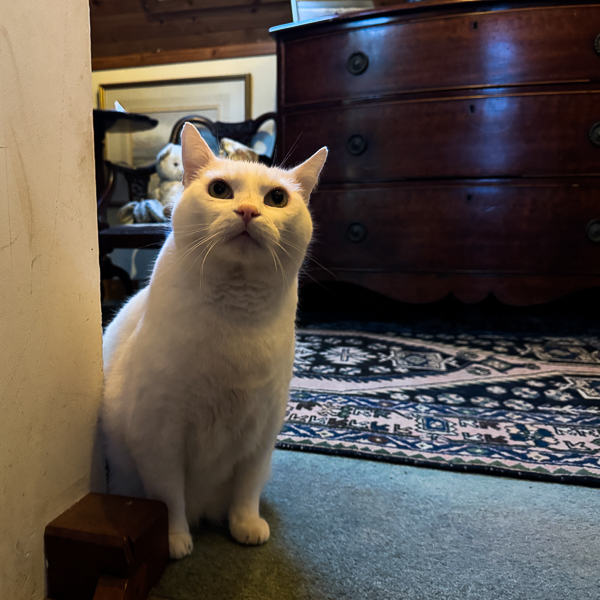
And, because Daisy is here helping, Monster needs a bed in her bedroom/study area. Of course he does. So we made him one next to his favourite place – the radiator – basically a folded up throw on an old wicker basket. Perfect. He spends many peaceful hours up there.
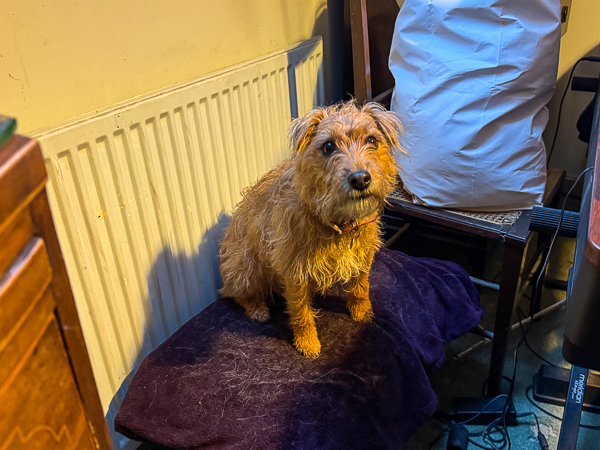
In one of her wanders around the house, Pepper found the new bed.
She was quite keen on investigating it.
So she hopped on and decided it wasn’t that great after all.
Phew, not another bed to have a fight about.
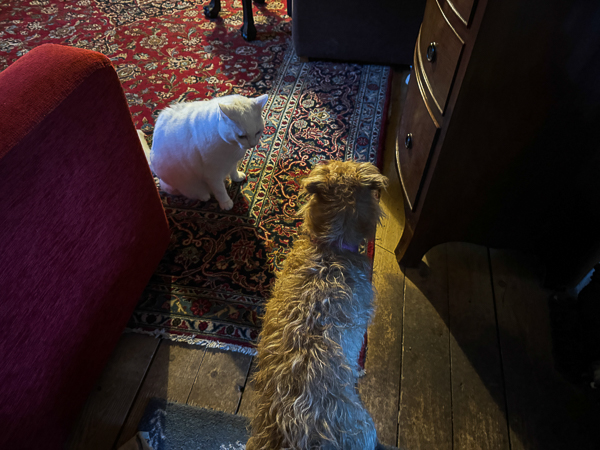
And anyway Monster always wins every battle with Pepper. He got her on her way past just now. So that’s us. The Bed Wars continue but are now being supervised. We were all very shocked by that latest fight. I think I made my feelings very clear as it has taken quite a while for Pepper and Ted to play nicely again together.
Like this:
LikeLoading…
Discover more from My Shetland
Subscribe to get the latest posts sent to your email.
For nearly four years Ukraine has been under attack resulting in millions of people fleeing the country, some taking their pets with them while others abandoned them to fend for themselves.
Rescuers, like our hero Krystina, continue to enter bombed villages to save those left behind.
The war is taking a toll on the stray and abandoned dogs. Researchers have been observing dogs with the help of rescuers, military members, and volunteers near the frontlines since the war began and have discovered they are adapting physically and mentally to survive the harsh conditions.
Photo: Best Friend Shelter
According to a study published in the journal Evolutionary Applications, researchers claim domestic dogs are turning more feral and their bodies are also adjusting to survive in the war zones.
The collection of data was taken from observing over 700 dogs across nine regions of Ukraine. Animal shelters, vets, military members, and volunteers near the frontlines recorded the data and it was recently compiled to show the changes witnessed in dogs.
Photo: United for Animals
Over the past few years their height has decreased, and their bodies are leaner, likely due to the lack of food and resources, but it also allows them to move quicker and take coverage in small areas.
Dogs were also observed living in packs and acting more like wild animals like wolves and coyotes. They younger dogs also have less white fur to help them camouflage into their surroundings. However, these changes are not enough to undo the damage to their environment from the war.
Photo: United for Animals
Homeless dogs still rely on humans for food as there is not enough for them to hunt or eat in nature.
That is where you can help these innocent dogs who are trapped in the middle of a war. While their bodies may be adapting to their dangerous surroundings, they are still in need of help.
Photo: Under the Sun
Military members and rescuers care for these animals and try to find them new homes.
Donate today to help feed and care for hundreds of rescued dogs living at Krystina’s shelter Under the Sun. She continues to save dogs in need, including the ones who have lost trust in mankind.
Photo: Under the Sun
As bombings continue, these dogs need your support to get the food and care they need to survive.
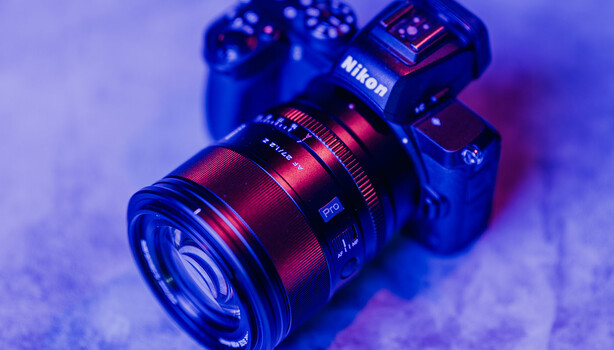
I like to carry minimal gear and travel light when on vacation or a travel photography adventure, and my favorite camera hasn’t changed after 7 years of ownership—it’s the Nikon Z50. Finding the right lens has always been a struggle, though, until I got my hands on Viltrox’s AF 27mm f/1.2 Pro.
Over the years, it’s been a continual search for the perfect lens to pair with this incredible little camera. I’ve used full-frame lenses, tried little vintage lenses, and Nikon’s APS-C kit lenses designed for the Nikon Z50. I shoot in low light when I travel—in restaurants, historic buildings, and on the streets at night. Having a cropped-sensor camera means not cranking up the ISO for fear of degraded image quality, so I’ve always looked for a lens with a wide aperture. An extra stop or two of light can make all the difference when shooting APS-C.
Over the years, I’ve had the best results with little manual-focus lenses. You can find very affordable options, which are great. But there are times when we need autofocus, and those options have been limited. APS-C (DX) lenses from Nikon are few and far between, and I’ve found them to be very plasticky and fragile. They’re not built to last; the two I had quickly broke while traveling.
A few months ago, when I heard Viltrox had released a 27mm f/1.2 autofocus lens designed for Nikon’s APS-C cameras, I was very keen to get my hands on one, having had a really good track record with Viltrox AF 27mm f/1.2 Pro since my full-frame Z-mount cameras.
Subject separation and a nice out-of-focus background—check!
Why a 27mm APS-C Focal Length?
A 27mm focal length on a lens designed for a cropped-sensor camera gives you a full-frame equivalent of 40mm. This focal length has grown in popularity recently because it can do the job of two essential focal lengths—a 35mm and 50mm—to a degree. A 40mm equivalent field of view is how our eyes see. We can get a natural-looking image with no distortion or compression. It’s the perfect focal length for documentary photography.
If you want a solid refresher on the fundamentals behind choices like this, Photography 101 is a good starting point.
One could argue there are some compromises, but having spent many months with this lens, and having many years of shooting 35mm and 50mm, my opinion is the compromise isn’t as great as one might first expect. It turns out 40mm is the perfect everyday focal length.
This focal length allows you to do what a 35mm can do. You can shoot street, travel, and environmental portraits, and it’s wide enough to show some context. You can also get close to your subject for a more intimate image, similar to using a 50mm.
I can use the 40mm full-frame equivalent focal length like I do a 35mm lens—it’s able to show context nicely.Noise-free night time shooting is a joy.
Viltrox AF 27mm f/1.2 Pro
The moment you lock this lens onto your camera, you can feel the reassuring quality. The Z50 is a tiny camera, so the lens does look slightly on the large side, but that’s because 15 very sophisticated elements are packed into the metal, weather-sealed casing. It only weighs 560 g, though, and with the camera (including battery) weighing 450 g, that’s a reasonable total weight of a touch over 1 kg. I’m happy to carry that around on my shoulder all day.
This lens provides fabulous separation with an impressive minimum focus distance of about 12 inches. Perfect for isolating your subject, including portraits. One unexpected use for this lens is shooting food in restaurants, which I do a lot on my travels. The out-of-focus areas are creamy smooth. The bokeh boffins will be very happy. There is a little vignetting wide open, but you won’t notice unless you shoot a white wall square-on. Who even does that?
A dark restaurant, no problem when shooting at f/1.2. The out-of-focus areas are creamy smooth.
Autofocus is quick, and image quality is impressively sharp even when shooting wide open at f/1.2. Two low-dispersion lens elements designed to reduce color fringing and chromatic aberrations do an excellent job and produce good clarity and color accuracy across all apertures.
I really appreciate the MF/AF switch and the aperture markings on the lens barrel for the times I prefer to shoot manual focus. When taking advantage of the superb autofocus system, I found it locked quickly in the trickiest low-light conditions.
Handheld in low light, and no signs of chromatic aberration. Vignetting is present, but for 99.5% of photos, will you even notice it? I don’t think so.
Specs
Focal Length: 27mm (40mm full-frame equivalent)
Aperture: Max. f/1.2, Min. f/16
Lens Mount: Z (also available for X and E)
Lens Sensor: APS-C (Nikon DX)
Angle of View: 55.3°
Minimum Focus Distance: 11 in / 27.9 cm
Optical Design: 15 elements in 11 groups
Aperture Blades: 11
Filter Size: 67mm
Dimensions: Ø 3.2 x L 3.6 in / Ø 82 x L 92 mm
Weight: 1.2 lb / 560 g
Grabbing manual-focus candid images is easy with an MF/AF switch.Shooting wide open at f/1.2 at night, handheld. The results are impressive.
Verdict
If I were to choose just one perfect lens to pair with my APS-C Nikon, the Viltrox AF 27mm f/1.2 Pro is it. There’s nothing better on the market right now.
The main reason I was drawn to this lens was low-light performance, and it delivered in spades. I found myself shooting on the streets at night and was able to get fabulous and impressive noise-free results when shooting handheld, despite neither the lens nor camera having built-in stabilization.
I’ve tested many lenses this year, and this Viltrox AF 27mm f/1.2 Pro is the best of the bunch. It does everything you want it to, without compromise. The price point is affordable for enthusiasts at $578, and the performance is at the professional level. Great job, Viltrox!
This is the first time I’ve rated anything 10/10.
Look above to watch a video from one of my first test outings for the lens.
Astrophotography places unusual demands on an imaging system. Light levels are extremely low. Signal strength varies across wavelengths. Thermal noise becomes a limiting factor long before resolution does. Conventional mirrorless cameras, even advanced ones, are not designed with these constraints in mind. They prioritise colour accuracy, autofocus speed, and general versatility. As a result, much of the faint astronomical signal never reaches the sensor. The OM System OM-3 ASTRO is a response to this problem. It is not a modified consumer camera, and it is not a dedicated astronomy sensor. Instead, it is a mirrorless camera intentionally engineered to operate closer to astrophotography requirements while retaining the flexibility of a photographic system.
OM System developed the OM-3 ASTRO by adapting the OM-3 mirrorless platform and refining it for night sky imaging. The company did not change the core sensor architecture or processing engine. Instead, it focused on optical filtering, computational tools, and operational reliability. OM System aims to improve astrophotography performance without breaking compatibility with existing photographic workflows. The result is a camera that sits between two worlds and addresses a long-standing gap in the market.
A familiar body with a different target
The OM-3 ASTRO shares its physical and electronic foundation with the standard OM-3. It uses a 20.4-megapixel stacked backside-illuminated Live MOS sensor in the Micro Four Thirds format. The camera pairs this sensor with the TruePic X image processor. This combination delivers fast readout speeds, low rolling shutter distortion, and efficient data handling. These characteristics are already important in conventional photography. They matter even more in astrophotography, where long exposures and repeated imaging cycles dominate.
OM-3 ASTRO has IP53-certified weather-sealing
The body construction remains unchanged. OM System uses a magnesium alloy chassis with extensive weather sealing. The camera meets IP53 standards for dust and splash resistance and remains operational in sub-zero temperatures. Astrophotography often takes place in remote locations under unpredictable conditions. Equipment failure due to moisture, cold, or dust is not uncommon. By keeping the OM-3 ASTRO physically identical to the OM-3, OM System ensures durability without redesigning the mechanical platform.
However, the defining change appears at the optical level. OM System replaced the standard infrared cut filter with a redesigned filter tuned specifically for astrophotography. This filter allows nearly full transmission of hydrogen-alpha light. This single modification fundamentally changes how the sensor responds to astronomical targets.
The OM-3 ASTRO body remains physically identical to the OM-3 camera
Hydrogen-Alpha sensitivity and astronomical signal capture
Hydrogen-alpha emission dominates the visible output of many deep-sky objects. Emission nebulae radiate strongly at approximately 656 nm. Standard camera filters suppress this wavelength to maintain colour balance in daylight photography. While that suppression improves skin tones and natural scenes, it severely limits nebular imaging. Photographers often resort to aftermarket sensor modification to bypass this limitation. Such modifications introduce risks, calibration inconsistencies, and autofocus errors.
The OM-3 ASTRO eliminates this compromise at the factory level. By allowing nearly 100 percent transmission of hydrogen-alpha light, the camera records significantly more nebular signal per exposure. This improves contrast and structure in emission regions without relying on artificial colour amplification in post-processing. The camera captures more of the actual photon data reaching the sensor.
Pleiades star cluster captured with OM-3 ASTRO (via OM SYSTEM)
This design choice also improves efficiency. With stronger signal capture, astrophotographers can reduce total integration time for certain targets. That matters when imaging windows are limited by weather or moon phase. It also reduces the need to push ISO settings aggressively, which helps control noise.
Importantly, OM System did not remove infrared suppression entirely. The filter still controls unwanted wavelengths to preserve star colour accuracy and optical performance. The balance between sensitivity and colour fidelity reflects a deliberate engineering decision rather than an extreme modification.
OM-3 ASTRO’s sensor allows Hydrogen-Alpha signals to enter the camera
Hardware alone does not solve astrophotography challenges. OM System has long invested in computational photography, and the OM-3 ASTRO benefits directly from this strategy. Several software-driven features address practical issues faced by night sky photographers.
Starry Sky AF stands out as one of the most relevant tools. Achieving accurate focus on stars is notoriously difficult. Manual focus often relies on trial and error, magnified live view, or external aids. Starry Sky AF detects point light sources and adjusts focus accordingly. This reduces setup time and improves repeatability, especially when temperatures change during long sessions.
Night Vision Mode in Live View offers a brighter depiction of the scene
Live Composite mode also plays a significant role. This mode accumulates light over multiple exposures while preventing overexposure of static elements. In astrophotography, this enables controlled star trail imaging and cumulative sky capture without constant monitoring. The photographer can observe exposure progress in real time and stop when sufficient signal accumulates.
The camera also supports high-resolution composite modes. While these modes are not optimised for moving stars, they can be useful for nightscapes that include static foregrounds. By shifting the sensor and combining frames, the camera reduces noise and increases detail. This flexibility allows photographers to adapt a single camera to different night imaging scenarios.
These tools reduce technical complexity. They do not replace astrophotography knowledge, but they lower the operational burden.
OM-3 ASTRO features Live Composite and Starry Sky AF to enhance the astrophotography experience in the field
Price and availability
The OM System OM-3 ASTRO is priced at $2,499.99 and is available for pre-order.
The OM-3 ASTRO does not replace dedicated astronomy cameras. Cooled monochrome sensors with narrowband filters still outperform mirrorless cameras for faint deep-sky imaging. OM System does not position the OM-3 ASTRO as a competitor in that space. Instead, the camera serves as a bridge. It offers astrophotography improvements while remaining usable for general photography. Landscape photographers who occasionally shoot the night sky gain immediate benefits. Astrophotography enthusiasts avoid the risks and costs of camera modification. Travel photographers carry one system instead of two.
This positioning reflects an understanding of how many photographers work. Most do not operate permanent observatories. They shoot under changing conditions, often with limited time. A camera that performs well across disciplines has real value. This also suggests that astrophotography has matured as a photographic discipline. Manufacturers now recognise it as a primary use case rather than a fringe activity.
Star trail captured with OM-3 ASTRO camera. Credit: Matt Suess (via OM SYSTEM)
The OM SYSTEM OM-3 Astro Helps You Reach For The Stars
Subscribe here for an ad-free experience!
We use cookies to ensure that we give you the best experience on our website. If you continue to use this site we will assume that you are happy with it.
Instagram account @freyathesiberian shared a video featuring two fluffy cat siblings, Freya and Teddy, showing how each has a different personality from the other. The onscreen title adds context: “The differences between our two cats.” And you can’t figure out the differences in the beginning, as both cats pose side-by-side, looking serious and slightly unimpressed.
2 cats are wildly opposite of each other
From there, the video explains how one cat’s personality differs from the second one’s through their day-to-day opposites. First up was grooming. The footage shows Freya staring straight ahead with an angry look as a brush comes toward her chest. Meanwhile, the onscreen text reads, “Freya: HATES being brushed, and gets extremely angry.”
The next shot flips the script, with Teddy enjoying as someone brushes him, while the onscreen text reads, “Teddy: Loves being brushed, will purr the entire time.”
Then come the vacuums — Freya sits near a robot vacuum looking nervous and ready to bolt. The caption explains, “Freya: Terrified of vacuums, will run away from them,” while Teddy treats cleaning tools like amusement park rides, as the video notes, “Teddy: Has no fear of vacuums, he enjoys riding them.” One clip even shows him sitting on top of the robovac as it moves across the floor.
Next, during playtime, Freya “always plays gently,” while Teddy “plays rough,” and the shots back it up with the cats bouncing off each other in very different ways.
The final comparison comes as Freya sits calmly by the car window as the text reads, “Freya: Enjoys going on car rides.” Teddy’s close-up tells the other side of that story, showing him meowing and popping his mouth open as the caption reads, “Teddy: Scared of car rides.”
The video’s caption says what we know by now, noting that Freya and Teddy “are very different.” And viewers loved it. In fact, one commenter went against the video’s theme and pointed out the similarities between the two cats, writing, “Things they have in common: 1, They’re really fluffy. 2, They’re adorable.” And it is true — they are all of these things.