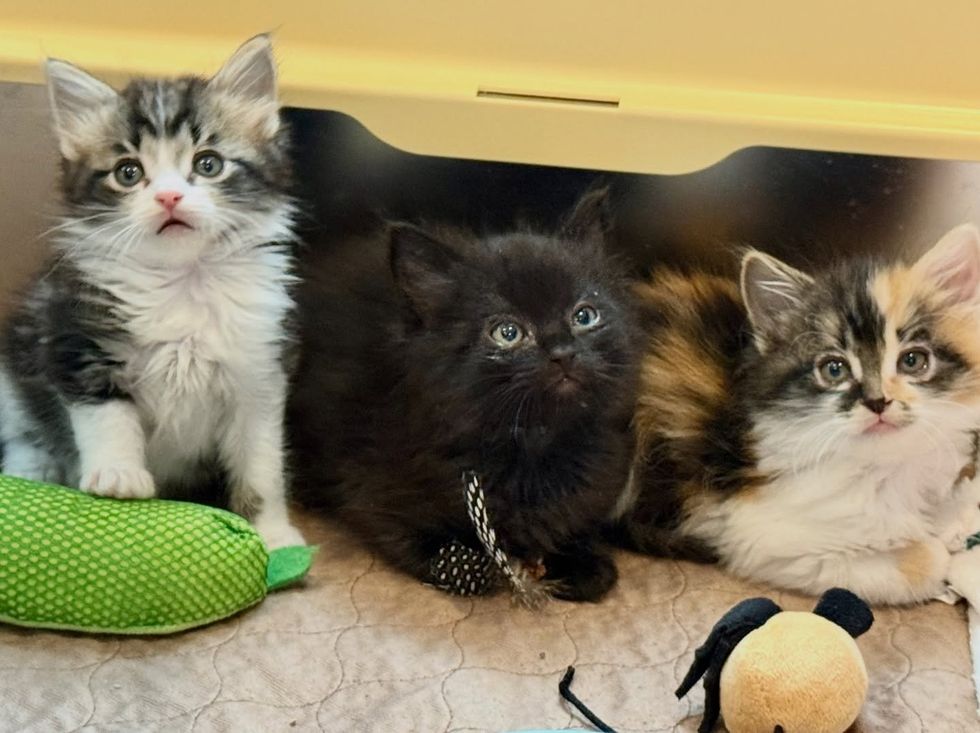
Pet Exercise Tips: Keeping Your Animals Active and Happy Made Easy


Understanding Your Pet’s Exercise Requirements

Every companion animal possesses distinctive physiological and psychological needs that dictate their optimal activity regimen. Canines typically require 30 minutes to two hours of vigorous movement daily, depending on breed characteristics and age. High-energy breeds like Border Collies and Jack Russell Terriers demand substantially more kinetic stimulation compared to brachycephalic breeds such as Bulldogs or Pugs.

Felines, despite their reputation for sedentary behavior, benefit immensely from structured play sessions totaling 15-20 minutes daily. Their crepuscular nature means they’re most receptive to activity during dawn and dusk hours. Small mammals like rabbits require supervised exploration time outside their enclosures, while birds need flight opportunities within safe, enclosed spaces.

“A well-exercised pet is not merely physically fit—they exhibit improved cognitive function, enhanced emotional stability, and stronger immunological responses to environmental stressors.”

Species-Specific Exercise Strategies

Canine Conditioning Programs

Dogs thrive on varied cardiovascular and strength-building activities. Implement interval training during walks by alternating between brisk pacing and moderate jogging. Swimming provides exceptional low-impact conditioning for joint-sensitive breeds or geriatric dogs. Agility training using household items creates mental stimulation while building proprioceptive awareness.

Consider your dog’s morphological structure when selecting activities. Dachshunds benefit from ground-level exercises that minimize spinal compression. Conversely, Greyhounds excel at sprint-based activities but require gradual conditioning for endurance work.

Feline Fitness Fundamentals

Cats respond exceptionally well to predatory simulation exercises. Feather wands, laser pointers, and motorized toys trigger their hunting instincts while providing cardiovascular benefits. Vertical climbing opportunities using cat trees or wall-mounted shelving systems engage their natural arboreal tendencies.

Interactive puzzle feeders transform mealtime into physical activity, encouraging problem-solving while promoting portion control. These devices particularly benefit indoor cats who lack natural foraging opportunities.

Small Animal Activity Enhancement

Rabbits require daily floor time in pet-proofed areas for natural hopping behaviors. Create obstacle courses using tunnels, ramps, and platforms to encourage exploration. Guinea pigs benefit from supervised lawn time in secure enclosures, allowing natural grazing behaviors while providing vitamin D synthesis.

Ferrets possess extraordinary energy reserves requiring multiple play sessions throughout their waking hours. Their curious nature makes them excellent candidates for interactive toy rotation systems.

Indoor Exercise Solutions for Every Season

Weather constraints shouldn’t impede your pet’s fitness routine. Transform your living space into an engaging activity center using creative environmental modifications. Staircase climbing provides excellent cardiovascular conditioning for dogs, while hallway fetch sessions maintain ball drive during inclement weather.

Treadmill training offers controlled exercise environments for dogs requiring specific gait rehabilitation or weight management protocols. Begin with stationary familiarization before introducing movement at minimal speeds.

Pet Type Indoor Exercise Duration Frequency
Dogs Treadmill training 10-20 minutes Daily
Cats Vertical climbing 5-10 minutes Multiple times daily
Birds Flight time 15-30 minutes Daily
Small mammals Floor exploration 30-60 minutes Daily

Recognizing Exercise-Related Health Considerations

Monitor your pet’s physiological responses during activity sessions. Excessive panting, lethargy, or reluctance to continue indicates potential overexertion. Brachycephalic breeds require particular attention due to their compromised respiratory efficiency.

Joint health considerations become paramount in senior animals or breeds predisposed to orthopedic conditions. Hip dysplasia, luxating patellae, and intervertebral disc disease necessitate modified exercise protocols emphasizing low-impact alternatives.

Hydration monitoring proves crucial during extended activity sessions. Provide frequent water breaks and observe for signs of hyperthermia, including excessive drooling, weakness, or altered mental states.

Creating Sustainable Exercise Routines

Consistency trumps intensity when establishing long-term fitness habits. Begin with abbreviated sessions and gradually increase duration as your pet’s conditioning improves. Document progress through activity logs noting duration, intensity, and behavioral responses.

  • Start with 5-10 minute sessions for sedentary pets
  • Increase activity duration by 25% weekly
  • Monitor weight changes and adjust portions accordingly
  • Incorporate rest days to prevent overuse injuries
  • Vary activities to maintain psychological engagement

Seasonal adjustments ensure year-round participation. Summer activities should occur during cooler morning or evening hours, while winter exercise may require indoor alternatives or protective gear for cold-sensitive breeds.

Frequently Asked Questions About Pet Exercise

How do I know if my pet is getting adequate exercise?

Well-exercised pets demonstrate improved sleep patterns, reduced destructive behaviors, and maintained body condition scores. They should appear pleasantly tired after activity but recover within 10-15 minutes.

Can overweight pets begin intensive exercise programs immediately?

Obese animals require veterinary clearance before beginning structured fitness regimens. Start with low-impact activities and gradually increase intensity as weight reduction occurs and cardiovascular conditioning improves.

What environmental factors should influence exercise timing?

Temperature, humidity, air quality, and surface conditions all impact exercise safety. Avoid concrete surfaces during hot weather, and consider protective footwear for dogs exercising on rough terrain.

Remember that exercise represents just one component of comprehensive pet wellness. Combining appropriate physical activity with premium nutrition, regular veterinary care, and environmental enrichment creates the foundation for optimal companion animal health and longevity.


Rubin Observatory Captured Interstellar Comet 3I/ATLAS Before Its Discovery


Rubin Observatory Captured Interstellar Comet 3I/ATLAS Before Its Discovery

The NSF–DOE Vera C. Rubin Observatory recorded interstellar comet 3I/ATLAS in wide-field commissioning data approximately ten days before its official discovery. Astronomers later identified the object in archived Rubin exposures after ATLAS announced the comet on 1 July 2025. The Rubin image, released by NSF–NOIRLab as Image of the Week, provides an earlier astrometric and photometric data point that extends the comet’s observational arc. That extension improves orbital solutions and supports early activity modeling. More importantly, the detection shows that Rubin’s survey system can capture faint, fast-moving interstellar objects within routine sky coverage.

Discovery and the interstellar confirmation

The Asteroid Terrestrial-impact Last Alert System (ATLAS) detected the comet on 1 July 2025 from Chile. Observers initially cataloged it as C/2025 N1 (ATLAS). Soon after, orbital calculations revealed a strongly hyperbolic trajectory. That result immediately signaled that the object was not gravitationally bound to the Sun.

Astronomers refined the orbit using follow-up observations from multiple facilities. The eccentricity remained well above one. Therefore, the Minor Planet Center assigned the object the designation 3I, marking it as the third confirmed interstellar object. The earlier visitors, 1I/‘Oumuamua in 2017 and 2I/Borisov in 2019, had already reshaped understanding of small-body populations beyond the Solar System. Consequently, the appearance of 3I/ATLAS triggered rapid global coordination.

While observers collected new data, researchers also examined archival survey images. They projected the comet’s path backward across recent sky coverage. This process led directly to Rubin Observatory’s commissioning dataset.

This image shows the observation of comet 3I/ATLAS when it was discovered on July 1, 2025. The NASA-funded ATLAS survey telescope in Chile first reported that the comet originated from interstellar space. Credit: ATLAS/University of Hawaii/NASA

Rubin’s commissioning data captured the comet

At the time of the comet’s inbound passage, the Vera C. Rubin Observatory was conducting engineering and system validation observations. Even during commissioning, the Simonyi Survey Telescope and the LSST Camera were operating at full optical depth. The system repeatedly imaged large areas of the southern sky to test image quality, tracking precision, and calibration pipelines.

After ATLAS announced the discovery, astronomers checked Rubin’s recent exposures along the predicted trajectory. They identified a faint, moving source consistent with 3I/ATLAS roughly ten days before 1 July 2025. That identification relied on positional consistency across sequential images and on matching brightness evolution.

NSF–NOIRLab later released one of those frames publicly. The image does not isolate the comet dramatically. Instead, it shows the object embedded within a dense stellar background. However, careful inspection reveals a slightly diffuse appearance. That subtle fuzziness indicates the presence of a coma. In other words, the comet was already active at the time Rubin recorded it.

Although ATLAS retains official discovery credit, Rubin’s earlier detection extends the comet’s recorded timeline inside the Solar System. That extension carries measurable scientific value.

This image shows comet 3I/ATLAS, the third interstellar object ever discovered, on 21 June 2025, ten days before its official discovery was announced. This image was taken with the LSST Camera at NSF–DOE Vera C. Rubin Observatory. Credit: NSF–DOE Vera C. Rubin Observatory/NOIRLab/SLAC/AURA; Image Processing: C. Chandler (University of Washington), M. Zamani & D. de Martin (NSF NOIRLab)

The contribution of the Rubin image

First, the earlier detection lengthens the observational arc. In orbital mechanics, even a small extension improves solution stability. Each additional astrometric point reduces uncertainty in key parameters such as eccentricity and inbound velocity. Consequently, Rubin’s data strengthened confirmation of the comet’s interstellar origin.

Second, the image provides an independent brightness measurement. Comets brighten as solar heating increases sublimation. By comparing Rubin’s earlier photometry with later observations, astronomers can model the rate of activity growth. That modeling constrains volatile content and dust production efficiency.

Third, the detection confirms that the comet was already developing a coma well before discovery. The diffuse structure visible in the Rubin frame indicates ongoing gas and dust release. Therefore, the comet likely began significant activity at a larger heliocentric distance than initially assumed.

Interstellar comet 3I/ATLAS appeared ten days earlier, on 21 June 2025, in high-resolution commissioning data captured with Rubin’s 3200-megapixel LSST Camera. Rubin continued observing 3I/ATLAS until 20 July, when it was no longer observable while the Sun was below the horizon. Credit: NSF–DOE Vera C. Rubin Observatory/NOIRLab/SLAC/AURA; Image Processing: C. Chandler (University of Washington), M. Zamani & D. de Martin (NSF NOIRLab)

Rubin Observatory’s survey design

The Vera C. Rubin Observatory was built to conduct the ten-year Legacy Survey of Space and Time (LSST). The survey will repeatedly image the southern sky with high cadence and unprecedented depth. The LSST Camera, one of the largest digital cameras ever constructed for astronomy, covers nearly ten square degrees per exposure. That wide field allows rapid, repeated coverage of vast areas of the sky.

Moreover, the system processes data quickly and flags transient or moving objects. Engineers designed Rubin specifically to detect near-Earth asteroids, distant trans-Neptunian objects, variable stars, and transient events. Interstellar objects fall naturally within that detection framework.

The 3I/ATLAS image shows this capability. Rubin did not intentionally target the comet. Instead, the telescope captured it during routine operations. Later, astronomers retrieved the data efficiently and confirmed the detection. This workflow represents the core philosophy of modern survey astronomy: observe broadly, archive systematically, and analyze dynamically.

As LSST transitions into full science operations, Rubin will discover millions of Solar System objects. Its depth and cadence will likely increase the frequency of early detections for rare interstellar visitors. Early detection matters because it provides more time for spectroscopic and thermal follow-up before perihelion.

Vera C. Rubin Observatory. Credit: NOIRLab

Further reading

Right from the discovery of the interstellar comet 3I/ATLAS, DIYP has published several articles on its photographs and features. Here is the list of articles:

The unannotated image of 3I/ATLAS captured by the Vera C. Rubin Observatory. Credit: NSF–DOE Vera C. Rubin Observatory/NOIRLab/SLAC/AURA; Image Processing: C. Chandler (University of Washington), M. Zamani & D. de Martin (NSF NOIRLab)

Clear skies!


Cat Transferred from a Shelter with Kittens in Tow, Months Later, She Receives Happiest Ending She Deserves


A cat was transferred from a shelter with her kittens in tow. Months later, she received the happiest ending she had always deserved.

Cat Transferred from a Shelter with Kittens in Tow, Months Later, She Receives Happiest Ending She Deserves Candy and her kittensFosterKittenMama

A few months ago, a mother cat and her four kittens arrived at a shelter already stretched beyond its limits. With their future uncertain, they were in urgent need of rescue.

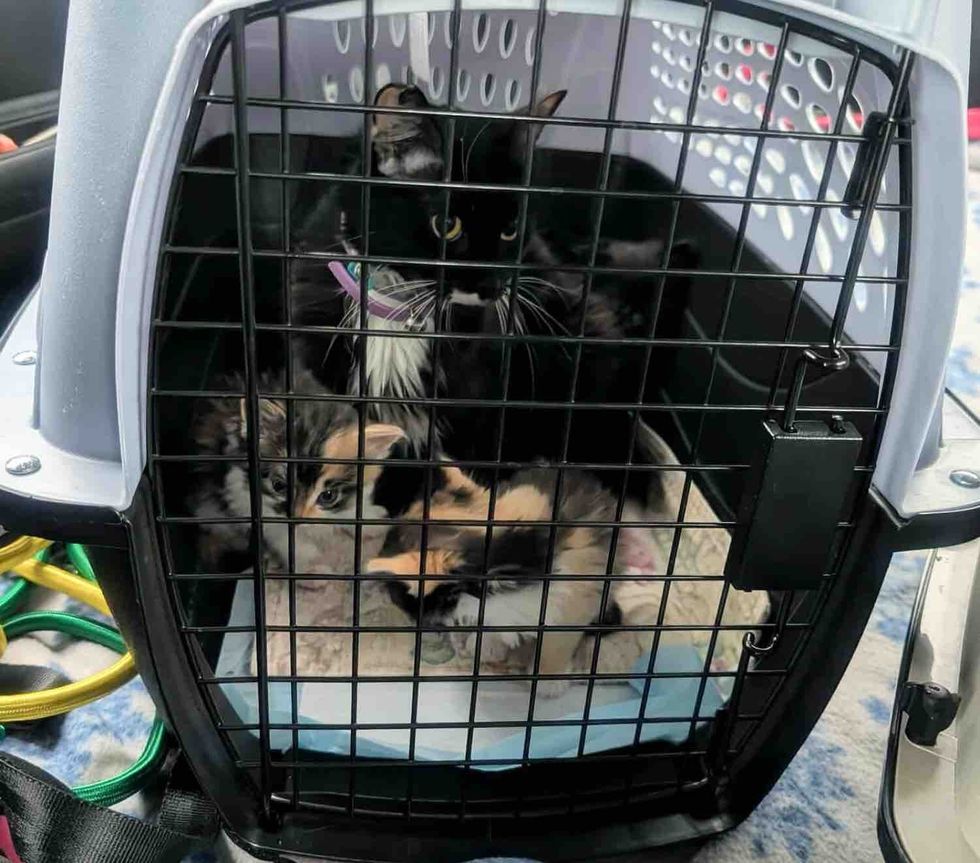
When Heidi Shoemaker, founder of Foster Kitten Mama, offered to take them in, a compassionate network of volunteers sprang into action. Together, they coordinated a relay-style transport spanning several states to bring the feline family to safety.

“They make their way with multiple people each driving a ‘leg’ and passing them off to the next driver,” Heidi shared.

cat kittens carrier FosterKittenMama

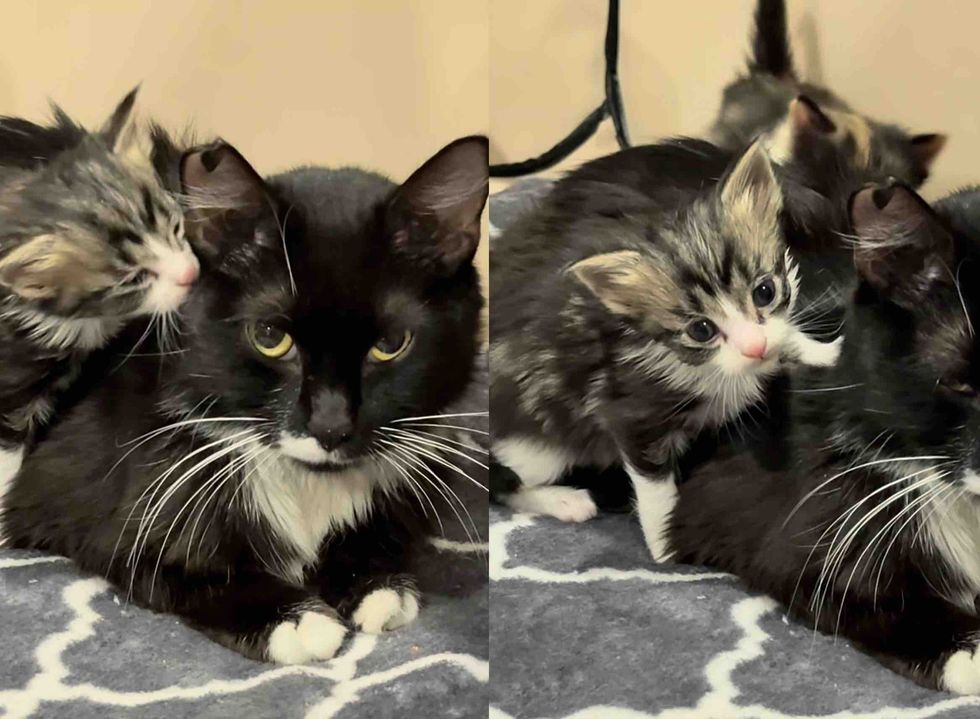
When the family finally arrived, the mother cat, named Candy, was exhausted but relieved to have a cozy, quiet space for her kittens. She allowed Heidi to gently brush her fur, remove her old collar, and clean her kittens’ crusted eyes.

Candy settled onto a soft blanket while her babies climbed all over her. As Heidi spoke softly to her, she began to relax.

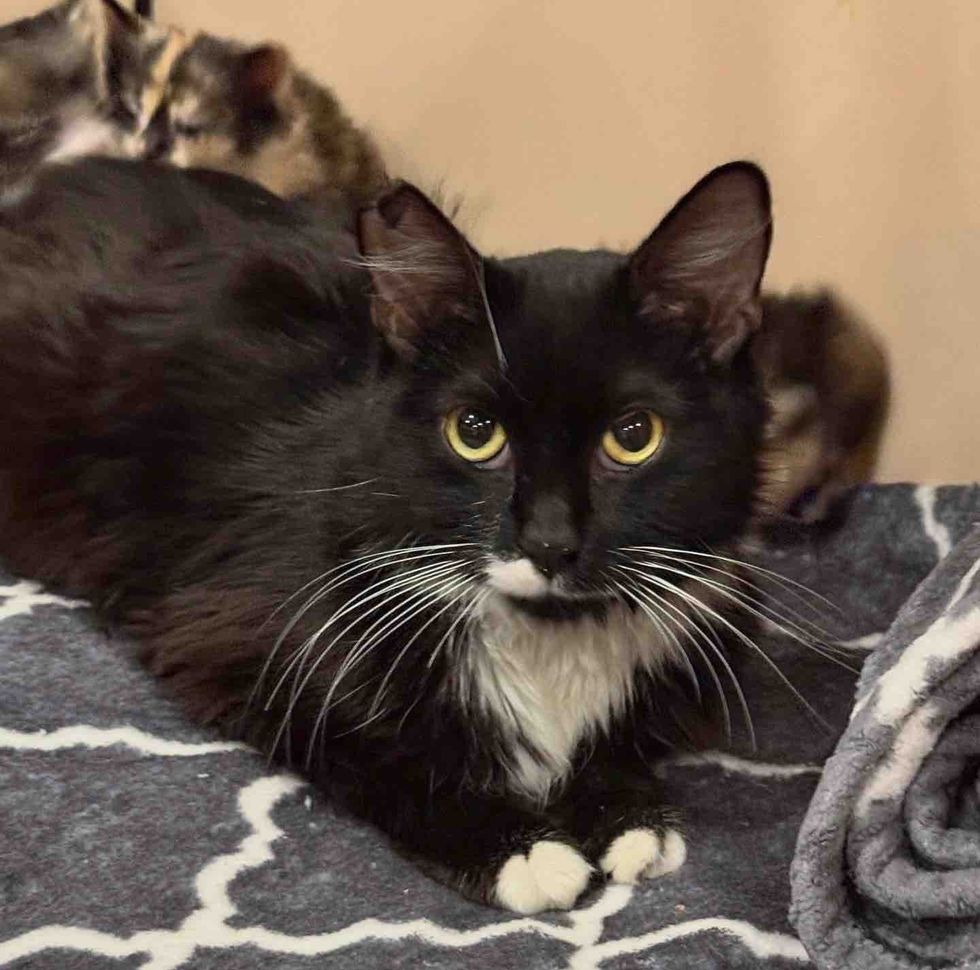
tuxedo cat mother FosterKittenMama

Curious and fearless, the kittens explored every corner of their playpen and even attempted a few daring escapes. “They are fast learners and are already using the litter box well after starting off going anywhere.”

With proper medication and attentive care, their eyes began to heal, and their stomach troubles subsided. Day by day, they grew bigger, healthier, and stronger.

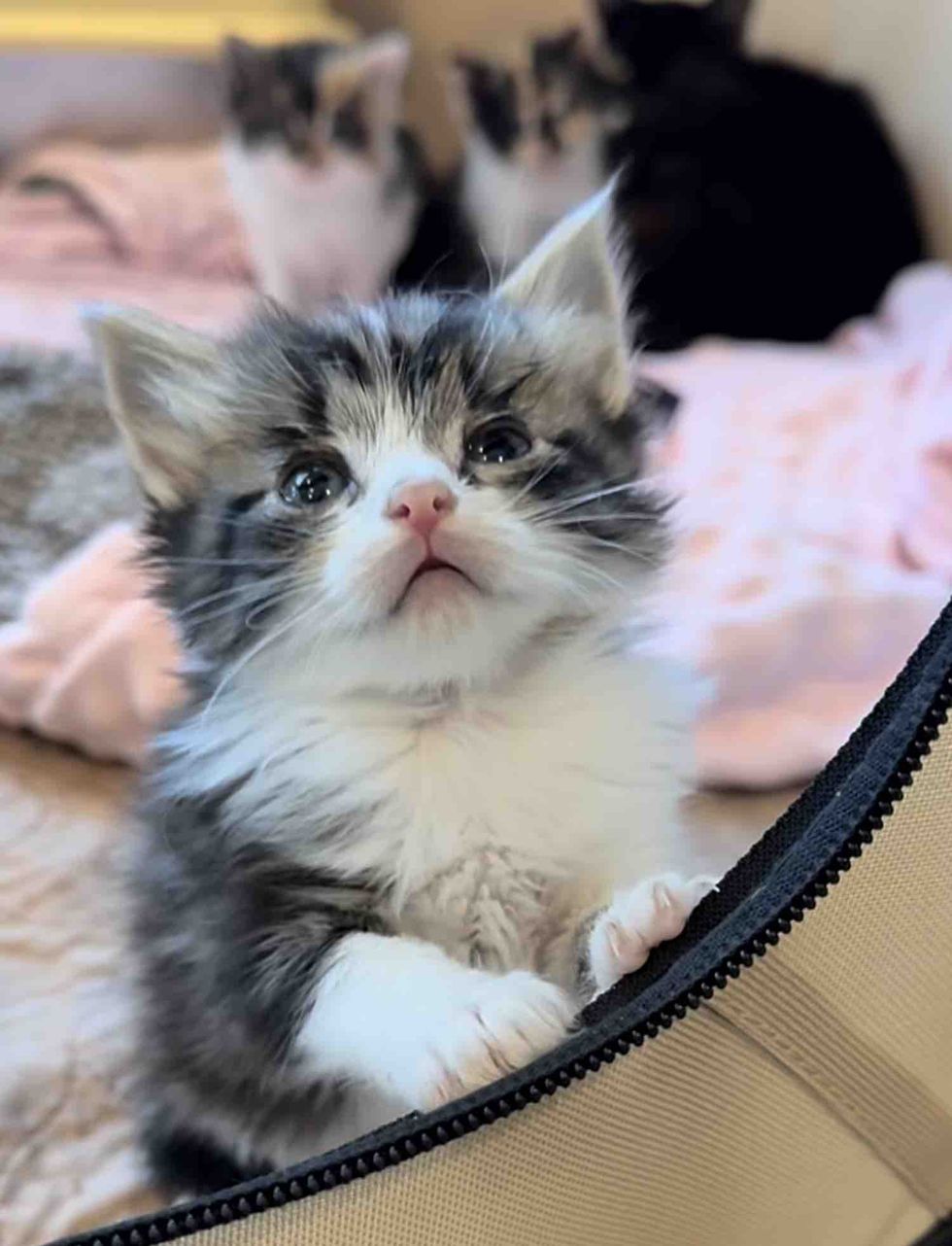
tabby white kitten FosterKittenMama

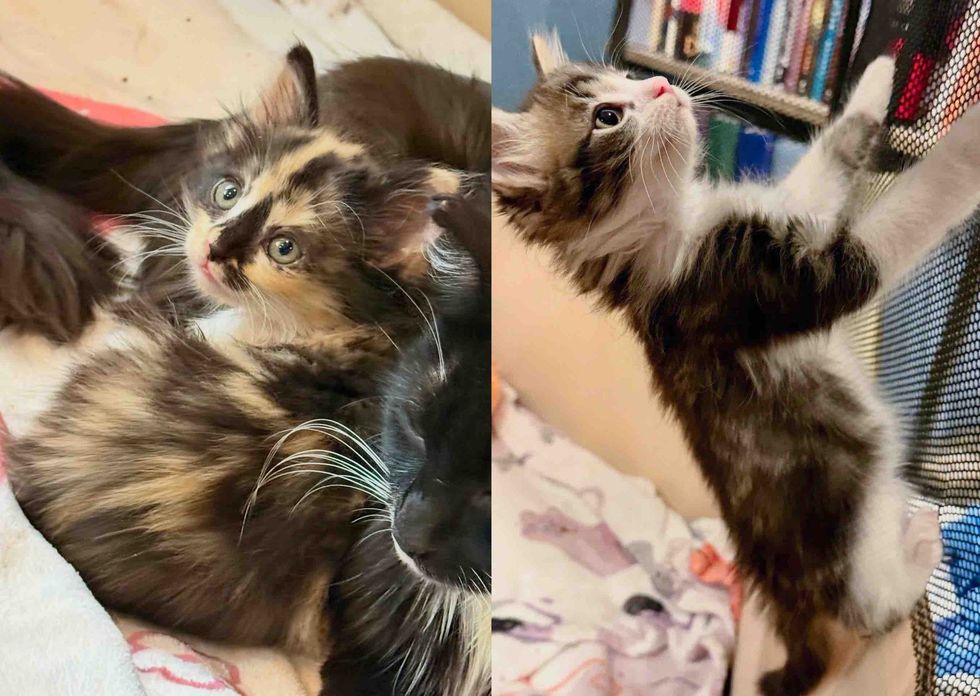
All four kittens were long-haired beauties: two calicos, one sleek little “house panther,” and a tiny tabby with a white belly and matching mittens. Their mother, a striking black-and-white tuxedo, was surrounded by a delightful mix of colors and personalities.

“Snickers (the tabby) is always ready to play and the first to run over.”

curious kittens playful Licorice and SnickersFosterKittenMama

With their eyes now bright and clear, their playful, adventurous spirits began to shine.

Toys that crinkled and jingled instantly became their favorites. The kittens chased, pounced, and wrestled with enthusiasm. Before long, they were scaling cat trees and surveying their room from the highest perch.

fluffy kittens playful Snickers, Licorice, and PixyFosterKittenMama
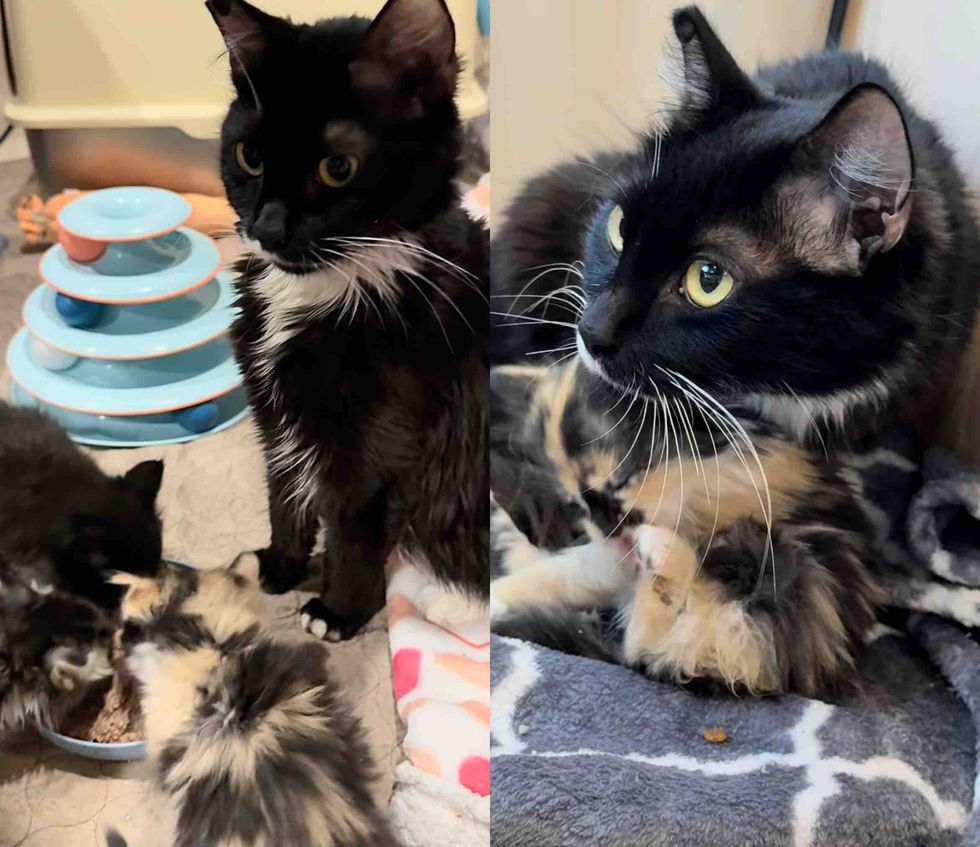
Candy adjusted beautifully to her foster home. She devoured every meal and patiently taught her kittens how to eat from a dish. She watched them play from the sidelines, always ready to offer a grooming session.

She kept their fluffy coats immaculate and allowed them to comfort-nurse even after they had been weaned.

mother cat kittens FosterKittenMama

With her kittens by her side, Candy slowly came out of her shell. Their presence gave her comfort and confidence. “Mama Candy is a very quiet and timid girl who I think has had a really hard life so far.”

Knowing that mother cats are often overlooked in favor of their adorable kittens, Heidi began searching early for Candy’s forever home, hoping she would be adopted with one or two of her babies.

kittens curious siblings FosterKittenMama

When the kittens were ready for adoption, Lolly (calico) and Snickers quickly found their dream home together. Just as it seemed Candy had secured hers as well, the adoption unexpectedly fell through. Undeterred, Heidi resumed the search, hopeful that the right family was still out there.

A few weeks later, the perfect match appeared, not just for Candy, but also for her two remaining kittens.

calico tuxedo kitten climbing Lolly and Snickers were adopted togetherFosterKittenMama
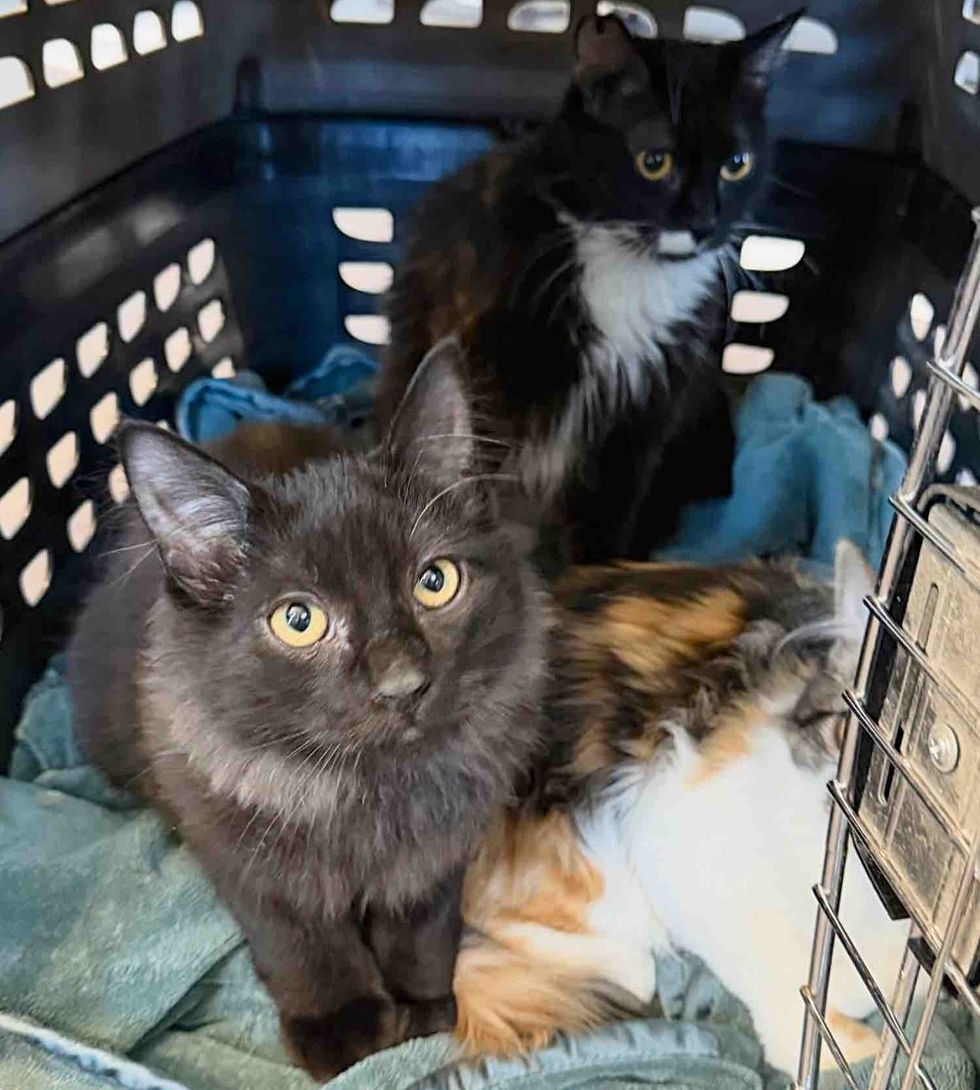
The family fell in love with the trio and knew they belonged together. “It’s been a long time coming, but Mama Candy and her two babies, Pixy (calico) and Licorice (house panther), have gone to their forever home.”

Now, they have a big, loving family and two feline brothers ready to shower them with affection every single day.

cat kittens carrier Candy, Licorice, and Pixy headed to their forever home togetherFosterKittenMama

Share this story with your friends. More cats and kittens at Foster Kitten Mama on Instagram @fosterkittenmama and Facebook.

Related story: Family and Their Cat Change Everything for Little 4-week-old Kitten in a World He Cannot See


Rhino Poaching In South Africa Drops 16% in 2025 — The Battle To Save Them Rages On – World Animal News


Rhino Poaching In South Africa Drops 16% in 2025 — The Battle To Save Them Rages On – World Animal News


South Africa’s anti-poaching and anti-trafficking efforts saw a 16% drop in rhino poaching in 2025 compared to 2024. Minister of Forestry, Fisheries and the Environment, Mr. Willie Aucamp, attributes the decline to “dedication and tactical, swift coordination.” Conservationists, however, caution that the fight against rhino poaching is far from over.

“From January to December 2025, 352 rhinos were poached in South Africa, with 266 being killed on state properties and 86 on privately owned parks, reserves, or farms. This was a decrease of 68 in comparison to 420 rhinos poached in 2024,” said Minister Aucamp.

Mpumalanga was the hardest-hit province, losing 178 rhinos, mostly in Kruger National Park, which reported 175 poached rhinos—up from 88 in 2024. In contrast, Hluhluwe-iMfolozi Park in KwaZulu-Natal saw poaching drop from 198 in 2024 to 63 in 2025, thanks to collaboration through the Integrated Wildlife Zones (IWZ) Programme and support from WWF, Save the Rhino International, Wildlife ACT, and Peace Parks Foundation.

Ezemvelo notes that 2025’s reduction was driven by multiple measures: strategic dehorning, advanced detection technologies, early-warning systems, and the Integrity Implementation Plan, including polygraphing of all park law-enforcement personnel.

The National Integrated Strategy to Combat Wildlife Trafficking (NISCWT) is strengthening prosecutions, centralizing cases to give courts a full view of criminal syndicates, including organized crime and money laundering. A key example is ZM Muiambo, aka Thomas Chauke, who was found guilty on 19 charges, including illegal rhino hunting and theft of rhino horns. In April 2025, he was sentenced to 20 years in prison. 

Minister Aucamp conveyed his gratitude to private rhino owners and the private sector for their anti-poaching efforts. He emphasized that coordinated action by the government, NGOs, and the private sector is central to sustaining progress.

“South Africa continues to strengthen its international collaboration to curb rhino poaching and wildlife trafficking. These efforts led to the country receiving the Asia Environmental Enforcement Recognition of Excellence Award late last year, which celebrates excellence in enforcement by government officials, institutions, and teams combatting transboundary environmental crimes,” said Minister Aucamp.

“Working together with the South African anti-poaching and anti-trafficking organizations, we remain committed to a balanced, intelligence-driven, and partnership-based approach to rhino protection, recognizing that sustained success requires constant adaptation, integrity, and cooperation across all sectors,” said Minister Aucamp.

“While this is much-needed progress, rhinos remain under serious threat. Urgent and coordinated action across all sectors is needed to stop poaching and ensure these animals have a future in the wild.” — Peace 4 Animals & World Animal News 

Members of the public can report suspicious wildlife activities to the environmental crime hotline at 0800 205 005 or SAPS 10111.


5 Things That Matter in Photography (And 5 That Don't)


5 Things That Matter in Photography (And 5 That Don't)

Photography forums, YouTube comment sections, and gear review threads would have you believe that the path to better images runs through spec sheets and brand allegiances. Spend enough time in these spaces and you might start to think that your sensor size is holding you back, or that real photographers only shoot in manual mode, or that your follower count reflects the quality of your work. None of this is true, but it takes time and experience to see through it. 

[Read More]


One Household Item That Kills More Cats Than You’d Think – Catster


Cats will eat the weirdest things. Hair ties vanish from bathroom counters. Earbuds disappear from nightstands. Ribbon from last night’s gift wrapping gets batted across the kitchen floor until it suddenly… doesn’t exist anymore.

Most of those oddball snacks either pass through harmlessly or cause straightforward problems vets deal with all the time. But string, thread, ribbon, yarn, dental floss—those are different. They create a specific type of emergency that’s both more common and more deadly than most cat owners realize.

The mechanics of what string does inside a cat’s body are genuinely disturbing. And the cruelest part? Cats often seem fine at first. By the time obvious symptoms appear, the damage can already be severe enough to require emergency surgery, or worse.

Here’s what every cat owner needs to know about why that innocent piece of ribbon is actually one of the most dangerous things your cat can swallow.

One Household Item That Kills More Cats Than You’d Think – Catster

Why String Becomes a Death Trap Inside Your Cat

a r
Image Credit: Sweetlouise, Pixabay

Unlike a toy or small object that might pass through or cause a simple blockage, string creates what veterinarians call a linear foreign body. The mechanics are genuinely disturbing.

Picture your cat’s intestines pulsing to move food through the digestive system, like an earthworm crawling forward. Now imagine a piece of string in there. One end gets stuck (maybe wrapped around the base of the tongue or caught in the stomach), while the other end gets pulled along by those natural gut movements.

Here’s where it gets dangerous. The intestines keep trying to push that stuck string along, and those pulsing movements cause the gut to bunch up around the string like a closed accordion. This bunching becomes so severe that it cuts off the blood supply to the intestinal tissue. The gut starts dying. Dead tissue becomes leaky to bacteria, then ruptures completely, spilling intestinal contents into the abdomen and causing peritonitis, a life-threatening infection.

Your cat can die from eating a piece of string, and it can happen fast.

The Tongue Trap You’ve Never Heard About

Those backward-facing barbs on your cat’s tongue act like a one-way reel for string. Once string touches those barbs, your cat literally cannot spit it out. The tongue movements just pull more string in, wrapping it around the base of the tongue. Cats will paw desperately at their mouths and retch repeatedly, but they cannot dislodge it themselves.

Yawning, choking, coughing Cat close up
Image Credit: Suzanne Tucker, Shutterstock

What You’ll See (and What You Won’t)

Symptoms depend entirely on where the string is and what damage it’s causing.

String stuck in the mouth: Choking behavior, pawing at the face, retching, visible thread hanging from the mouth

String in the stomach: Lethargy, refusing food, vomiting

String causing intestinal problems: Extreme lethargy, complete loss of appetite, vomiting, diarrhea, painful abdomen, rapid deterioration into dehydration and septic shock

Here’s the cruel part: some cats seem fine initially. By the time obvious symptoms appear, the damage may already be severe.

The One Thing You Must Never Do

If you see string hanging out of your cat’s mouth or rear end, do not pull it. Pulling can tighten any bunching in the intestines and cause catastrophic damage. Leave it alone and get to the vet immediately.

One Household Item That Kills More Cats Than You’d Think – Catster

What Happens at the Emergency Vet

Most cats require sedation or anesthesia just for a thorough examination, since checking for string damage can be painful. If the string is only in the mouth, removal under anesthesia is straightforward and most cats recover quickly.

If the string has been swallowed, your vet needs X-rays or ultrasound to look for obstruction patterns. The string itself doesn’t show up on imaging, but the bunched-up tissue and trapped gas around it does.

vet checking up tabby cat
Image Credit: mojo cp, Shutterstock

When Surgery Becomes Necessary

String beyond the mouth almost always requires surgical removal because it doesn’t digest.

For string in the stomach, surgery involves a single incision with excellent outcomes and recovery in just a few days.

For string in the intestines, surgery becomes complex. Surgeons need multiple incisions along the length of the affected bowel because pulling the string out through one opening would cause further damage. Recovery typically takes 10 to 14 days with higher complication risks.

In worst-case scenarios where the intestine\ is already damaged or ruptured, sections of bowel may need to be removed entirely. These surgeries carry the highest complication rates, and a significant percentage of cats don’t survive.

The Bottom Line on Survival

Most cats who eat string will make a full recovery, but only if their owners recognize the problem early and seek immediate veterinary care. The timeline matters enormously. A cat treated within hours has vastly better odds than a cat who goes untreated for a day or more.

For cats with severe linear foreign bodies and peritonitis, the statistics are grim despite aggressive treatment.

vet checking a cat's stomach
Image Credit: Dina da, Shutterstock

One Household Item That Kills More Cats Than You’d Think – Catster

Keep Your Cat Safe

The simplest solution is prevention. Store thread, ribbon, yarn, tinsel, and dental floss where your cat cannot access them. Dispose of meat strings in sealed bins. Supervise play with any string-like toys and put them away when you’re done. Kittens are the worst offenders, so be especially vigilant during that first year.

That piece of ribbon might seem harmless, but inside your cat’s body, it can transform into a surgical emergency in a matter of hours. When it comes to string, the only safe amount for your cat to eat is none.

Feature Image Credit: megaflopp, Shutterstock


Did You Know? 

  • Our brand-new posts are rounded up and included in our weekly emails. Don’t miss out on the latest – sign up for our newsletter below!


UPDATE! Justice For Orelha: Case Enters Judicial Review With Prosecutors Seeking More Evidence – World Animal News


Photo credit: Reproduction

Update: 2/11/26

The case surrounding the brutal killing of Orelha, the beloved community dog from Praia Brava in Florianópolis, Brazil, has now moved into the judicial phase.

Orelha was found tortured and gravely injured on January 4, 2026, and later euthanized due to the severity of his injuries. His death has sparked national outrage and protests across Brazil, with thousands demanding accountability and stronger protections for animals.

The Civil Police of Santa Catarina have formally concluded their investigation. Authorities identified one adolescent as the principal assailant in the beating that led to Orelha’s death and have requested his internment under Brazil’s juvenile justice system. The police report references security footage, witness testimony, and forensic findings as part of the evidence.

The investigation also examined the attempted drowning of another beloved community dog, Caramelo, who thankfully survived.

In addition, three adults were formally indicted for coercion of a witness after investigators determined there were efforts to interfere with testimony during the case.

Although the police have closed the inquiry, the Public Ministry of Santa Catarina (MPSC) has identified gaps in the investigation and requested additional measures. Prosecutors are considering requesting that Orelha’s body be exhumed for further forensic analysis to resolve remaining questions in the case.

Because minors are involved, key details of the case remain confidential under Brazil’s Statute of the Child and Adolescent, the judicial process is ongoing.

Orelha’s death has ignited a nationwide call for justice and renewed pressure on lawmakers to strengthen enforcement of Brazil’s animal cruelty laws.

WAN will continue to closely monitor official court proceedings and report developments as they unfold.

______________________________________

Update 2/2/26

Public outrage continues to sweep across Brazil following the tragic killing of Orelha, a 10-year-old beloved community dog. On January 4, 2026, he was attacked and brutally tortured in Praia Brava, Florianópolis, leaving him gravely injured. His wounds were so severe that Orelha had to be euthanized the following day, January 5, at a veterinary clinic, cutting short the life of a dog cherished by his community and leaving a nation in shock and grief.

The case has sparked mass demonstrations across Brazil, including protests in Florianópolis this past weekend, with thousands of people taking to the streets demanding justice and accountability. Demonstrations have also occurred in other cities, as animal advocates and concerned citizens call for stronger enforcement of animal cruelty laws.

According to the Civil Police of Santa Catarina, four teenagers are under investigation in connection with Orelha’s death. Authorities say the case is being examined using witness statements and other evidence, as part of an ongoing investigation.

The investigation has since expanded beyond the teenagers allegedly involved. Police have confirmed that at least three adults are under investigation for obstruction of justice, including allegations of witness intimidation and attempts to interfere with the investigation. One of those under investigation is reportedly a police officer and the father of one of the suspects. Authorities have said this aspect of the case remains ongoing.

The story has also drawn widespread international attention online, with the hashtag #JustiçaPorOrelha (“Justice for Orelha”) trending as supporters demand accountability and stronger legal protections for animals in Brazil.

As the investigation continues, Orelha has become a symbol of the fight against animal cruelty in Brazil, uniting activists and communities across the country to use their voices for those who cannot speak for themselves.

______________________________________

1/29/26

Communities in Brazil are in shock after the horrifying death of Orelha, a 10-year-old “community dog” cherished by residents of Praia Brava. In early January 2026, he was found tortured and critically injured in a case that has shocked the nation and continues to draw international attention.

According to reports, Orelha’s injuries were so severe that veterinarians had no choice but to euthanize him to end his suffering. His tragic death has left the community heartbroken, mourning the loss of a dog who had been a beloved presence for over a decade.

Authorities have identified at least four to five teenagers as suspects. Reports suggest the attack may have been recorded. At least two of the suspects reportedly fled to Orlando, Florida, shortly after the incident, prompting calls for their return to Brazil to face justice.

The Civil Police of Santa Catarina (PCSC) are leading the investigation. Authorities are treating the case as severe animal cruelty, highlighting the extreme violence inflicted on Orelha.

Orelha’s death has sparked broader concern about how crimes committed by minors are handled in Brazil, raising questions about justice and fairness in such cases.

More than a dog, Orelha was a symbol of community spirit and love. His tragic death is a stark reminder of how vulnerable animals are and the urgent need for accountability. Across Brazil and beyond, people are calling for justice, not just for Orelha, but for all animals who cannot speak for themselves.


Widowed Too Soon She Found Four Cats Who Gave Her a Reason to Stay | The Animal Rescue Site


Collage showing Riley (orange tabby), Audyn (brown tabby), Zoey (gray tabby), and Isabella aka Izzy (gray and white cat) lounging indoors on blankets and cushions.

This story was originally shared on The Animal Rescue Site. Submit your own rescue story here. Your story just might be the next to be featured on our blog!

My four girls — Riley, Izzy, Audyn, and Zoey — mean the absolute world to me.

Collage of four cats resting beneath a decorated Christmas tree with colorful lights, labeled Isabella aka Izzy, Riley, Zoey, and Audyn aka Audy.

Whitney Shope

Riley was found on an old country road with her mama. Izzy was discovered in a field with her mama and her brother, who was injured. Audyn and Zoey were supposed to be fosters, but they became foster fails when I simply couldn’t let go.

Collage showing Riley (orange tabby), Audyn (brown tabby), Zoey (gray tabby), and Isabella aka Izzy (gray and white cat) lounging indoors on blankets and cushions.

Whitney Shope

Being widowed young and learning how to navigate this entirely new life is incredibly hard, but they make it bearable. They are my four little anchors in this world.

Story submitted by Whitney Shope

This story was originally shared on The Animal Rescue Site. Share your very own rescue story here!

Guest ContributorGuest Contributor


Why Emotional Storytelling, Not Gear, Will Make Your Photos Stand Out in 2026


Why Emotional Storytelling, Not Gear, Will Make Your Photos Stand Out in 2026

Time and time again, we are reminded that the most memorable photographs are not defined by the latest camera model, lens, or accessory. 

Storytelling has become the true measure of a photographer’s impact. Images that connect emotionally, convey a clear narrative, or transport viewers to another moment are gaining more attention than technically perfect shots. 

While gear continues to improve, allowing photographers to capture detail and low-light scenes more easily, you can now tell powerful visual stories with even modest equipment. Photography trends show that audiences increasingly value context, emotion, and narrative over the newest technology.

emotional storytelling

Emotional Connection Outweighs Technical Perfection

One of the main reasons storytelling is more important than gear is that people respond to emotion first. A photo that conveys joy, tension, or intimacy can engage viewers even if it is slightly out of focus, overexposed, or shot with a basic camera. You can use composition, framing, and timing to create images that feel alive and authentic.

Studies of social engagement and photo sharing show that emotionally resonant images receive more interaction than technically flawless ones. A slightly imperfect portrait can be more compelling than a studio-perfect shot if it captures a fleeting expression that viewers recognize and relate to. 

Photography in 2026 is increasingly judged by the emotional impact it has, rather than the equipment used to capture it.

Narrative Drives Audience Engagement

Storytelling gives your images purpose. Audiences today are drawn to photos that communicate a story, create a sense of place, or document a unique moment. A single image can function as a narrative in itself or as part of a series, giving viewers insight into an event, culture, or personal experience.

You can think of photography as journalism, documentary work, or personal storytelling. What matters most is that your images communicate meaning. Gear can help achieve clarity or specific effects, but it is the story that engages the audience. Images that tell stories invite viewers to linger, think, and feel, increasing both engagement and memorability.

emotional storytelling

Context Enhances The Power Of Any Shot

In 2026, contextual storytelling has become more important than ever. Where an image is taken, what is happening around the subject, and how it relates to larger events or experiences can dramatically elevate its impact. Even with modest gear, an image placed in meaningful context can outperform technically superior photos lacking narrative depth.

You can enhance storytelling by including environmental cues, gestures, and details that reveal relationships or emotions. Context provides viewers with information that allows them to interpret and connect with your work. 

Photography is no longer solely about capturing light and focus; it is about framing moments that resonate because of the story they tell.

Creativity Matters More Than Camera Specs

Creative decisions like composition, color, and timing often have a larger effect on your image than the camera body or lens. While high-end gear allows for flexibility, you can craft striking photographs using simple tools if your storytelling is strong. Using angles, lighting contrasts, or candid moments can transform ordinary scenes into compelling visual narratives.

Photography trends in 2026 emphasize experimentation with perspective and storytelling techniques over obsession with technical perfection. 

By prioritizing narrative, you are encouraged to explore visual ideas, incorporate emotion, and engage viewers with unique interpretations of familiar subjects.

emotional storytelling

Social media platforms have accelerated the shift toward storytelling. Images that tell a story, evoke emotion, or invite conversation often receive higher engagement than technically perfect but sterile photographs. Platforms like Instagram, TikTok, and Pinterest increasingly favor content that feels authentic and narrative-driven.

For you, this means that even if you use entry-level equipment, you can still create images that capture attention and encourage sharing. A strong narrative can transform simple imagery into content that resonates with followers, builds your brand, and inspires interaction. 

Audience behavior demonstrates that storytelling is a more effective driver of engagement than high-end gear alone.

How You Can Focus On Storytelling In Your Work

To prioritize storytelling over gear, start by asking yourself what you want the viewer to feel or understand. Identify the moments, gestures, and environments that convey meaning. Experiment with angles, framing, and light to emphasize the story rather than perfect exposure. Use sequences of images to create narrative flow, or focus on capturing decisive moments that communicate emotion.

Even if you are shooting with entry-level gear or your smartphone, these storytelling principles remain effective. Photography is about capturing the human experience, and you can convey powerful narratives without expensive equipment. 

Practice observation, anticipate moments, and prioritize context over perfection. These approaches are increasingly recognized as defining trends for photographers in 2026.

emotional storytelling

Storytelling Defines Success In Photography

In 2026, photography success is measured less by your gear and more by your ability to tell compelling stories. Emotional resonance, narrative depth, and creative interpretation have become the key indicators of strong photography. Technical perfection supports your work but is no longer the primary determinant of impact.

As you approach photography, focus on capturing moments that communicate meaning. Your images will stand out not because of the camera used, but because of the stories they tell. 

By prioritizing narrative, you engage viewers, create memorable experiences, and ensure your work resonates long after it is seen. Storytelling is not optional but an essential for photographers who want their work to matter.