At Newquay Zoo in Cornwall, a tapir and a capybara known for their deep companionship were put to sleep on the same day so neither would be left alone.
The zoo said both animals were suffering from age-related health decline and that the decision followed thorough veterinary assessment and consultation, Newquay Zoo reports.
Johnson was a nine-year-old capybara. Al was a 20-year-old Brazilian tapir.
Visitors and staff had come to know them as fixtures in the zoo’s South American enclosure, reports The Independent.
Bond Beyond Species
The animals shared their enclosure for years. Capybaras and tapirs are both calm, social species, which keepers said helped foster their unusual friendship, according to the zoo’s announcement.
Johnson arrived from Chester Zoo in 2017 and quickly became a favorite with visitors and staff for his gentle nature. Al had been at Newquay since 2014 after arriving from Gdańsk Zoo in Poland.
Both animals continued to live closely together year after year, zoo officials noted.
Zoo keepers said recent months had brought increasing health challenges for both. Their declining quality of life made care difficult.
Officials determined euthanasia was the most humane option for both animals at the same time, Newquay Zoo reports.
Facebook/NewquayZoo
A tapir and a capybara shared an enclosure in Cornwall for years.
Reaction from Visitors and Community
News of their deaths spread on social media, with fans expressing sadness over the loss. Many shared memories and photos from visits to see the pair, according to BBC Cornwall’s social post.
Commenters described how the animals had touched their visits to the zoo. Some wrote that watching the duo interact was a highlight of their day. Their bond, unusual in a zoo setting, drew attention and affection from locals and tourists alike.
End of an Era at the South American Enclosure
Keepers and visitors now face the enclosure without two of its most recognizable members.
The zoo said the loss is deeply felt by staff who cared for them daily, according to an official statement.
Newquay Zoo also said it will review the South American enclosure’s future plans as part of its wider development work.
The family-friendly Cornish attraction houses nearly 1,000 animals and was recently acquired by a Dutch leisure group, The Independent reports.
Voigtlander Reveals Three New Prototypes for CP+ 2026
Subscribe here for an ad-free experience!
We use cookies to ensure that we give you the best experience on our website. If you continue to use this site we will assume that you are happy with it.
Nikon has announced the Nikkor Z 70-200mm f/2.8 VR S II, a lighter and more refined version of its pro workhorse telephoto zoom. The original Z 70-200mm was already excellent. This Mark II focuses on trimming weight, speeding up autofocus, and subtly improving optics.
The biggest headline? It’s 26% lighter than the first-generation Z version and about half an inch shorter. The original weighed around 3 lb / 1,360 g . The new one drops to 2.2 lb / 998 g (without foot/cover). For event and sports shooters who carry this lens all day, that’s a meaningful reduction.
Lighter Build, Revised Optics
The optical formula changes from 21 elements in 18 groups to 18 elements in 16 groups. Nikon removed three elements, added more advanced aspherical components, and thinned certain glass elements to cut weight.
It now features 11 rounded diaphragm blades instead of 9, promising smoother bokeh and rounder highlights – something portrait shooters will appreciate.
Minimum focus distance improves too. The original Z version focused down to 50 cm. The Mark II goes as close as 38 cm at 70mm and delivers up to 0.3x magnification. That adds flexibility for tighter detail shots without switching lenses.
Nikon also introduces its Meso Amorphous Coat alongside ARNEO for improved flare resistance, especially in challenging backlit situations.
Faster, Quieter Autofocus
The original used dual stepping motors. The Nikkor Z 70-200mm f/2.8 VR S IImoves to Nikon’s Silky Swift VCM system. Nikon claims significantly faster focusing, better tracking while zooming, greater precision, and quieter operation.
For sports and wildlife shooters, improved tracking consistency matters more than spec-sheet sharpness gains. Video shooters should also benefit from reduced focus breathing and quieter operation.
Stabilization And Handling Improvements
Vibration Reduction is now rated up to 6 stops, improving handheld usability at slower shutter speeds.
The tripod foot has been redesigned with an integrated Arca-type dovetail, eliminating the need for a separate plate. Handling refinements include:
Two customizable L-Fn buttons
Configurable Control Ring with a click on/off option
Weather sealing and fluorine front coating
HB-119 hood with filter adjustment window
Internal zoom and internal focus designs remain, keeping the balance consistent throughout the zoom range.
Nikkor Z 70-200mm f/2.8 VR S II Specs
Focal Length
70–200mm
Maximum Aperture
f/2.8
Minimum Aperture
f/22
Lens Mount
Nikon Z
Format Coverage
Full-Frame
Angle of View
34° 20′ to 12° 20′
Minimum Focus Distance
1.2′ / 38 cm (Wide) – 2.6′ / 80 cm (Tele)
Maximum Magnification
0.3x
Optical Design
18 Elements in 16 Groups
Diaphragm Blades
11, Rounded
Focus Type
Autofocus (Silky Swift VCM)
Image Stabilization
Yes, up to 6 stops
Tripod Mount
Removable, rotating, Arca-type compatible
Filter Size
77 mm
Dimensions
3.5 x 8.2″ / 90 x 208 mm
Weight
2.2 lb / 998 g (without foot/cover)
Pricing and Availability
The Nikkor Z 70-200mm f/2.8 VR S II is available for preorder now at $3,196.95, with shipping expected soon.
Adrienne Salinger Gives Us a Look Into America’s Teenage Past
Subscribe here for an ad-free experience!
We use cookies to ensure that we give you the best experience on our website. If you continue to use this site we will assume that you are happy with it.
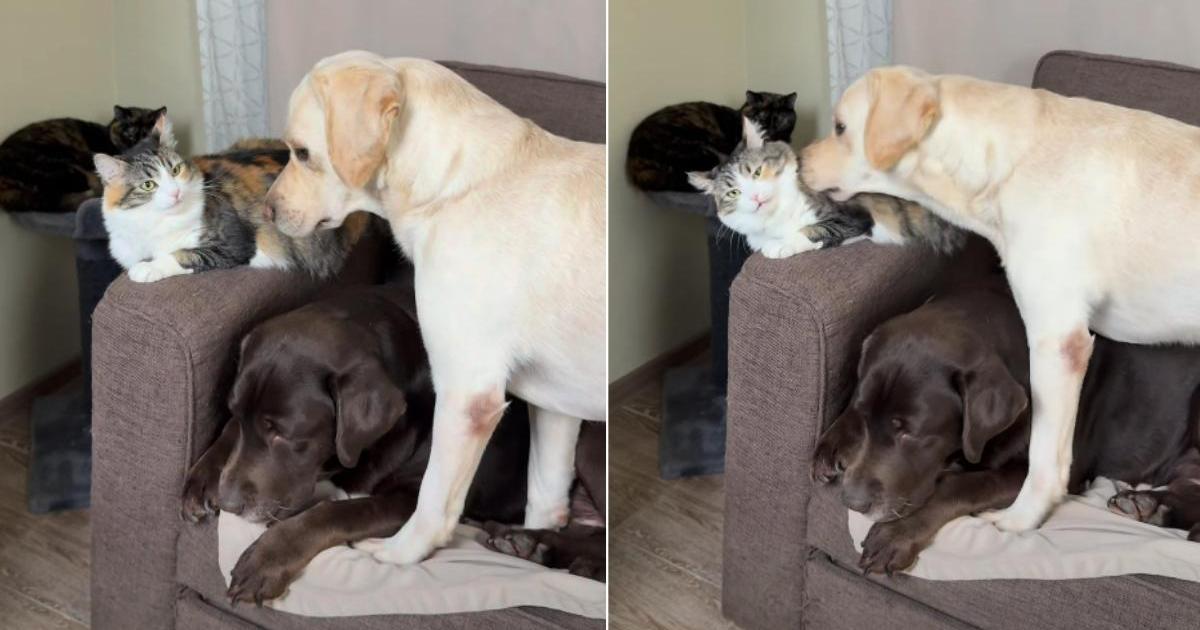
A funny pet video from an Instagram account, oskar_and_plusha shows a white Labrador testing a calico cat’s patience on a couch. The feline in the clip is Plusha. The doggo named Johnny keeps nudging her face while chocolate Labrador Oskar rests nearby.
The reel turns into a tiny living room standoff within seconds. Johnny wants attention and keeps booping. Plusha is clearly not in the mood, and the reaction makes the video even funnier.
Cat walks away after Labrador boops repeatedly
The video was posted one day ago on Instagram by oskar_and_plusha, a page for Labrador Oskar and kitten Plusha. The clip uses original audio and carries the caption, “Not in the mood…”. It has 9.5K likes and 59 comments as the engagement. The scene plays out in a living room with a couch, a cat tree, and all four pets sharing the same small space.
Labradors are usually social and physical, so Johnny’s repeated nudges fit the breed’s friendly style. Plusha, a calico cat, shows a more guarded mood here. Oskar, the chocolate Labrador, stays relaxed on the couch cushion. The black cat also remains calm on the cat tree, which makes the contrast even funnier.
The reel starts with Johnny approaching Plusha while Oskar lounges on the couch, and the black cat watches from the tree. Johnny then leans in and boops Plusha again. Plusha answers with a sharp hiss and an open-mouth warning. Johnny quickly pulls back and looks startled. He still circles back for another try, but Plusha finally leaves the couch area. In the end, Oskar and the black cat stay completely unbothered.
Fans replied fast. One wrote, “Still in training,, Johnny nudges are love hugs ????” Another said, “My poor cat probably wishes my dog would do this to her. She wants his attention and tries to get him to play with her, but he only does half the time.” A third added, “ohnny doesn’t realise it’s not a doggie it’s a cat ? he’s bit rough ????”.
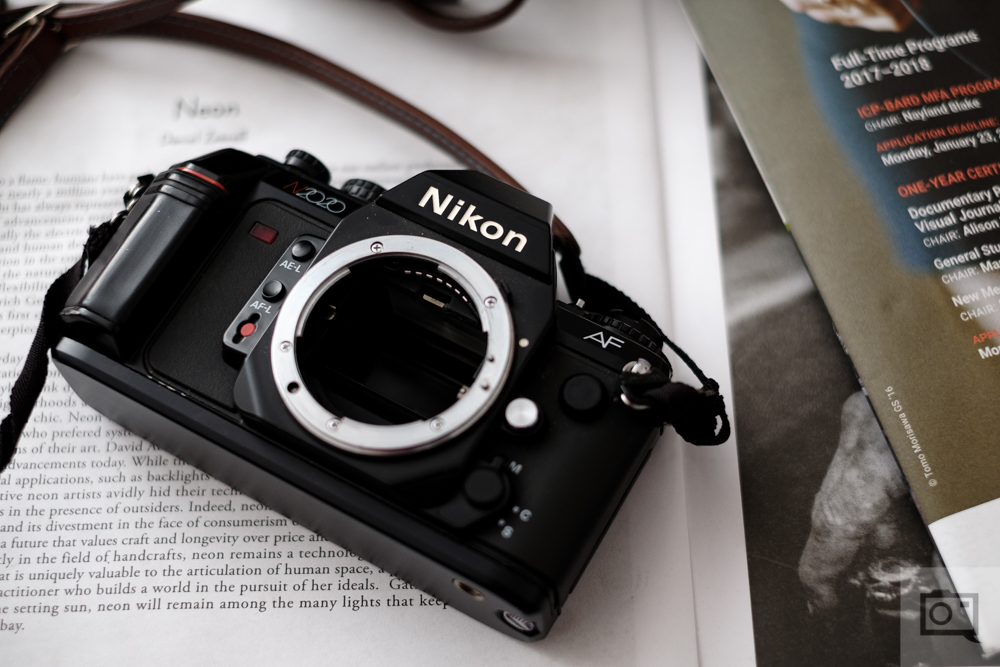
The Best Vintage Cameras Designed for Analog Lovers
Subscribe here for an ad-free experience!
We use cookies to ensure that we give you the best experience on our website. If you continue to use this site we will assume that you are happy with it.
I visited with the peach kitty, but my human didn’t get any photos of us together. (What you see above is just a frame grab from some video.) But she did get some nice portraits of the two of us separately. Well, the ones of me are nice…his are a bit on the silly side! You can see them below. (No secret messages because the photos speak for themselves.
Recent observations of the binary system AFGL 4106, obtained with the SPHERE instrument on the Very Large Telescope, provide an unusually clear look at how a stellar companion can influence circumstellar morphology. The data reveal a dusty envelope with a distinctly asymmetric structure, offering direct observational support for binary-driven shaping during late stellar evolution.
Astronomers have long suspected that many non-spherical nebulae originate from binary interaction. However, resolving the relevant spatial scales has remained difficult. Bright stellar cores often overwhelm faint surrounding dust, especially in ground-based observations. The new SPHERE data overcome many of these limitations. As a result, AFGL 4106 now serves as an important laboratory for studying how massive stars shed material in the presence of a nearby companion.
The evolutionary status of AFGL 4106
AFGL 4106 consists of two massive, evolved stars that occupy slightly different stages of late stellar evolution. Observational studies indicate that one component has already undergone substantial mass loss. The expelled material forms the dusty circumstellar envelope visible in the SPHERE image.
Massive stars enter this phase after exhausting hydrogen and helium in their cores. Radiation pressure and strong stellar winds begin to drive material away from the stellar surface. Over time, these outflows can remove a significant fraction of the star’s outer layers. The process enriches the surrounding interstellar medium with heavy elements and dust grains.
In an isolated star, the outflow often expands in an approximately spherical geometry. However, AFGL 4106 does not evolve in isolation. The companion star orbits within proximity. Its gravitational field perturbs the expanding material and alters the density distribution of the envelope.
Binary systems are common in the Milky Way. Many massive stars form and evolve in pairs. Despite this, well-resolved examples of binary-shaped dusty envelopes remain relatively rare. AFGL 4106 provides valuable observational evidence for testing theoretical models of late-stage stellar evolution.
A closer look at the binary system AFGL 4106. Credit: ESO/G. Tomassini et al.
Evidence for gravitational sculpting
The most striking feature of AFGL 4106 is the shape of its circumstellar envelope. Instead of forming a symmetric shell, the dust cloud appears elongated and slightly off-center. This departure from spherical symmetry carries important physical implications.
When stellar mass loss proceeds without external influence, the resulting envelope tends to remain roughly round. Gravity and radiation pressure act isotropically. Consequently, the density profile shows only modest variation with direction. In contrast, the envelope around AFGL 4106 exhibits a clear large-scale asymmetry.
The companion star provides the most plausible explanation. As the primary star ejects material, the secondary star exerts a continuous gravitational pull on the expanding flow. This interaction redistributes momentum within the outflow. Over time, the envelope becomes distorted and develops the observed egg-like morphology.
Such shaping mechanisms have been proposed for decades to explain the wide diversity of nebular forms observed in evolved stellar systems. Planetary nebulae, for example, frequently display elliptical geometries that simple single-star models struggle to reproduce. The AFGL 4106 observations strengthen the case that binary interaction plays a dominant role in many of these systems.
Importantly, the SPHERE data provide spatial resolution sufficient to connect the central binary directly with the surrounding structure. This link moves the discussion from theoretical speculation toward observational confirmation.
The pair of points at the centre of the image, taken with ESO’s Very Large Telescope (VLT), is an old stellar couple, a binary system officially called AFGL 4106. Credit: ESO/G. Tomassini et al.
How SPHERE and VLT made it possible
Achieving this level of detail from the ground requires advanced instrumentation. The SPHERE instrument was specifically designed for high-contrast imaging near bright stars. Although its primary science driver involves direct exoplanet detection, its capabilities also apply to circumstellar environments.
The instrument employs extreme adaptive optics to correct atmospheric turbulence in real time. Wavefront sensors continuously monitor distortions introduced by Earth’s atmosphere. Deformable mirrors then compensate for these distortions, producing a much sharper image than conventional seeing-limited observations.
In addition, SPHERE incorporates coronagraphic techniques that suppress the glare of bright stellar sources. By reducing the dynamic range between the central stars and the surrounding dust, the system allows faint structures to emerge. This combination of adaptive optics and high-contrast imaging proved essential for resolving AFGL 4106.
The observation demonstrates how modern ground-based facilities now approach space-based performance in certain regimes. The Very Large Telescope, equipped with SPHERE, can probe circumstellar environments with unprecedented clarity. As a result, systems that were once observationally inaccessible are now within reach.
A detailed view of the SPHERE optical bench is shown with the main subsystems clearly visible. SPHERE (Spectro-Polarimetric High-contrast Exoplanet REsearch) is installed on the ESO Very Large Telescope. Credit: ESO
Interpreting the dark stellar cores
The SPHERE image shows the two central stars as dark spots, which may appear counterintuitive. In reality, both stars are extremely luminous. Their apparent darkness results from detector saturation during the exposure.
When the incoming photon flux exceeds the detector’s dynamic range, the recorded signal clips at the maximum value. During subsequent image processing, this saturated region often appears artificially dark or flattened. The effect does not indicate the intrinsic faintness of the stars.
Observers deliberately accepted this saturation. Their primary scientific goal was to reveal the faint circumstellar dust rather than preserve detailed stellar profiles. Shorter exposures could have avoided saturation, but they would also have reduced sensitivity to the extended envelope. This compromise is common in high-contrast astronomy. Researchers frequently optimize exposure parameters to study faint structures near bright sources.
The Very Large Telescope at night. Credit: Y. Beletsky (LCO)/ESO
On 17 February 2026, the Sun–Moon–Earth system aligned to a precise geometric configuration that produced an annular solar eclipse. During this configuration, the apparent angular diameter of the Moon was slightly smaller than that of the Sun. As a result, the lunar disk could not fully occult the photosphere. Instead, a narrow ring of solar emission remained visible.
While the event was largely inaccessible to ground observers due to its Antarctic track, the European Space Agency’s Proba-2 spacecraft observed the eclipse under stable orbital conditions. Its extreme ultraviolet measurements now provide a scientifically valuable record of the event.
The geometry behind the February 2026 eclipse
A solar eclipse always depends on exact orbital geometry. The Moon must pass directly between Earth and the Sun. However, the visual outcome changes depending on the Moon’s distance from Earth. Because the lunar orbit is elliptical, the Moon’s apparent size varies by several percent over the course of a month.
During the February 2026 event, the Moon was positioned near apogee. Consequently, its angular diameter fell short of the Sun’s apparent size. This mismatch produced an annular eclipse rather than a total one. Observers located along the central path would have seen a bright ring of sunlight surrounding the Moon’s silhouette.
The peak annular phase occurred near 11:31 UTC. At maximum, the Moon covered roughly 96 percent of the solar diameter. Although this level of coverage is substantial, it still leaves enough photospheric light to prevent totality. Therefore, the solar corona did not become visible in white light from the ground.
Proba-2’s image during the first eclipse. Credit: ESA/Royal Observatory of Belgium
Limited Visibility from Earth
Despite the scientific interest, this eclipse offered poor viewing conditions for most of the world. The path of annularity crossed the Southern Ocean and Antarctica. Only a small number of research stations lie within the narrow zone of maximum alignment.
Outside this path, some regions in the Southern Hemisphere experienced a partial eclipse. However, large populated areas across Asia, Europe, and most of Africa saw nothing at all.
Even within Antarctica, weather and logistics posed challenges. Polar conditions often limit ground-based observations. Cloud cover, extreme cold, and limited accessibility reduce the chances of successful imaging. For these reasons, space-based observations became especially important for documenting the event.
Proba-2’s image during the second eclipse. Credit: ESA/Royal Observatory of Belgium
Proba-2 and its solar monitoring role
ESA launched Proba-2 in November 2009 to support solar research and technology demonstration. Although compact in size, the spacecraft carries a capable suite of instruments. Among them, the SWAP imager plays a central role in monitoring the Sun’s outer atmosphere.
SWAP operates at a wavelength of approximately 17.4 nanometres in the extreme ultraviolet range. This spectral region reveals plasma structures in the solar corona that remain invisible in ordinary light. Because the corona reaches temperatures exceeding one million degrees Celsius, it emits strongly in EUV wavelengths.
The spacecraft follows a sun-synchronous low-Earth orbit. This orbital configuration keeps the satellite in consistent lighting conditions while allowing frequent solar observations. Importantly, during the February 2026 eclipse, the orbit caused Proba-2 to intersect the Moon’s shadow multiple times. ESA reported four separate eclipse observations during successive passes.
This repeated sampling provided an unusually rich dataset. Instead of a single moment of alignment, scientists obtained several views under slightly different geometries. Such coverage improves both calibration and scientific interpretation.
Proba-2’s image during the third eclipse. Credit: ESA/Royal Observatory of Belgium
The eclipse as seen in extreme ultraviolet
The Proba-2 images differ markedly from familiar eclipse photographs. In visible light, annular eclipses display a bright orange or white ring. In contrast, SWAP records the Sun’s EUV emission. Therefore, the released imagery emphasizes the hot coronal plasma rather than the photosphere.
In the processed frames, the Moon appears as a sharply defined dark disk. Surrounding it, the solar atmosphere glows in structured patterns. Magnetic loops and extended coronal regions become visible with high contrast. Because the observations occur above Earth’s atmosphere, the limb definition remains exceptionally clean.
Each orbital pass shows subtle changes in alignment. In some frames, the Moon sits slightly off-center relative to the Sun. In others, the annular ring appears more symmetric. These variations arise from the spacecraft’s motion combined with the evolving Sun–Moon geometry.
From a technical standpoint, such occultation events are useful. When the Moon blocks part of the Sun, it creates a natural calibration edge. Scientists can analyze how the instrument responds to sharp intensity transitions. This helps refine image processing and radiometric accuracy.
ESA’s Proba-2 spacecraft captured the “Ring of Fire” during the annular solar eclipse from space on 17 February 2026. Credit: ESA/Royal Observatory of Belgium
Importance of space-based eclipse data
Observing eclipses from orbit offers several advantages. First, spacecraft avoid atmospheric turbulence. Ground-based solar imaging always suffers from seeing effects, even at excellent sites. In orbit, the optical path remains stable.
Second, satellites can observe continuously. They do not depend on local daylight or weather conditions. This allows multiple measurements during a single eclipse event. In the February 2026 case, Proba-2 captured four separate sequences.
Third, extreme ultraviolet imaging reveals physical processes that visible light cannot show. The photosphere dominates white-light observations. However, EUV data highlight the corona and transition region. These layers play a major role in solar activity and space weather.
Understanding coronal structure remains a key objective in solar physics. Magnetic fields shape the corona into loops and arcades. These structures store and release energy through flares and coronal mass ejections. By examining EUV brightness patterns during occultations, researchers can test models of plasma distribution and magnetic topology.
Proba-2’s image during the fourth eclipse. Credit: ESA/Royal Observatory of Belgium
A cat brought her kitten to a neighbor’s yard. Once inside, she left her son in trusted hands.
TheStrayCatClub
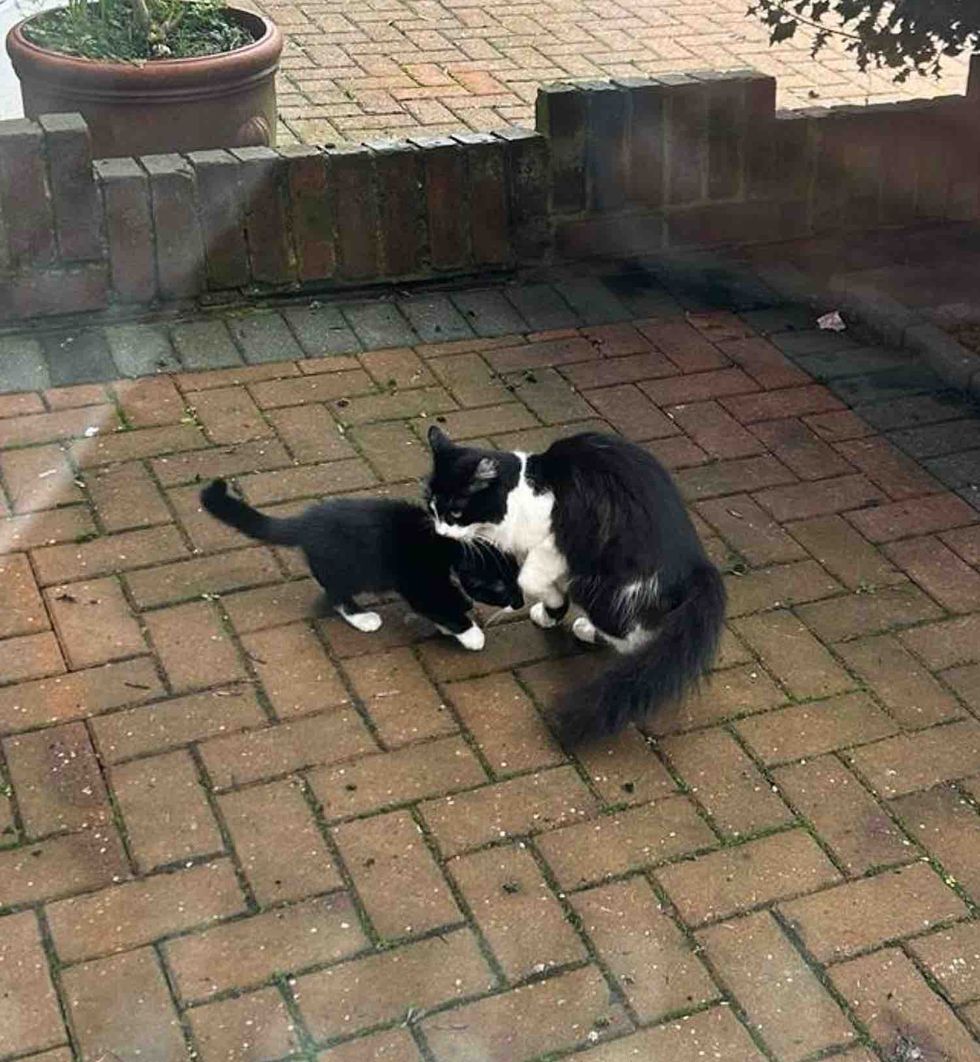
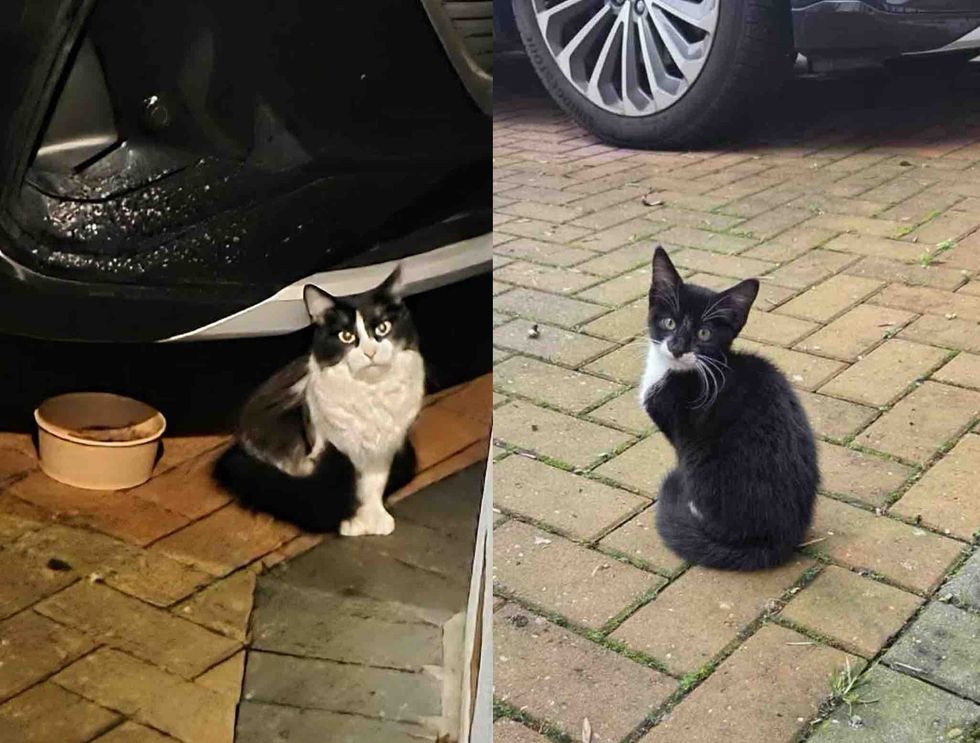
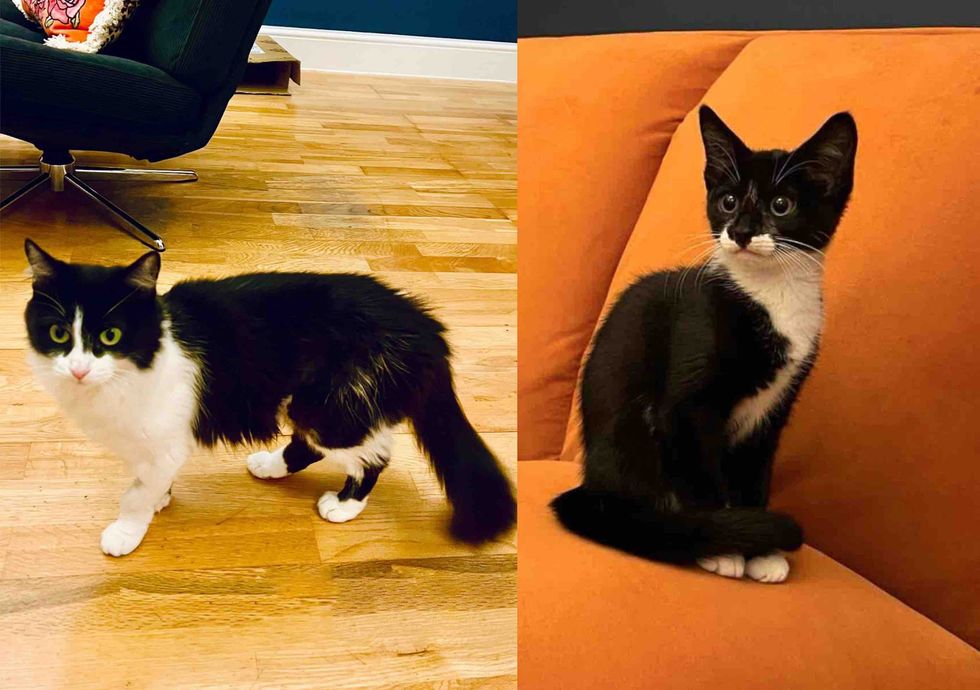
A black-and-white cat appeared outside a neighbor’s home, but she wasn’t alone. A tuxedo kitten followed behind her like a shadow.
No one knew where they had come from or how long they had been fending for themselves. Despite their circumstances, both were friendly and gentle, and it was clear they didn’t belong outside. When The Stray Cat Club, a volunteer-run rescue, learned about the duo, they stepped in to help.
The devoted mother kept a watchful eye on her son, making sure he stayed out of trouble.
TheStrayCatClub
The kitten shared his mother’s sweet nature, but life on the streets had taken its toll. He was underweight and struggling with stomach issues.
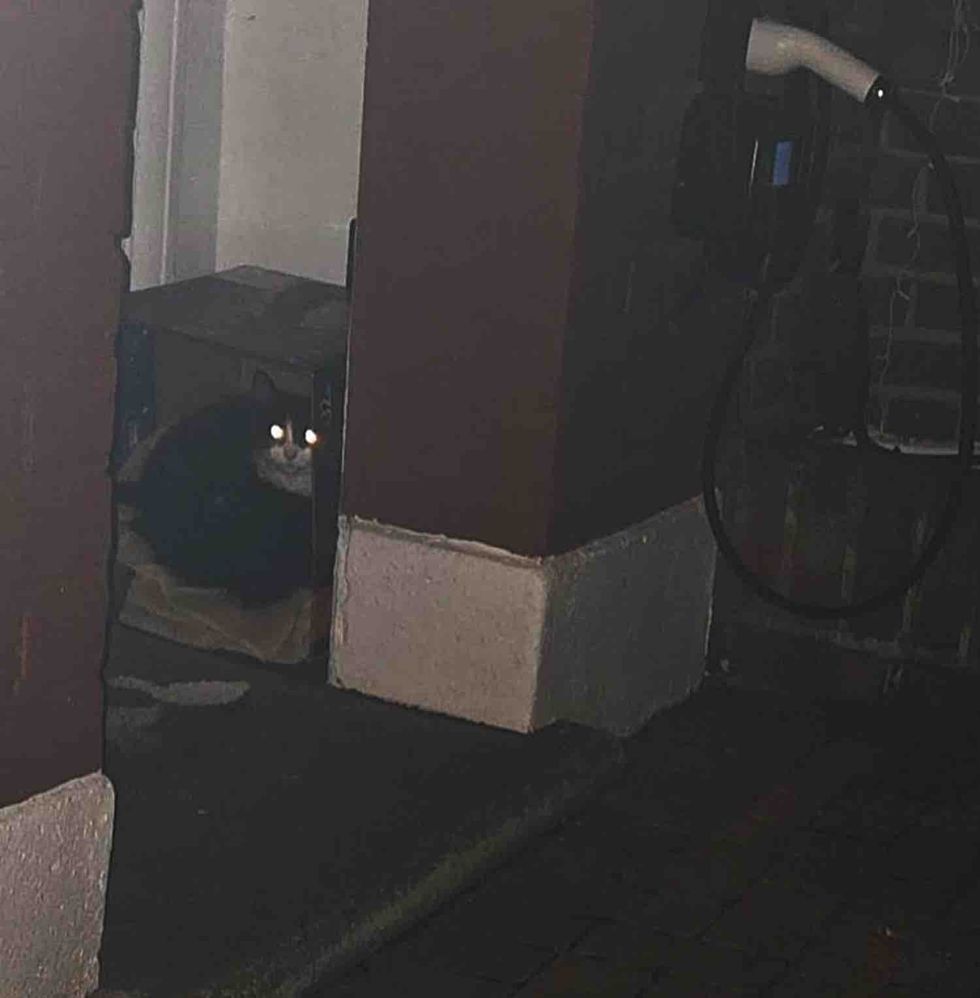
Caring neighbors provided food and built a makeshift shelter so the pair would have a place to sleep at night. As time went on, it became clear they needed more support and a real chance at a better life.
TheStrayCatClub
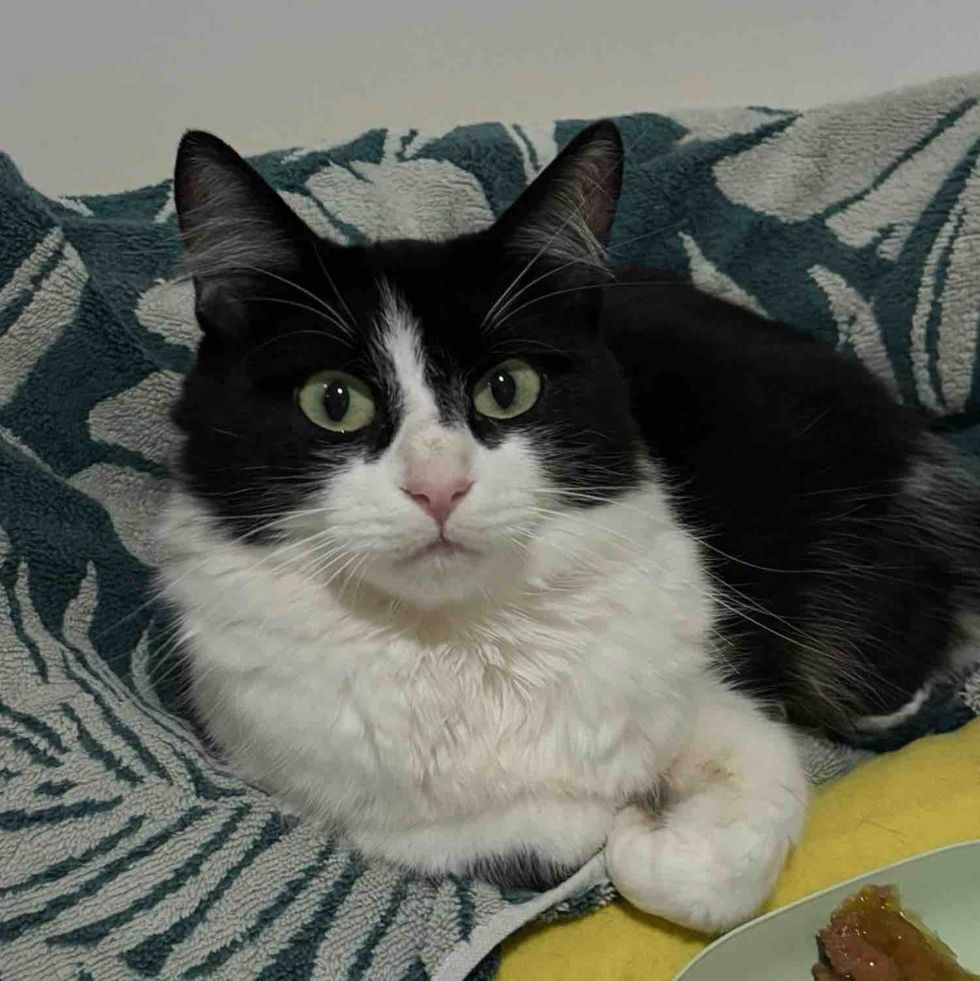
Thanks to the volunteers at The Stray Cat Club, the mother and son were brought to safety, finally leaving the streets behind. The mom, named Nettle, was understandably nervous at first, but it didn’t take long for her to come out of her shell.
“She was initially hissy, but this settled quickly once she realized she was safe: a reminder of how often fear is mistaken for temperament,” the rescue shared.
Nettle and PimentoTheStrayCatClub
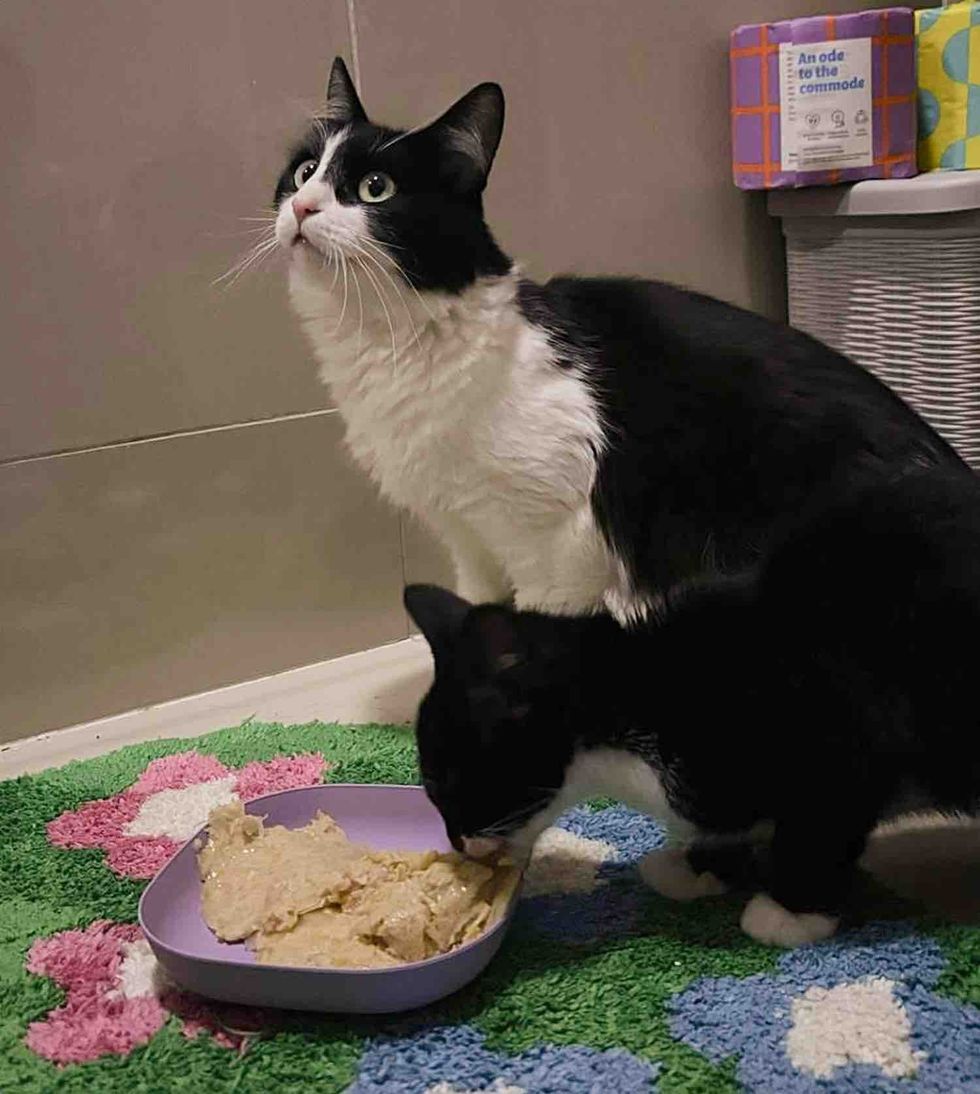
Nettle’s son, Pimento, received the medical care he urgently needed. He was treated for his upset stomach and had a tick removed. After everything he’d endured outdoors, he was thrilled to have a cozy bed to roll around in and a bottomless food bowl.
With her kitten safe and cared for, Nettle finally allowed herself to relax. She began exploring her surroundings, making herself right at home.
TheStrayCatClub
The rescue was surprised to discover that Nettle was microchipped. Unfortunately, repeated attempts to reach the registered owner went unanswered. “She was also found miles away from the address linked to her chip, leaving more questions than answers about how she ended up here.”
Whatever happened in the past, Nettle now seems content to have a roof over her head and a soft couch to call her own.
TheStrayCatClub
As Pimento grew stronger and more independent, Nettle was ready to hang up the “mom” hat for good and reclaim her spot as the center of attention. She began distancing herself from her son, leaving him in the capable hands of the foster family and turning her focus to important cat business.
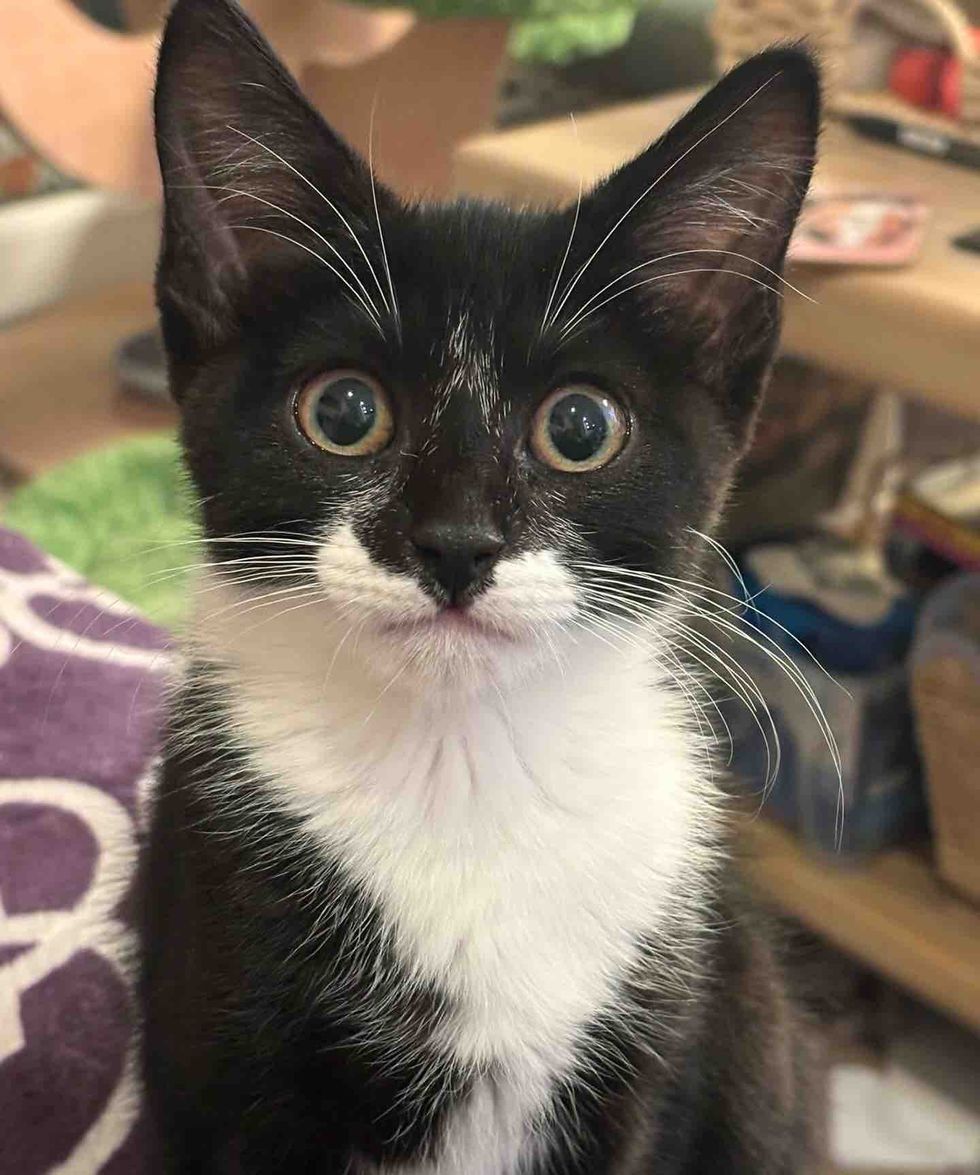
Once nursed back to health, Pimento’s energy soared. With his bold personality, he turned into a total character.
TheStrayCatClub
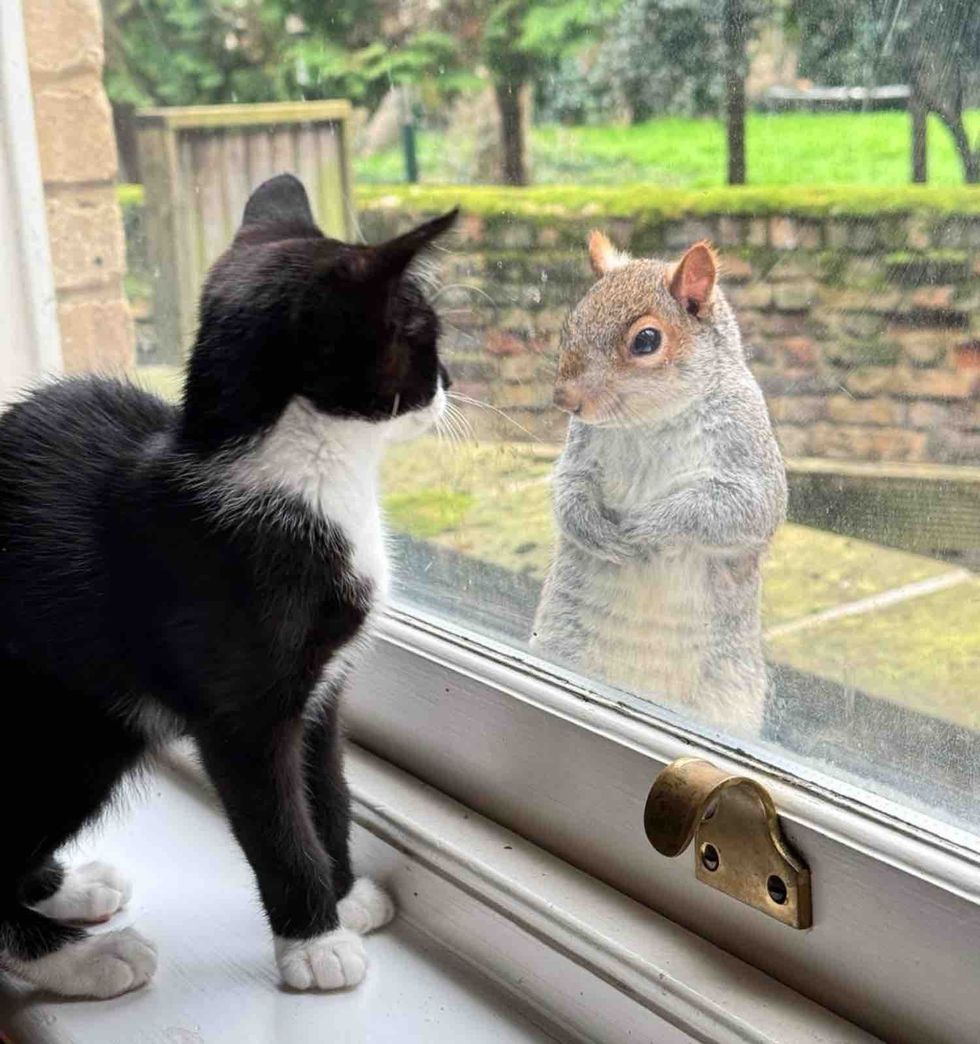
Pimento greets the world with endless curiosity, investigating every new sight, sound, and smell. He follows all the action, eager to see what everyone is up to. “His new daily routine now includes befriending the squirrel.”
The squirrel seems just as intrigued by Pimento. The two even mirror each other’s movements through the window.
TheStrayCatClub
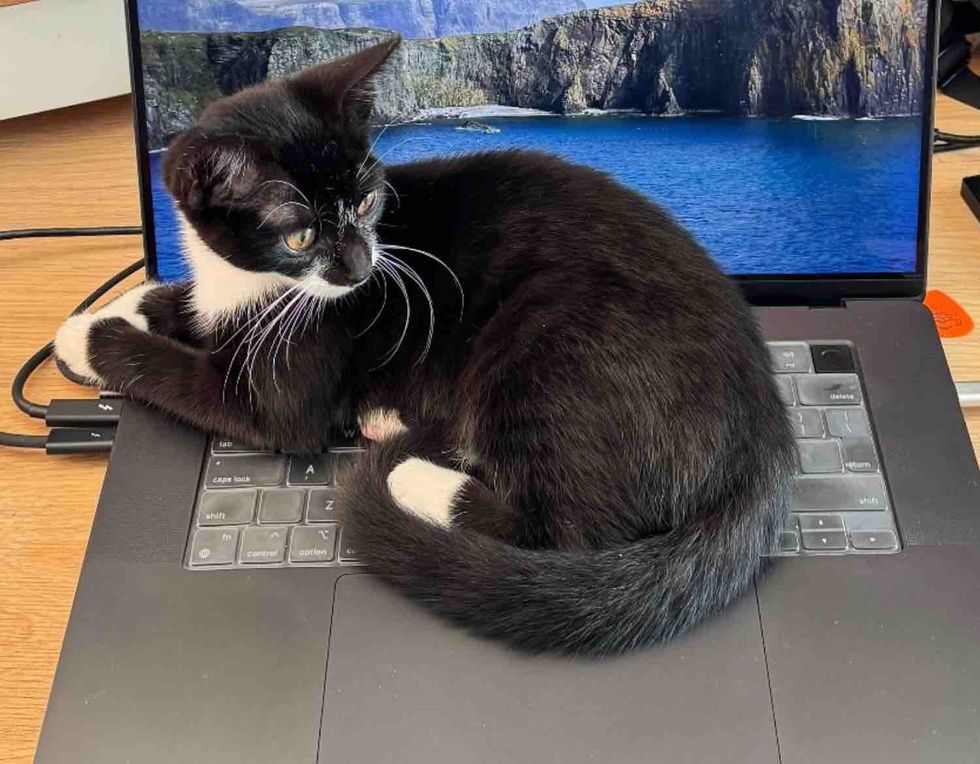
When Pimento discovered the home office, he decided it was time to “help.” He hopped onto the desk, inspected the monitors, then plopped himself squarely on the keyboard. Turning to his human, he looked perfectly pleased with himself.
“Pimento is literally work. Employee of the month?”
TheStrayCatClub
Today, Nettle and Pimento are thriving in foster care, healthy, happy, surrounded by love. Nettle is back to being herself and will never have to raise another litter. Pimento continues to charm everyone he meets with his vibrant personality, spreading joy and laughter wherever he goes.
Thanks to the kind neighbors and dedicated volunteers, Nettle and her son now have the bright future they always deserved.




 TheStrayCatClub
 TheStrayCatClub
 Nettle and PimentoTheStrayCatClub
 TheStrayCatClub
 TheStrayCatClub
 TheStrayCatClub
 TheStrayCatClub
 TheStrayCatClub
 TheStrayCatClub