The U.S. is declining, and future Gen Z leaders clearly see it. How do I know? Over the past year, I’ve had a front-row seat as a Schwarzman Scholar.
At Tsinghua University in Beijing, I recently completed a master’s degree alongside the leaders of tomorrow, many of them the children of prominent academics, business leaders and government officials, mostly from the U.S. and China.
These bright young minds include multimillion-dollar startup founders, emerging public servants and talented young scientists. Some are already operating in government, venture capital and diplomacy, and are poised to shape policy, markets and institutions in the decades ahead.
Here’s what I observed:
At the start of the program, the American students looked proud: their country, they knew, was seen as fair, forward-looking and stable.
Many non-Americans, including children of Chinese Communist Party officials, appeared envious of America’s rule-based governance versus what they were accustomed to in their own countries. To be sure, they knew the U.S. had its flaws, but they believed America represented the best the world had to offer.
Today, however, it’s clear to me that most of them are deeply skeptical of the American system as it stands.
At the start, nearly all my Chinese classmates were looking forward to graduate studies or internships in the U.S., convinced that American democratic ideals were something they could one day carry back to China. Yet as the year progressed, admiration gave way to ambivalence and, increasingly, distrust.
That shift was compounded by the Trump presidency’s attacks on America’s own leading universities, which prompted several students to decline their offers of admission, most reluctantly.
This erosion of U.S. confidence among future Chinese Gen Z leaders reached a nadir with the ICE protests in Minneapolis, the horrors of the Epstein files and the aggressive rhetoric against Greenland.
The consequences of this cognitive restructuring among global Gen Z minds can be profound if American soft power is no longer assumed and must now compete on the world stage against other liberal democracies.
The perceptions that these young people form now — about which countries are stable, fair and trustworthy — can shape decisions on trade, research collaboration and crisis co-operation, potentially for decades to come.
Meanwhile, a U.S. withdrawal from the minds of Gen Z across the world creates an opportunity for Canadian soft power. However, time is of essence. If Canada does not act, the vacuum will eventually be filled by other middle powers or even China’s own institutions.
The world is changing at lightning speed, and as Prime Minister Mark Carney said in Davos, we cannot expect the old world order to come back. It is time for Canada to realign its priorities and market itself as a strong, open and democratic alternative to Trump’s America.
One starting point would be to promote Canada to Gen Z talent across the world, especially from unexpected places like China. While human rights violations must be called out when they occur, moral clarity shouldn’t hinder strategic engagement on issues that serve Canadian interests.
Canadian universities, governments and businesses must invest astutely in building sustained institutional bridges with Chinese Gen Z, typically born between 1997 and 2012. This could be done through increased academic exchanges, joint research degree programs in areas not vital to national security, and increased cultural dialogues, where Canadian culture and values are shared.
The world is recalibrating into a new world order, and young people are seeing it with their own eyes. Moments like this do not come often, and Canada has an opportunity to play a quiet, but important role.
This, however, would require predictability, openness and the confidence to engage pragmatically while remaining principled. If we are deliberate, then we can position ourselves as a trusted reference point for a rising generation of global leaders.
The question now is not whether this realignment will occur, but whether we are prepared to act before the moment passes.
Zhida Shang is a medical student at McGill University and a 2024-2025 Schwarzman Scholar.
Related
Neal: I believed in American exceptionalism. Now, I’m not so sure
Opinion: After the U.S. booze boycott, we’re left with the hangover
The Department of Government Efficiency’s release of years of anonymous, open-source Medicaid data was hailed by former DOGE chief Elon Musk as a transparency win that will make fraud “easy to find.” But turning internet sleuthing into prosecutions could prove far harder for the Justice Department— and legally messy.
Prosecutors and privacy experts warn the leap from anonymous tips to a courtroom case runs through three choke points: patient privacy, proof standards and the uneven quality of state-reported Medicaid data.
The DOGE data will include aggregate-level information about providers, claims, and other general information, according to the Department of Health and Human Services. Senior Trump administration officials have stressed that any information released will be done in accordance with federal privacy laws, in order to avoid identifying individuals or sharing private medical information.
The release comes as the Justice Department ramps up healthcare fraud enforcement, particularly targeting schemes involving Medicaid and other taxpayer-funded programs. Its healthcare fraud “strike force” now operates across 25 federal districts and has brought charges against roughly 5,000 individuals, according to information shared with Fox News Digital.
FLORIDA EXECS SENTENCED IN $233M OBAMACARE FRAUD THAT TARGETED HOMELESS, HURRICANE VICTIMS
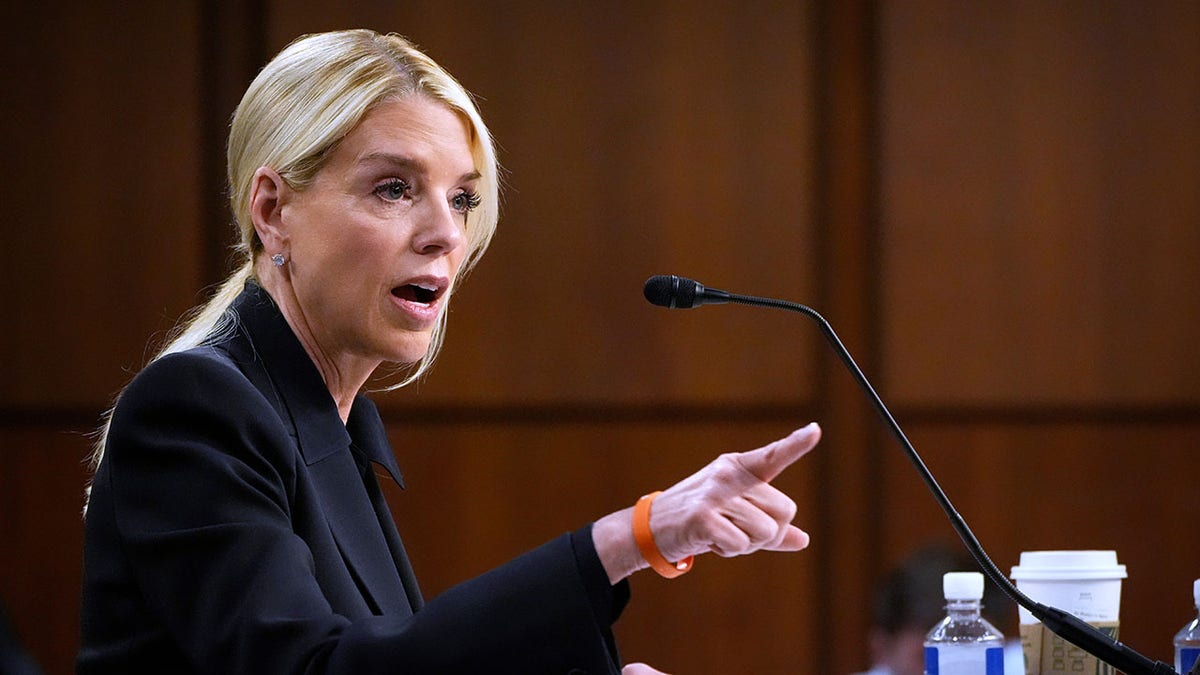
Attorney General Pam Bondi celebrated a “historic deal” with Northwestern University on Nov. 28.(AP Photo/Mark Schiefelbein)
But before the Justice Department can chase down new leads, it may have to sort through mountains of flawed data.
Information shared by DOGE in its early days may be imperfect due to its reliance on state data submitted through the Transformed Medicaid Statistical Information System, or T-MSIS — a system that has struggled with data quality and reporting issues that vary widely from state to state. The Centers for Medicare & Medicaid Services is actively working to improve state compliance.
There are open questions as to how the federal government might seek to retroactively “claw back” Medicaid reimbursements from states, in the event fraud is detected.
Others have cautioned that investigations could be hindered by new or thorny legal challenges — including privacy concerns, statute of limitations questions and evidentiary hurdles.
The emphasis on healthcare fraud reflects a broader enforcement priority for Trump and Attorney General Pam Bondi, who built her prosecutorial profile in Florida cracking down on opioids, drug trafficking, and so-called “pill mills.”
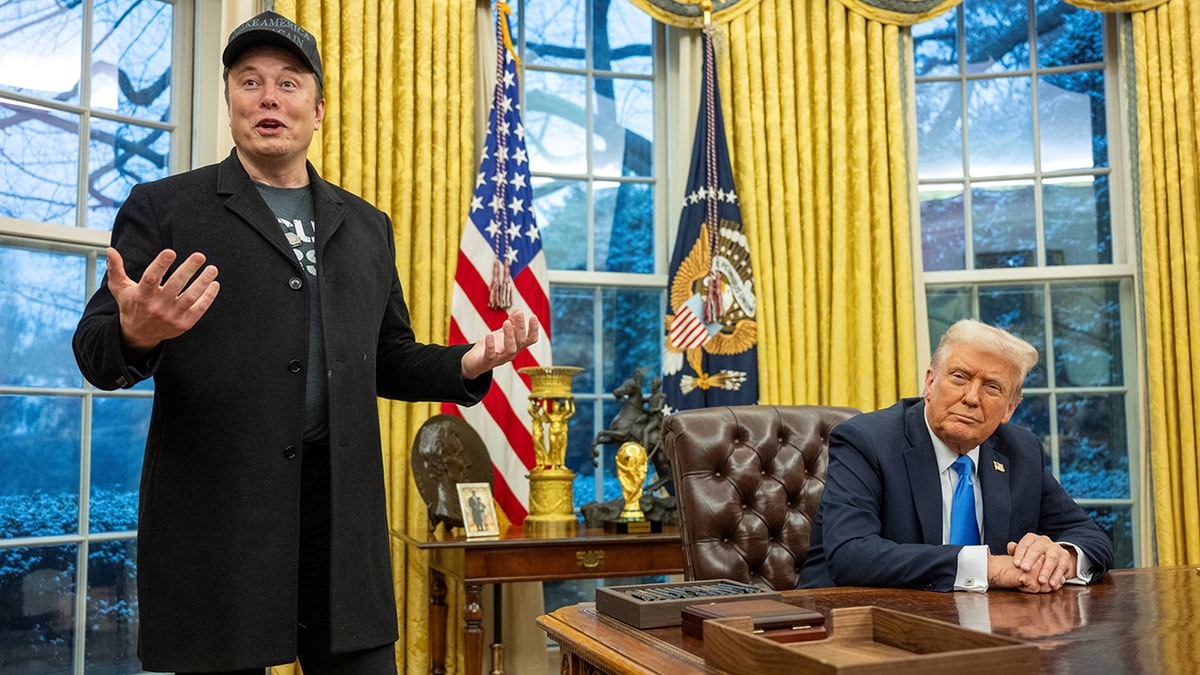
Elon Musk and President Donald Trump are seen at the Oval Office.(JIM WATSON/AFP via Getty Images)
That enforcement posture has translated into expanded resources for federal prosecutors, particularly within the Justice Department’s Health Care Fraud Unit. Formed in 2007, the unit has grown in scope and funding in recent years as officials confront increasingly complex and large-scale fraud schemes.
The unit has benefited from the creation of its data analytics team in 2017 and the newly announced healthcare fraud data “fusion center” late last year. The center draws on DOJ’s criminal and fraud divisions, the FBI and outside agencies, including HHS-OIG, to leverage cloud computing, artificial intelligence and other analytics tools to more quickly identify and prosecute sweeping healthcare fraud in the public and private sectors, at a rate and scope that would have been unimaginable just years ago.
A Justice Department official with knowledge of the unit’s operations told Fox News Digital that the effort allows prosecutors to identify so-called “outlier” providers earlier.
“It’s an area of work that’s not only reactive prosecutions — but proactive prosecutions, using data analytics,” this person said.
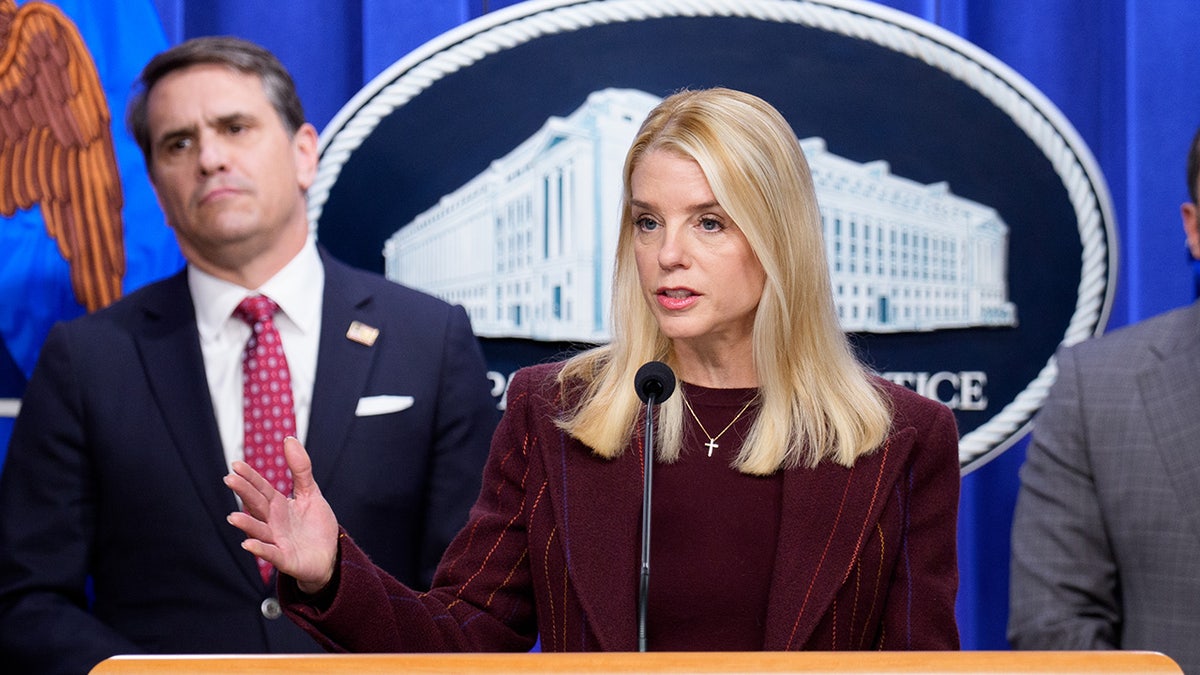
Attorney General Pam Bondi accompanied by Deputy Attorney General Todd Blanche and FBI Director Kash Pate, speaks during a news conference. (Andrew Harnik/Getty Images)
The new data analytics have been crucial to helping DOJ develop and prosecute widespread instances of healthcare fraud cases, as well as major prescription drug cases.
One official pointed to the recent conviction of a California telehealth company founder and CEO who was sentenced to 20 years in prison for illegally prescribing and distributing roughly 40 million Adderall pills, a Schedule II controlled substance, over the internet using false and fraudulent information.
The tools the Justice Department used in that case were critical in quickly identifying the $100 million scheme.
CLICK HERE TO GET THE FOX NEWS APP
The Justice Department’s Health Care Fraud Unit announced the largest-ever national healthcare fraud takedown in its history in 2025, securing an estimated $15 billion in losses and forfeitures and returning a record $560 million to the public.
Breanne Deppisch is a national politics reporter for Fox News Digital covering the Trump administration, with a focus on the Justice Department, FBI and other national news. She previously covered national politics at the Washington Examiner and The Washington Post, with additional bylines in Politico Magazine, the Colorado Gazette and others. You can send tips to Breanne at Breanne.Deppisch@fox.com, or follow her on X at @breanne_dep.
MILAN — Sidney Crosby skated Saturday morning with Team Canada, but no determination has been made yet on his status for the gold medal game Sunday against Team USA, coach Jon Cooper said.
Team Canada closed its practice to reporters, so there was no chance to see what Crosby looked like on the ice or with whom he skated with.
“I haven’t spoken to him yet,” Cooper said. “We’re gonna meet tonight and have a determination of what’s gonna happen tomorrow. He won’t put himself in harm’s way and he’s not gonna put the team in harm’s way. Obviously, we’d love to have him. That determination will be made tonight.”
Sidney Crosby was injured in the quarterfinals. REUTERS
Cooper said Crosby will not dress in a limited role, or to serve as an inspiration, a la Victor Hedman in Sweden’s quarterfinal game.
“It’s too important,” Cooper said. “We don’t want to have somebody in there as an inspiration when we could have a player that could be capable of helping. You never know if guys are gonna get hurt in the game. He wouldn’t want to do that either.”
He also fielded a question about whether it was allowed for Crosby to be behind the bench as a de facto assistant coach, saying he didn’t know, but it won’t happen.
Cooper did confirm that Canada will be without defenseman Josh Morrissey, who suffered an upper-body injury in the first game of the tournament.
2026 WINTER OLYMPICS
He deflected when asked whether Morrissey — who practiced fully before Canada’s preliminary-round finale against France and looked set to return — suffered a setback.
“Josh, in the end, he just wouldn’t be able to perform at what he could,” Cooper said. “We made the decision.”
Asked if he meant that UK and other European allies’ forces should go to safe parts of Ukraine now to “flip a switch”, he said: “Yes, I think, you know, if we are willing to do it in the context of a ceasefire, which of course puts all the initiative, all the power in Putin’s hands, why not do it now?
The audio version of this article is generated by AI-based technology. Mispronunciations can occur. We are working with our partners to continually review and improve the results.
Kevin Spofford always wanted to act, but to actually do it felt out of reach.
Then he signed up for Inclusion Yukon’s mentorAbility program.
The program facilitates short-term mentorship matches between people experiencing disabilities and employers they are interested in working with.
Spofford teamed up with the Guild Hall theatre’s artistic director Brian Fidler for a mentorship.
After getting a taste of the theatre, Spofford decided to try out for a role in The Birds, the latest play at the Guild.
“I invited him to come to the auditions,” said Fidler. “He was pretty impressive. I remember thinking, ‘did Kevin write this?'”
Spofford also impressed the director, and ended up landing a part in the play.
I felt like I had won the lottery– Kevin Spofford, Actor, The Birds
“It was like the happiest day of my life,” said Spofford. “I felt like I had won the lottery.”
Nik Potapenko is a support worker with Inclusion Yukon.
He helped connect Spofford with the Guild and Fidler.
“Kevin has always been an incredible storyteller,” said Potapenko. “Thankfully Brian was very receptive to what we do and we are incredibly grateful that he actually invited Kevin to participate as a mentee. Kevin just fell in love with it.”
Kevin Spofford (left) and Brian Fidler teamed up for a mentorship through Inclusion Yukon’s mentorability program. Soon after Spofford audtioned for a part in The Birds and landed a role. (George Maratos/CBC)
Inclusion Yukon wanted to do something to recognize Spofford’s acting debut.
On Wednesday they bought all the tickets for The Birds for clients of Inclusion Yukon and their family and friends.
The evening was catered by Bridges Cafe.
Staff with the cafe are also clients of Inclusion Yukon.
Marie Fast was one of the people to attend the special performance.
She’s a close friend of Spofford’s.
“Kevin is deserving because anybody deserves an opportunity to develop their skills,” said Fast, “Kevin just has run with it, he’s been completely committed to all his rehearsals, you can see when he’s acting he’s so into it and really intent on it. They picked a good one when they picked Kevin.”
Marie Fast is a close friend of Spofford’s. She was of the many to attend a special evening at the Guild put on by Inclusion Yukon. (Bruce De La Cruz/CBC)
As for Spofford, he says his first acting experience has gone exactly as he always hoped it would.
“I got to show them what I can do, and that I’m more than just a one-hit wonder or just a mere Canadian Tire worker who just puts on his uniform and boots and just goes to work everyday,” said Spofford.
“I’ve shown that I can be more.”
The Birds continues until February 28th at the Guild Hall.
The audio version of this article is generated by AI-based technology. Mispronunciations can occur. We are working with our partners to continually review and improve the results.
Cancer care in Nova Scotia will suffer because of staffing shortages after the province turned down a plan to train radiation therapists at Dalhousie University, says the association that represents the health-care providers.
Jennifer Carey, the Atlantic manager of the Canadian Association of Medical Radiation Technologists, says with a number of retirements looming, the lack of succession planning won’t just hurt patients, but the province’s bottom line, too.
“This will detrimentally affect access to cancer care in Nova Scotia and in Atlantic Canada. Is the current government OK with that?” Carey said.
Radiation therapists operate the equipment when cancer patients receive radiation, often seeing the patients daily during their treatment. They also provide guidance on side-effects and give emotional support.
“Cancer patients see radiation therapists more often than they see their own physicians and oncologists,” said Carey.
There are no training programs on the East Coast. Instead, people have to attend university in Ontario or further west in order to pursue the career.
10-seat program pitched for Dal
Carey said three years ago, the association started advocating for the creation of a local program to help fill gaps in Atlantic Canada.
She said Dalhousie University and the provincial departments of health and advanced education created a proposal to start a 10-seat program in 2027, but the plan was rejected by the treasury board.
The Department of Advanced Education declined an interview, but said in a statement it has to weigh competing priorities.
“We remain focused on addressing workforce gaps. Options to strengthen training capacity, such as in radiation therapy, are never off the table,” the statement said.
The treasury board said all deliberations are confidential.
Dalhousie University also sent a statement, saying work will continue between the school and the province to help create training capacity to fill gaps in the workforce.
None of them addressed the question of how much the new program would cost.
Jennifer Carey, Atlantic manager of the Canadian Association of Medical Radiation Technologists, says this was a rare opportunity where stakeholders were all on board and Nova Scotia could fix a growing health-care problem. (Submitted by Jennifer Carey)
While the program is still possible in the future, Carey is calling for urgency.
“It just seemed to me that we had all of the dots in a row,” she said. “It’s such a missed opportunity … I was extremely disheartened.”
According to the association, there are six permanent vacancies in Nova Scotia, with some short-term vacancies as well.
It says about 27 per cent of the workforce in Atlantic Canada will be eligible to retire in the next 10 years.
Carey said she’s aware of the financial pressures facing Nova Scotia, but points out that the long-term costs could be significantly worse if the province can’t find more staff.
N.L. cancer patients sent to Ontario
She used the example of Newfoundland and Labrador. Three years ago, nearly 200 cancer patients had to be sent to Ontario because of a shortage of radiation therapists.
Carey also pointed out early intervention in cancer care is cheaper, and longer wait times will cost more to treat.
“It shows the short sightedness of what a budget looks like on paper not translating it to what the long-term effects of this are going to be and not wanting to take leadership in that way,” she said.
“There are very few problems in health care that can be fixed by throwing money at it…. this is one of them.”
The audio version of this article is generated by AI-based technology. Mispronunciations can occur. We are working with our partners to continually review and improve the results.
Opposition is mounting as the provincial Progressive Conservatives seek a workaround to allow a cabinet minister to maintain his lobster fleet.
Earlier this week, it was announced the PCs intend to seek changes to the P.E.I. Conflict of Interest Act to allow Morell-Donagh MLA Sidney MacEwen to maintain the fleet while serving as minister of transportation, infrastructure and energy, and minister of housing and communities, in direct violation of the act.
In a statement Friday, P.E.I. Green Party Leader Matt MacFarlane raised concerns about the effort, and accused Premier Rob Lantz of playing “fast and loose” with provincial and national laws.
“For our new Premier to make one of his first – and one of his most important – decisions without even consulting with the very people who this decision will affect – our Island fishers – does not sit well with me,” the statement reads.
“I am concerned that Premier Lantz, while distracted for almost a year by a very contentious and close leadership race, has lost focus on what matters most: Islanders.”
P.E.I.’s Conflict of Interest Act states cabinet ministers must place business assets into a blind trust when on executive council, but Fisheries and Oceans Canada’s owner-operator policy requires MacEwen’s fishing licence stay in his name.
MacEwen has said that he plans to apply to the Department of Fisheries and Oceans to name a substitute operator for his lobster operation and that he has no intention of fishing this spring. He wants to keep the fleet’s licence in his name, and has said the act should be changed to allow him.
Process ‘bungled’
In an interview with CBC News, MacFarlane said the “whole process has been bungled.” He said whether the act should be changed is “another discussion” and admonished the premier’s previous statement about speaking “to people at the highest level of the federal government,” which he called “inappropriate.”
P.E.I. Green Party Leader Matt MacFarlane accused Premier Rob Lantz of playing “fast and loose” with provincial and national laws. (Wayne Thibodeau/CBC)
“That’s interference,” he said. “The integrity of the commercial fishery is based on the owner-operator independence and being the beneficial holders of the license. So we can’t mess with that on a whim. And I think it’s a situation where the premier and his government are in a situation of acting first and then asking for forgiveness later.”
MacFarlane also referenced opposition from the P.E.I. Fisherman’s Association, which described the appointment as “troubling” in a news release earlier this week.
“The association is and continues to be a fierce advocate for policies, regulations and laws that support independent owner operators,” it reads.
Executive director Ian MacPherson said in an interview with CBC News this week he is disappointed the association wasn’t contacted or consulted on the matter by the premier’s office.
Ian MacPherson, executive director of the PEIFA, said he was surprised the organization wasn’t consulted. (Wayne Thibodeau/CBC)
“We’ve always had good dialogue with the province,” he said.
“It’s a real concern that the premier has gone on a very specific issue that hasn’t been talked about or even mentioned to the PEIFA.… Certainly there’s going to be pushback.”
MacFarlane said he fails to see how MacEwen could hold a cabinet position and shouldn’t have been appointed in the first place, noting the Progressive Conservatives have held power for almost seven years and have had plenty of time to seek changes to the law.
MacEwen was first elected in 2015 and, due to his fishing fleet, is a first-time cabinet minister.
“They’ve had ample opportunity with their majority government to change the law to allow Sidney McEwen to come in and sit legitimately,” MacFarlane said.
“But the way they’re doing it is unethical by bringing in the federal government to create an exception for him. And they’ve got the cart before the horse on it.”
National interest
The attempted law change also saw national interest this week when Egmont MP Bobby Morrissey weighed in, saying in a statement it is “unacceptable” that the province is “attempting to interfere with the owner-operator policy.”
Egmont MP Bobby Morrissey spoke out against changes to the P.E.I. Conflict of Interest Act. (Jackie Sharkey/CBC)
“Owner-Operator rules are critical for responsible fisheries management,” the statement reads.
“They ensure that inshore fishing licences are held and operated by the people who live and work in coastal communities, keeping the economic value of our marine resources where it belongs…. Rest assured, the federal government remains committed to maintaining the integrity of the policy.”
Reached Thursday, MacEwen said he doesn’t intend to change any rules and plans to apply to the Department of Fisheries and Oceans for a substitute operator, arguing his appointment to cabinet is an “exceptional circumstance.”
LISTEN | Canadians are slowly learning what happened to friends and family in Iran:
The Current24:19Canadians desperate for information about friends and family in Iran
Late at night on Jan. 10, Dr. Alireza Golchini was arrested by security forces in the city of Qazvin, Iran.
His cousin Nima Golchini, who lives in Toronto, says Alireza was beaten up and his ribs broken in front of his wife and son.
“You’re doing your practice like anybody else and they come towards you, seven, eight people. He’s not a murderer, he is not a thief. He’s a doctor of the country. And they treated him like this,” Nima said.
For 48 hours, his family didn’t know where he had been taken.
Finally, a call came in. Alireza was in prison. “He said to family that ‘I’m alive’ and that’s it, the phone conversation disconnected,” Nima said. “It was less than a couple of seconds.”
Though his cousin has since been released pending trial, Nima is one of many Canadians who have endured long waits to learn the fate of relatives who have been arrested or gone missing in the wake of a violent crackdown on protests during which at least 7,000 people were killed, rights groups say.
Iranians took to the streets in late December, at first protesting the state of the economy. But the demonstrations evolved into a movement calling for the end of the Islamic regime. The protests spread across the country until the government cracked down in early January amid a phone and internet blackout. Earlier this week families took part in mourning ceremonies marking 40 days since thousands were killed.
Alireza Golchini has a specialty in surgical oncology. During the Women, Life, Freedom protests in 2022, he offered to treat injured protesters for free.
Golchini was barred from working in Iran’s state hospitals after he treated people who were wounded during 2022’s Women, Life, Freedom protests there. (Submitted by Nima Golchini)
He was barred from working in state hospitals after that. But that didn’t deter him from once again offering help through a post on social media during the January protests.
Nima Golchini wasn’t surprised to see his cousin’s post.
“He’s a brave man. He believes in what he has sworn, to cure the people,” Nima said.
Iran’s only official statement on the death toll was a state broadcast Jan. 21 that said 3,117 people were killed.
Nima was told that Alireza was able to treat about 45 people before he was arrested. Some had broken bones. Others had bullet wounds that needed surgery.
For those efforts, Alireza spent 22 days in jail, says Nima. The first 12 were spent in solitary confinement where Alireza was interrogated three times a day about his travels, about who he treated and why he did it for free, Nima says. After that he was put into an area with around 200 other people jailed following the protests.
He’s back at home but still awaiting his court date and worried about what sentence he might face. Meanwhile, all of his equipment and documents — including his passport — were seized and he’s not allowed to work or travel, says Nima, adding that his cousin says he’s scared about what’s next.
Hossein Raeesi, a human rights lawyer originally from Iran, lives in Canada now because his work there defending women and religious minorities made him a target for the regime.
He says he gets snippets of information from inside Iran when communications open up, and that he’s hearing many more stories of medical workers being targeted.
“They have to choose a lawyer from the list confirmed by the head of judiciary… they don’t want to allow people that …have been arrested to access to their own lawyers,” Raeesi said. “Even if you choose someone from that list, you have no chance to visit with him or her. Those lawyers also have no access to the file.”
Raeesi says Canada has a unique role as one of the world’s human-rights defenders, and could help to establish a special international criminal court to hold the Iranian regime accountable.
In a rally at in Vancouver’s David Lam Park, many protesters held photos of those killed during Iran’s crackdown against anti-government protests. (CBC)
Canadians ask for response from government, international community
Nima Golchini joined hundreds of thousands of others on the streets of Toronto on Feb. 14 calling on the Canadian and international governments to step in and help the people of Iran.
“The help that we want is not just empty words like condemning this brutal massacre. Do something about it.”
CBC asked Global Affairs Canada whether it supports regime change in Iran. In an email it didn’t answer that question directly but did state, among other things, that Canada “strongly condemns the killing of protestors, the use of violence, arbitrary arrests, and intimidation tactics by the Iranian regime against its own people.”
The late Ehsan Afshari, who went missing during protests in Tehran before his mother found his remains at a morgue, is depicted in a selfie at left and with his young son at right. (Submitted by Leila Afshari)
Leila Afshari joined protests in Vancouver, and is clear on the help she’s hoping will come soon.
“I’m waiting, counting, when Trump is gonna attack this government because it’s the only way.” she says. “My country is not gonna be free. There has to be an end to this regime.”
U.S. President Donald Trump has hinted that he could take military action against Iran if the negotiations happening now about Iran’s nuclear program aren’t productive.
It’s personal for Afshari, because her brother Ehsan Afshari went missing after joining the protests on Jan. 8.
“My parents, they keep calling my brother. After 9:30 p.m., his phone was shut, and they didn’t reach him anymore,” Afshari said.
He was missing for 12 days. Finally their mother found him at the Kahrizak, a makeshift morgue.
Afshari says he had two bullets in his stomach and his face and body were badly bruised.
“Just they identified him by this tattoo on his arm,” Afshari said through tears.
Leila Afshari, who lives in North Vancouver, lost her brother Ehsan Afshari during the crackdown on protesters in Iran that has taken the lives of at least 7,000 people, with 12,000 other deaths under review. (Elizabeth Hoath/CBC)
‘He wasn’t afraid to speak up’
Ehsan had a history of activism. In 2009, he made a music video as a tribute to Neda Agha Sultan, who was shot that year at a protest in Tehran and whose name became synonymous with the protest movement.
“He wasn’t afraid to speak up,” Afshari said. “He was really brave.”
But the video put him in danger so he went to live in Sweden.
“After 16 years he was really homesick and he just wanted to visit my parents,” Afshari said.
WATCH | Rally in Toronto in support of Iran protests:
An estimated 350,000 people rally in Toronto in support of Iran protests, police say
Hundreds of thousands of people filled the streets in Toronto on Saturday as part of a ‘Global Day of Action’ against the Iranian regime. The protesters called on the Canadian government to recognize Iran’s exiled crown prince, Reza Pahlavi, as the leader of Iran’s democratic transition after anti-government protests erupted in Iran at the end of last year.
That’s why he was in Iran this January when the protests were growing. Afshari says she wasn’t surprised he joined in.
“He is always thinking that maybe that kind of stuff will help our country become free.”
“I don’t know how he’s been killed, tortured…,” Afshari said. “There is no truth coming from that government. It’s a big mystery.”
Until regime change happens, she says she doesn’t even want to have a funeral for her brother.
“I’m just waiting. I am hoping very soon, praying for this government to collapse,” she said. “After that, maybe I could say goodbye to my brother.”
The audio version of this article is generated by AI-based technology. Mispronunciations can occur. We are working with our partners to continually review and improve the results.
A Kamloops, B.C., couple has 3D printed a feeding stand to help a foster kitten that has a unique medical condition.
Piglet the kitten, who is five months old, is being fostered by Angela and Jason Lyall. When they first got her at two days old, she couldn’t eat properly, they said.
“Even as a bottle baby she couldn’t suckle properly. She stayed tiny and didn’t gain like the others,” Angela told CBC News.
Piglet was part of a litter, along with her mother, and had been fostered from local rescue Sammy’s Forgotten Felines.
Piglet the kitten was thought to be lethargic — but it turned out she was malnourished. (Diego Machado/CBC)
As the days went on, she developed pneumonia. Angela said that euthanizing the tiny black kitten was a serious consideration.
But after some veterinary tests, it was determined she likely had megaesophagus — a condition which means the tube that moves food down to her stomach normally doesn’t work as well, according to the couple.
“If she eats like a normal kitten, the food can come back up. The biggest risk is that she could inhale it into her lungs,” Angela said.
This image of a vertical cat feeder was taken from an online 3D printing template website. Jason Lyall said he modified it slightly to make it work for Piglet. (Christopher Leinbach/Makerworld)
That’s when they 3D printed a unique vertical feeding stand, something Jason said he designed based on a template released for free on the internet.
“We thought she was just a lethargic little kitten, and it turns out that she was really sick and really malnourished,” Jason said.
“So, once she started feeding regularly and actually getting nutrition into her, her fur grew in properly. She’s starting to bulk up.”
A social media video of Piglet’s feeder went viral, with over a million views, after Angela posted a video to Sammy’s Forgotten Felines’s account.
She said she hopes Piglet’s experience serves as an educational one for other cat owners, saying the megaesophagus condition is rarer in cats compared to dogs, who can use a device called a Bailey chair to help them eat.
The vertical feeding stand can be modified and changed, so the couple says they can adapt to Piglet growing up.
Angela says that the kitten has to be fed five times a day and then held upright after her meals for 15 minutes — something she described as a “full family effort.”
“There were times where we didn’t know if she was going to make it, but she’s worth it,” she said.
“Watching her finally thrive has been incredible, and we’re just grateful that she’s still here.”





; "As Iranian Canadians mark 40 days of mourning, fate of some loved ones still unknown | CBC Radio")


