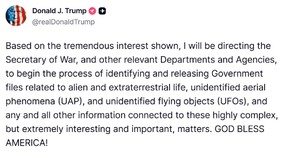
U.S. President Donald Trump directed the Pentagon and other government agencies to release files on aliens and UFOs due to “tremendous interest” after earlier saying that doing so might get former president Barack Obama “out of trouble.”
Trump posted the edict on his Truth Social account Thursday night after accusing Obama of leaking “classified information” during a podcast appearance where he suggested extraterrestrials were real.
Article content
Obama later walked back his comments, saying that he had not seen evidence of first contact but that “statistically the universe is so vast that the odds are good there’s life out there.”
Article content
Peter Doocy from Fox News asked President Trump about the comments former President Obama made about aliens being real. Here’s the exchange. pic.twitter.com/0VhrSLvYwT
“Well, he gave classified information; he’s not supposed to be doing that,” Trump told reporters on Air Force One when asked about Obama’s comments. “I don’t know if they’re real or not, but he gave classified information … he made a big mistake.
“I don’t have an opinion on it. I don’t talk about it. A lot of people do. A lot of people believe it.”
A Truth Social post by Donald Trump.Photo by Donald Trump /Truth Social
‘Highly complex’ subject
Trump later added that “maybe I’ll get him (Obama) out of trouble. I’ll get him out of trouble by declassifying.”
The president later posted on social media that he was directing the Department of War and “other relevant departments and agencies” to release files related to aliens, extraterrestrial life, unidentified aerial phenomena and UFOs, calling them “highly complex, but extremely interesting and important matters.”
Article content
The announcement came after Trump’s daughter-in-law Lara Trump suggested on another podcast earlier this week that the president planned to speak on the topic and had a speech prepared on aliens that he would give at the “right time.”
Her comments caught the White House off guard, according to The Associated Press, with Press Secretary Karoline Leavitt responding with a laugh on Wednesday when she was asked about the possibility of such a speech.
RECOMMENDED VIDEO
We apologize, but this video has failed to load.
White House caught off guard
“A speech on aliens would be news to me,” she told reporters, via The Associated Press.
Public interest in UFOs and the possibility of the government covering up secrets about extraterrestrial life re-emerged after a group of former Pentagon and government officials leaked navy videos of unknown objects to the New York Times and Politico in 2017.
The renewed scrutiny prompted Congress to hold the first hearings on UFOs in 50 years in May 2022, though officials said that the objects, which appeared to be green triangles floating above a navy ship, were likely drones.
Since then, the Pentagon has promised more transparency on the topic and in July 2022 created the All-Domain Anomaly Resolution Office to collect reports of all military UFO encounters.
The women’s winter warming shelter on Avenue C that opened late last year may see a new location.
Concerns about the close proximity to the Salvation Army Men’s Emergency Shelter have kept the city looking for another location, worried about the congregation of people.
A new location, 130 Idylwyld Drive North, has been proposed to city council as a new drop-in centre.
“It has been a challenge over the years to find locations. The city only really got into this in the last few years,” said Lesley Anderson, director of planning development for the City of Saskatoon.
“And these types of facilities do generate quite a bit of interest and feedback from adjacent landowners, so we’ve been working through that, and we know there’s challenges with every location.”
Story continues below advertisement
The proposed long-term location is looking to have distinct spaces for both men and woman.
Get breaking National news
For news impacting Canada and around the world, sign up for breaking news alerts delivered directly to you when they happen.
Existing funding from the federal government would go into purchasing the building with money from the city to renovate it.
Tribal Chief Mark Arcand of the Saskatoon Tribal Council says more services are needed in the new building compared to the resources they had in the previous Avenue C building.
“Showers are really important, proper bathrooms, you now, so we can actually monitor what’s going in there because again, we have some people that are still breaking the rules and sneaking in, you know, addiction situations,” Arcand said.
The new location is close to other service organizations like Big Brothers and Big Sisters, as well as The Friendship Centre.
Arcand says he isn’t concerned about moving the concentration of people as those nearby services aren’t dealing with the same challenges in homelessness, and they may help people attending the drop-in shelter.
Trending Now
Former prince Andrew arrested on suspicion of misconduct in public office
‘No reason to continue discussing’: Ontario mayor wants Andrew’s name dropped
“They’re running programs and services. I think what it’ll do is potentially support this opportunity. So it’s easier access, I’ll say, for them to go on … over to the Friendship Centre and … access some of their services, whether it’s an AA meeting or whatever they’ve got going on,” said Arcand.
If the city decides to go through with the purchase, the Idylwyld location is set to open in November, but Arcand is pushing to have it open sooner to be prepared for cold temperatures.
Story continues below advertisement
As for the Avenue C location, Arcand says that instead of closing it, he would like to see it used as a backup winter shelter, since a lot of money and resources have already gone into the building.
Talks will continue in the next city council meeting on Feb. 25th.
Watch above for more on the proposed drop-in shelter.
Secretary Rubio’s Meeting with Indonesian Foreign Minister Sugiono
Readout
February 19, 2026
The below is attributable to Principal Deputy Spokesperson Tommy Pigott:
Secretary of State Marco Rubio met with Indonesian Foreign Minister Sugiono today in Washington, D.C. Secretary Rubio and Foreign Minister Sugiono affirmed the contribution of our Comprehensive Strategic Partnership to a secure and prosperous Indo-Pacific region and recommitted to deepening mutually beneficial economic and security cooperation. The Secretary also expressed gratitude to the Foreign Minister for Indonesia’s support for the Board of Peace as a founding member, as well as for its commitment to post-conflict reconstruction in Gaza.
Alberta Premier Danielle Smith says out-of-control immigration levels are overwhelming the province’s core social services and has announced a referendum will take place nine months from now, asking residents to weigh in on nine questions addressing both that and possible changes to Canada’s Constitution.
(Scroll down to see the questions)
In a televised speech Thursday night, Smith said the Oct. 19, provincial referendum will be primarily focused on finding out how Albertans want the government to “deal with the issue of immigration, as well as steps we can take as a province to strengthen our constitutional and fiscal position within a united Canada.”
Smith said the changes her UCP government has determined the province needs to make to immigration are a significant departure from the status quo.
“These were far and away the issues most strongly identified by Albertans during last year’s Alberta Next panel town halls and online submissions, and in my view, it is time to act on them,” Smith said in a 13-minute televised speech that the government paid to air during the 6 p.m. primetime news hour.
Story continues below advertisement
“The fact is, Alberta taxpayers can no longer be asked to continue to subsidize the entire country through equalization and federal transfers, permit the federal government to flood our borders with new arrivals, and then give free access to our most-generous-in-the-country social programs to anyone who moves here,” Smith said.
The premier noted the province will be unveiling a large deficit in next week’s budget and lower oil prices have contributed to less revenue.
According to the Alberta government, each $1 drop in the price of oil means roughly $750 million fewer royalties for the province.
However, Smith said social services costs going to more new residents is making Alberta’s budget woes even worse.
“This is not only grossly unfair to Alberta taxpayers, but also financially crippling and undercuts the quality of our health care, education and other social services.”
Mount Royal political scientist Lori Williams challenges that assertion.
“To suggest that this budget deficit is primarily caused by immigration — that non-citizens who come to Alberta are filling emergency rooms and classrooms and that’s where problems coming from — it creates, I think, a distorted picture of what’s actually going on,” Williams said after Smith’s speech aired.
Danielle Smith has been Alberta premier since 2022 and Williams believes Thursday’s speech aimed to redirect public attention away from the province.
Story continues below advertisement
“People are concerned very much about affordability, they’re concerned about health care, and they are concerned about education. And the government has invested in some areas, has been addressing some of the problems that have been raised — but they persist.”
“People, when a government has been in power for years, start to notice if promises aren’t fulfilled. They start ask questions and they start make more demands of a government.”
Danielle Smith launches Alberta Next panel to boost provincial autonomy
Bradley Lafortune, executive director of Public Interest Alberta, said a bad news budget is not unheard of in a province that gleans so much of its income from oil and gas royalties.
“That’s nothing new in Alberta. But what is new, I think — at least with this degree of focus and tone — is the shift in blame towards immigration and newcomers,” he said after listening to the speech.
Story continues below advertisement
“Fundamentally, this is a Trump-style, MAGA government that is doing their best to imitate the current Republicans in the United States,” Lafortune said.
“And what that means is blaming newcomers, cutting services, reducing taxes, and then telling everyone that we need to do more with less, at the same time as friends and insiders are receiving massive amounts of grift on the public dollar.”
Lafortune thinks Albertans should prepare for a “very bad budget” next Thursday that he predicts will contain more cuts to frontline services and the administration of them.
“What I mean by bad is it’s going to be bad for Albertans, working middle-class Albertans. I think its gonna be very bad.”
Smith said in the short-term, the government will not be implementing drastic cuts in the 2026 budget but will instead be cutting unnecessary bureaucracy, improving efficiencies in program delivery (such as more income testing for social programs) and prioritizing needs before wants as much as possible.
Get daily National news
Get the day’s top news, political, economic, and current affairs headlines, delivered to your inbox once a day.
“The approved wage increases for our doctors, nurses, and teachers will remain in place so we can continue to attract the skilled professionals needed to catch up with our growth,” Smith said.
Challenges arise as Alberta’s population keeps booming
Story continues below advertisement
According to Statistics Canada, Alberta’s population surged by 202,324 residents in 2023. That’s the largest annual increase in the province’s history, the equivalent of 550 people moving to Alberta every day.
While the bulk of the growth came from international migration, Alberta also shattered a national record for interprovincial migration, most of whom came from Ontario and B.C.
The province’s population growth peaked in the third quarter of 2023, with it dropping off significantly in 2024 and 2025, according to the most recent Statistics Canada data.
“I think the federal government started realizing that they’ve been pushing too strongly on the population growth through different types of migration, international migration,” Carleton University economics professor Christopher Worswick said of the decline that began in 2024.
“So we saw caps on the number of international students coming in. I think that needed to be done because the program was growing just way too fast.”
Premier Smith blames the former Justin Trudeau Liberal government for Alberta’s population woes, saying over five years almost 600,000 people moved to Alberta, pushing the population over five million people.
“Ottawa throttled our most important job creating industries and prioritized immigration away from economic migrants and instead focused on international students, temporary workers and asylum seekers,” Smith said.
“Although sustainable immigration has always been an important part of our provincial growth model, throwing the doors wide open to anyone and everyone across the globe has flooded our classrooms, emergency rooms and social support systems with far too many people, far too quickly,” Smith said.
Overcrowded classrooms and a strained health-care system has been a documented issue in Alberta for well over a decade and Williams said blaming it on newer residents is a deflexion of responsibility.
“There’s no question that we have seen very large numbers of newcomers to Alberta. Part of that is because the Alberta government has invited people, citizens of Canada to come here and to work in Alberta.
“To somehow suggest that the problem has been created by immigration — as if these problems didn’t exist before those immigration numbers ticked up — I think is inaccurate.”
She fears it will create strife and inflame racial tensions.
“I think that impression is potentially quite problematic, particularly for those who are already struggling with people’s hostility toward them.”
Alberta is calling, but migration speed sparks affordability concerns
The October referendum, a year before the province’s scheduled general election, could be even longer.
Story continues below advertisement
Last year, Smith promised a referendum on separation in 2026 if citizens gathered the required number of signatures on a petition.
One citizen-led petition to be put to lawmakers this spring could lead to a referendum vote on making it a provincial policy that Alberta stay in Canada.
Another petition effort, with a deadline for signatures in early May, seeks a referendum question about pulling the province out of Confederation.
Smith said Thursday that strengthening Alberta’s “constitutional and fiscal position within a united Canada” and immigration were the biggest issues her Alberta Next panel heard as it toured the province last year.
Trending Now
Real Canadian Superstore fined for ‘misleading’ Product of Canada displays
Former prince Andrew arrested on suspicion of misconduct in public office
One of the issues tabled for debate was whether Alberta should withhold social services from some immigrants. The panel was propped up by calls from in-person attendees who at times called for mass deportations.
In January, Smith’s United Conservative Party government walked back what it called a “premature” decision to cut off temporary foreign workers from provincial health-care coverage, including those who had already obtained work permits.
The ministry in charge said, at the time, the move was on pause pending review.
On Wednesday, Smith’s chief of staff, Rob Anderson, reposted a social media infographic about immigration numbers and invited readers to watch the premier’s televised address.
Story continues below advertisement
“This absolute insanity needs to stop. It will,” he wrote.
Premier Danielle Smith staffer under fire for immigration comments
“Does their contempt for Canada’s core values and traditions drive them to flood our borders with millions from societies not built on the same foundations that have made us thrive?” McAllister said on X.
“Why import from nations with failed systems when our Judeo-Christian heritage and principles have worked so well here? It almost feels like these elites are ashamed of what built this great country.”
The people orchestrating this reckless, unsustainable mass immigration into Canada fill me with profound disgust. To deliberately engineer and champion such explosive, unmanageable population growth in your own nation? That’s the height of civic irresponsibility. Was it fueled by… https://t.co/2GBxx9s0Ne
Smith was asked Wednesday if her government shared McAllister’s values. She didn’t directly answer but said western society is based on “the Socratic Judeo-Christian tradition.”
“However, Alberta was also created since 1905 based on the immense diaspora communities that come here,” she said.
She said the federal government has made changes to refocus on economic migrants and that the previous system “broke.”
“It was the No. 1 issue that we heard,” she said, referring to the Alberta Next panel.
As it stands right now, the referendum in October will ask Albertans nine questions concerning immigration and the Constitution:
Immigration
1. Do you support the Government of Alberta taking increased control over immigration for the purposes of decreasing immigration to more sustainable levels, prioritizing economic migration and giving Albertans first priority on new employment opportunities?
2. Do you support the Government of Alberta introducing a law mandating that only Canadian citizens, permanent residents and individuals with an Alberta-approved immigration status will be eligible for provincially-funded programs, such as health care, education and other social services?
3. Assuming that all Canadian citizens and permanent residents continue to qualify for social support programs as they do now, do you support the Government of Alberta introducing a law requiring all individuals with a non-permanent legal immigration status to reside in Alberta for at least 12 months before qualifying for any provincially-funded social support programs?
Story continues below advertisement
4. Assuming that all Canadian citizens and permanent residents continue to qualify for public health care and education as they do now, do you support the Government of Alberta charging a reasonable fee or premium to individuals with a non-permanent immigration status living in Alberta for their and their family’s use of the healthcare and education systems?
5. Do you support the Government of Alberta introducing a law requiring individuals to provide proof of citizenship, such as a passport, birth certificate, or citizenship card, to vote in an Alberta provincial election?
Constitution
6. Do you support the Government of Alberta working with the governments of other willing provinces to amend the Canadian Constitution to have provincial governments, and not the federal government, select the justices appointed to provincial King’s Bench and Appeal courts?
Alberta premier demands more say in federal judicial appointments
7. Do you support the Government of Alberta working with the governments of other willing provinces to amend the Canadian Constitution to abolish the unelected federal Senate?
Story continues below advertisement
8. Do you support the Government of Alberta working with the governments of other willing provinces to amend the Canadian Constitution to allow provinces to opt out of federal programs that intrude on provincial jurisdiction such as health care, education, and social services, without a province losing any of the associated federal funding for use in its social programs?
9. Do you support the Government of Alberta working with the governments of other willing provinces to amend the Canadian Constitution to better protect provincial rights from federal interference by giving a province’s laws dealing with provincial or shared areas of constitutional jurisdiction priority over federal laws when the province’s laws and federal laws conflict?
***THE DAILY PUBLIC SCHEDULE IS SUBJECT TO CHANGE***
SECRETARY MARCO RUBIO
11:00 a.m. Secretary Rubio meets with UK Foreign Secretary Yvette Cooper at the Department of State. (CAMERA SPRAY AT TOP) Call time for video cameras, still cameras, and writers is 10:15 a.m. from the 23rd Street entrance.
DEPUTY SECRETARY OF STATE CHRISTOPHER LANDAU
Deputy Secretary Landau is on travel to Hawaii, Tonga, Fiji, and Samoa from February 22-March 2, 2026.
DEPUTY SECRETARY OF STATE FOR MANAGEMENT AND RESOURCES MICHAEL J. RIGAS
Deputy Secretary Rigas attends meetings and briefings at the Department of State.
UNDER SECRETARY FOR POLITICAL AFFAIRS ALLISON M. HOOKER
11:00 a.m. Under Secretary Hooker joins Secretary Rubio’s meeting with UK Foreign Secretary Yvette Cooper at the Department of State.
UNDER SECRETARY FOR ECONOMIC AFFAIRS JACOB HELBERG
Under Secretary Helberg is on travel to India from February 20-21, 2026.
UNDER SECRETARY FOR ARMS CONTROL AND INTERNATIONAL SECURITY THOMAS G. DINANNO
1:00 p.m. Under Secretary DiNanno meets with Panamanian Environment Minister Juan Carlos Navarro at the Department of State. (CLOSED PRESS COVERAGE)
3:20 p.m. Under Secretary DiNanno meets with UK Minister of State for Europe, North America, and Overseas Territories Stephen Doughty at the Department of State. (CLOSED PRESS COVERAGE)
ASSISTANT SECRETARY FOR DEMOCRACY, HUMAN RIGHTS, AND LABOR RILEY M. BARNES
2:40 p.m. Assistant Secretary Barnes meets with UK Minister of State for Europe, North America, and Overseas Territories Stephen Doughty at the Department of State. (CLOSED PRESS COVERAGE)
SENIOR BUREAU OFFICIAL FOR EUROPEAN AND EURASIAN AFFAIRS BRENDAN P. HANRAHAN
11:00 a.m. Senior Bureau Official Hanrahan joins Secretary Rubio’s meeting with UK Foreign Secretary Yvette Cooper at the Department of State.
The Department of State has taken steps to impose visa restrictions on individuals in Uzbekistan identified as knowingly facilitating illegal immigration to our nation. This action applies to executives and senior officials at two Uzbekistan-based visa facilitation companies who knowingly provided travel services designed primarily for aliens intending to illegally immigrate to the United States. These actions are taken under Section 212(a)(3)(C) of the Immigration and Nationality Act (INA), which generally bars entry to those whose entry or proposed activities would have potentially serious adverse U.S. foreign policy consequences.
Investigations indicate that individuals in Uzbekistan actively coordinated transportation for aliens, including minors, intending to illegally immigrate to the United States through airports and across borders to transit points in Central America, where many were later encountered attempting to enter the United States illegally.
The United States will not tolerate any attempts to undermine our national security or immigration laws. The Department will ensure those who profit from illegal immigration face consequences, and we will aggressively target smuggling networks to protect our borders and national security. The United States reaffirms its deep appreciation to the Government of Uzbekistan for its close cooperation to shut down the criminal networks that facilitate illegal immigration to the United States.
The below is attributable to Principal Deputy Spokesperson Tommy Pigott:
Secretary of State Marco Rubio met today with UAE Deputy Prime Minister and Foreign Minister Sheikh Abdullah bin Zayed Al Nahyan. The Secretary and the Foreign Minister discussed the Board of Peace and the ongoing implementation of Phase Two of President Trump’s Gaza peace plan. The Secretary expressed his gratitude to the UAE for its generous contribution of $1.2 billion to bring peace, prosperity and security to Gaza. They spoke about ongoing developments in Sudan and the continued need for a humanitarian truce. Additionally, the Secretary and Foreign Minister noted the strong AI cooperation and partnership between the United States and the United Arab Emirates. They agreed to continue coordination in support of regional security, stability, and economic prosperity.
Angelina Stamper listens to the voicemail her son left her almost every day.
“Hey Mom, happy birthday, just calling again. Give me a call back.”
The message was recorded on Oct. 17, 2024. Six weeks later, her 28-year-old son, Sheldon Stamper, took his own life.
Now, more than a year after his death, the Osoyoos, B.C., mother says she is still searching for answers about what happened during his time in psychiatric care, and why she cannot access his medical records.
“I just want to know what happened, I just want to know why it happened,” said Stamper.
Stamper says her son had been struggling with his mental health and had been diagnosed with schizophrenia. In September 2024, after what she describes as his third suicide attempt that year, Sheldon was admitted under involuntary care to the psychiatric ward at Chilliwack General Hospital.
Story continues below advertisement
Despite his history and diagnosis, Angelina believes the care he received was inadequate.
Get daily National news
Get the day’s top news, political, economic, and current affairs headlines, delivered to your inbox once a day.
“Days and days without someone coming in,” she said. “He would ask the doctors to change his prescriptions, ask to just talk to someone, they would not come to see him for days.”
Stamper says she was told by hospital staff that her son was last seen in his bed at 8 a.m. on Nov. 29, 2024. At approximately 9:15 a.m., he was found dead in a bathroom. During that time, she says, he was unaccounted for.
“They went to find him for his medication and couldn’t find him. He wasn’t in his bed anymore. They knocked on the bathroom door. Nobody answered,” she said.
Trending Now
‘No reason to continue discussing’: Ontario mayor wants Andrew’s name dropped
Provinces are bracing for record deficits. What’s causing budgets to see red?
In the months following his death, Stamper says she has repeatedly asked for access to her son’s medical records in an effort to understand what led up to that morning. She says Fraser Health denied her request, stating that access was being refused because it was for her own personal reasons ‘rather than acting on behalf of the deceased.’
“What are they hiding? Why can’t I see what my son was on, what medications, what was following up to his death? I can’t see any of that. They won’t give me any information on that,” she said.
In a statement, Fraser Health told Global News it has been in ongoing communication with the family, as well as with the staff and medical teams involved in Sheldon’s care. But Stamper disputes that characterization, saying the health authority only responded to her again last week.
Story continues below advertisement
Stamper says she remains determined to find out more about what happened in the final hours of his life.
The audio version of this article is generated by AI-based technology. Mispronunciations can occur. We are working with our partners to continually review and improve the results.
Several First Nations say they weren’t adequately consulted on a plan to build one of the largest carbon capture projects in the world on their territory.
Whitefish Lake First Nation, Frog Lake Cree Nation and Beaver Lake Cree Nation are asking a federal court to weigh in on whether a wide-ranging energy deal struck between Alberta and the federal government was unconstitutional and violated Canada’s duty to consult.
Onion Lake Cree Nation and Kehewin Cree Nation say they also have each filed court cases challenging Canada’s decision to support and advance the proposed Pathways Alliance project.
A memorandum of understanding signed between Alberta Premier Danielle Smith and Prime Minister Mark Carney in November says trying to build a new bitumen pipeline to the West Coast hinges on getting the Pathways Alliance carbon capture project off the ground.
Pathways Alliance, a consortium of major Canadian oilsands companies, has proposed building a massive carbon capture facility near Cold Lake, Alta. It would trap emissions from oilsands projects.
The First Nations announced on Thursday that they have applied for judicial review. The application says the nations’ ancestral and reserve lands are within the project’s boundaries and could be directly impacted by the plan.
“The Pathways Alliance wants to store millions of tonnes of carbon from Alberta’s oilsands under our lands, forever,” Whitefish Lake First Nation Chief Herb Jackson wrote in a statement to CBC News.
“Carbon capture has never been done at this scale before and we don’t know what kind of impacts it will have.”
The nations say their decision to seek a judicial review comes after years of failed attempts to engage with the federal government about their concerns around the project.
Pathways Alliance said it has engaged with Indigenous communities on the project, dating back to fall 2023.
“Care for the communities where our members operate is a core value for Pathways Alliance members and they will continue to seek input from Indigenous leaders and communities,” the organization wrote in a statement.
But First Nations argue that the MOU signals federal support for the project and triggers a legal duty for the government to consult.
“So for Canada and Alberta to now sign a deal to support this project behind our backs — it’s dishonourable and it’s disrespectful,” Jackson wrote.
The nations have requested a federal environmental review but say that, to date, this has not happened.
Jackson said communities are concerned about the potential for carbon dioxide leaks, contamination of drinking water, increased seismic activity and underground pressure.
“When the hunting is good we go out and fill our freezers with moose and deer,” he said. “We fish the lakes, rivers and streams.
“What will this project do to the resources we rely on? And more importantly, what will it do to our people?”
The nations say they believe the transportation of compressed carbon dioxide is a volatile practice and could endanger nearby communities.
They say they believe it could also impede their ability to develop or farm their lands, the application says.
The project was not selected as part of Carney’s initial list of major projects the federal government wants to help fast-track. Pathways Alliance was, however, referred to Canada’s Major Projects Office as part of a list of projects that require further development.
Because of that, the nations say it is unclear what regulatory environment the carbon capture project is operating under.
“We want to be clear — Frog Lake supports responsible economic development and we do not necessarily oppose this project. But it needs to be done in partnership with us — not behind our backs and without our consent,” Chief Greg Desjarlais of Frog Lake Cree Nation wrote in a statement.
Representatives for the provincial and federal governments say they are reviewing the applications but cannot comment during an ongoing legal process.