Oklahoma State picked up a desperately needed marquee victory by upsetting No. 16 BYU 99-92 on Wednesday night, despite 36 points from Cougars star freshman AJ Dybantsa. The win is the first Quad 1 victory for the Cowboys (16-6, 4-5 Big 12), who travel to face No. 1 Arizona on Saturday.
The outcome prompted a court-storming at Gallagher-Iba Arena as the Cowboys closed out a win that could prove monumental come Selection Sunday.
Oklahoma State led by as much as 15 in the first half before Dybantsa keyed a furious rally to send the teams into halftime tied at 41. BYU kept the surge going in the second half, building a five-point lead in the opening minutes before the Cowboys finally regained their footing.
Anthony Roy led the charge for Oklahoma State with 30 points, as the senior guard built on a 26-point performance from Saturday’s win at Utah with another big showing. The Green Bay transfer keyed a 10-3 run late in the second half as Oklahoma State kept the Cougars at arm’s length down the stretch.
Dybantsa finished 13 of 20 from the floor for BYU (17-5, 5-4), but his fourth 30+ point game of the season couldn’t save the Cougars from their fourth loss in five games. BYU committed 16 turnovers, which marked its highest tally since Jan. 7. Oklahoma State capitalized with an 21-8 edge in points off turnovers.
Implications for Oklahoma State
Oklahoma State entered the day among the “First Four Out” in the CBS Sports Bracketology model. Initial projections suggest the Cowboys will move to a No. 11 seed in the next updated bracket after securing their best win to date. While it’s technically the Cowboys’ first Quad 1 win, it’s not their first over a projected NCAA Tournament team. Oklahoma State also owns victories against Texas A&M and UCF, both of whom are on track for at-large bids to the Big Dance. There is a strong likelihood that Oklahoma State will rise into the top 40 nationally in the important Wins Above Bubble (WAB) metric as a result of its victory over BYU.
Fallout for BYU
BYU, projected to remain a No. 4 seed in CBS Sports Bracketology, is grinding through a difficult portion of schedule after a soft opening to its Big 12 slate and has now dropped four of its past five games. While BYU is 4-5 in Quad 1 and has no losses outside of Quad 1, it doesn’t yet have a true marquee victory. Beating No. 8 Houston on Saturday would change that, but BYU will have to snap out of its recent funk to pull that off, particularly on defense. BYU’s past three opponents have each shot better than 50% from the floor.
Remember a few weeks ago, I did a Valentine shoot with several outfits and this cute mailbox? My human also shot video, but didn’t get around to editing it until just now!
I had four outfits to match with this mailbox.
And yes, I used both of my red and white striped dresses.
And to change things up, I also wore this beret and scarf combo.
Check out each outfit in action below, and let me know what you think!
За першу добу підприємці подали 2700 заявок на «Енергодопомогу ФОП». Ще понад 9000 заявок було у процесі оформлення. Про це повідомила Прем’єрміністр Юлія Свириденко.
«Одноразову безповоротну фінансову допомогу до 15 000 гривень можуть отримати ФОПи 2—3 груп, які працюють у соціально важливих галузях і забезпечують людей ліками, продуктами та іншими базовими послугами. Програму спрямовано на підтримку малого бізнесу для забезпечення безперервної роботи в періоди відключень електроенергії», — зазначила очільниця уряду.Кошти можна спрямувати на придбання або ремонт генераторів та іншого енергообладнання, пальне для генераторів або оплату електроенергії для автономної роботи під час відімкнень.Подання заявок відбувається онлайн через портал «Дія», повідомляє Департамент інформації та комунікацій з громадськістю Секретаріату КМУ.
Morning opening: Trilateral talks on Ukraine war in Abu Dhabi get back under way
Jakub Krupa
Ukraine-Russia talks have restarted this morning, after Russian president’s envoy Kirill Dmitriev reported “positive movement forward” last night.
Members of the US, Russian and Ukrainian delegations attend the second round of trilateral talks in Abu Dhabi, United Arab Emirates. Photograph: Uae Ministry Of Foreign Affairs/Reuters
“The warmongers from Europe, from Britain, are constantly trying to interfere with this process, constantly trying to meddle in it. And the more such attempts there are, the more we see that progress is definitely being made,” he claimed.
The talks continue in a trilateral format of consultations, Ukraine’s lead negotiator and former defence minister Rustem Umerov said.
Separately, Poland’s prime minister Donald Tusk is in Kyiv today to express his solidarity with the wartorn country amid continuing energy, heat outages. Last week Poland was one of the EU countries which sent heat and power generators to the Ukrainian capital.
His visit comes just days after Nato’s secretary general Mark Rutte visited Ukraine.
Separately, EU leaders António Costa and Ursula von der Leyen are expected in Paris today for talks with the French president, Emmanuel Macron, about the upcoming EU summit on competitiveness on 12 February.
Macron, somewhat sidelined by the seemingly growing German-Italian partnership, will want to put on the table his ideas on how to fix the bloc.
Lots for us to cover.
It’s Thursday, 5 February 2026, it’s Jakub Krupa here, and this is Europe Live.
But if England are to have any chance in India and Sri Lanka, it feels like Salt and Buttler, their two leading batters, will have to hit form.
After Buttler’s period at number three, the pair were reunited as openers at the end of last summer and, despite a quiet run for Salt in Sri Lanka, have returned impressive results.
Salt hit scores of 141 not out, 85 and 89 against South Africa and Ireland. Buttler also made 83 against South Africa when an opening stand of 126 sent England on their way to a record 304-2.
Salt, a notoriously aggressive starter, cuts loose from the start, striking at 149.7 in the first two overs of T20s since the start of 2024 – the third best of any opener at this World Cup.
Buttler, in comparison, has a strike-rate of just 105 in that time. He sits back and watches Salt do his thing.
But by the final two overs of the powerplay Buttler is often flying.
The former captain, having taken a bit of time to get in, has been striking at 172.9 in the fifth and sixth overs, even outdoing Salt’s healthy strike-rate of 163.7.
The pair take on the powerplay in specific and complementary ways.
Today the United States, together with our partners and allies, has set out to reshape the global market for critical minerals and rare earths. Secretary of State Marco Rubio, joined by Vice President JD Vance, Treasury Secretary Scott Bessent, Interior Secretary Doug Burgum, Energy Secretary Chris Wright, and U.S. Trade Representative Ambassador Jamieson Greer, hosted representatives of 54 countries and the European Commission, including 43 foreign and other ministers, at the 2026 Critical Minerals Ministerial.
Delegations from the following countries attended: Angola, Argentina, Armenia, Australia, Bahrain, Belgium, Bolivia, Brazil, Canada, Cook Islands, the Czech Republic, the Democratic Republic of the Congo, the Dominican Republic, Ecuador, Estonia, the European Commission, Finland, France, Germany, Greece, Guinea, India, Israel, Italy, Japan, Jordan, Kazakhstan, Kenya, Lithuania, Malaysia, Mexico, Mongolia, Morocco, New Zealand, Norway, Oman, Pakistan, Paraguay, Peru, Philippines, Poland, Qatar, the Republic of Korea, Romania, Saudi Arabia, Sierra Leone, Singapore, Sweden, Thailand, the Netherlands, Ukraine, the United Arab Emirates, the United Kingdom, Uzbekistan, and Zambia.
Critical minerals and rare earths are essential for our most advanced technologies and will only become more important as AI, robotics, batteries, and autonomous devices transform our economies. Today, this market is highly concentrated, leaving it a tool of political coercion and supply chain disruption, putting our core interests at risk. We will build new sources of supply, foster secure and reliable transport and logistics networks, and transform the global market into one that is secure, diversified, and resilient, end-to-end.
At today’s Ministerial, the United States and our partners took action to build secure and resilient critical mineral supply chains. In one day, the United States signed new bilateral critical minerals frameworks and memorandums of understanding (MOUs), announced U.S. government financing opportunities to support strategic minerals projects, and celebrated the launch of the Forum on Resource Geostrategic Engagement (FORGE). These efforts are complemented by our collaboration between the United States and its nine Pax Silica partners to secure strategic stacks of the global technology supply chain.
Today, the United States signed eleven new bilateral critical minerals frameworks or MOUs with countries, including Argentina, the Cook Islands, Ecuador, Guinea, Morocco, Paraguay, Peru, the Philippines, the United Arab Emirates, and Uzbekistan. The United States signed ten other critical mineral frameworks or MOUs in the past five months and reached completion of negotiations on such agreements with seventeen other countries. The United States is demonstrating unprecedented leadership in critical minerals diplomacy. These frameworks lay the groundwork for nations to collaborate on pricing challenges, spur development, create fair markets, close gaps in priority supply chains, and expand access to financing.
Secretary Rubio announced the creation of FORGE as the successor to the Minerals Security Partnership (MSP). FORGE, which will be chaired by the Republic of Korea through June, will lead with bold and decisive action to address ongoing challenges in the global critical minerals marketplace. Understanding the benefits of working together and building on the MSP, FORGE partners will collaborate at the policy and project levels to advance initiatives that strengthen diversified, resilient, and secure critical minerals supply chains.
Recognizing that governments alone cannot solve this problem, we are committed to close partnership with the private sector, including through Pax Silica, which will lead through investments in mining, refining and processing, end use applications, and recycling and reprocessing. On February 3, the day before the ministerial, we brought leading lights in the private sector together with governments from around the world to discuss supply chain challenges and investment opportunities. That day, Deputy Secretary Landau witnessed the signing of an MOU between Glencore and the U.S.-backed Orion Critical Mineral Consortium in relation to a potential acquisition of assets in the Democratic Republic of the Congo (DRC). This MOU reflects the core objectives of the U.S.-DRC Strategic Partnership Agreement by encouraging greater U.S. investment in the DRC’s mining sector and promoting secure, reliable, and mutually beneficial flows of copper and cobalt to the United States from the DRC. Following the ministerial on February 4, Deputy Secretary Landau and Under Secretary Helberg convened a task force of mining industry leaders to advance priority projects in the framework of new collaboration with the United States and its partners.
The U.S. Government is mobilizing unprecedented resources to secure critical mineral supply chains, supporting projects with more than $30 billion in letters of interest, investments, loans, and other support over the past six months in partnership with the private sector. These investments, along with Pax Silica and our reinvigorated diplomatic and commercial engagement driven by America First values, are having a multiplier effect, mobilizing private capital many times greater than the U.S. government outlay, which will generate billions of dollars in new projects to secure our supply chains. These coordinated efforts span domestic and international projects, strengthening U.S. national security and economic competitiveness. Under the Trump Administration, America is leading the global race for strategic minerals and advanced manufacturing. This is only the beginning—dozens of additional projects are in the pipeline undergoing due diligence by U.S. funding agencies, with more coming online soon.
U.S. Government support for critical mineral supply chains in the recent past includes:
Export-Import Bank of the United States (EXIM)
On February 2nd, President Trump announced Project Vault, a landmark initiative led by the Chairman of the Export-Import Bank of the United States (EXIM), which marks an unprecedented step in U.S. industrial policy by establishing a domestic strategic reserve for critical minerals. The EXIM Board of Directors approved a Direct Loan of up to $10 billion for Project Vault, more than double the largest financing in EXIM’s history, designed to shield domestic manufacturers from supply shocks, expand U.S. production and processing of critical raw materials, and fundamentally strengthen America’s critical minerals sector.
More broadly, over the past year, EXIM has issued $14.8 billion in Letters of Interest for critical minerals projects under the Trump Administration, including, in recent months, $455 million for rare earth development and processing in the United States; $400 million for lithium extraction in Arkansas; $350 million for cobalt and nickel production in Australia; and $215 million for tin extraction across the United Kingdom and Australia.
EXIM’s critical minerals portfolio of authorized transactions includes:
$10 billion – Project Vault: Establishing the U.S. Strategic Critical Minerals Reserve to support domestic manufacturers and strengthen supply chain security
$1.3 billion – Reko Diq (Pakistan): Copper and gold production
$27.4 million – 6K Additive (Pennsylvania): Titanium, nickel, and advanced metal powders
$23.5 million – Amaero Advanced Materials (Tennessee): Advanced materials and critical metals processing
$15.9 million – Empire State Mines (New York): Zinc mining and production
$11.1 million – IperionX (Virginia): Titanium processing and manufacturin
Department of Energy (DOE)
Through the DOE Loan Programs Office, the Department has supported major private sector projects to strengthen U.S. critical mineral and battery supply chains, including:
$2.3 billion loan for Lithium Americas’ Thacker Pass project (lithium carbonate from clay);
$996 million loan for Ioneer’s Rhyolite Ridge project (lithium carbonate and boric acid);
$475 million loan for Glencore Battery Recycling (lithium, nickel, cobalt, and manganese extraction);
$98 million loan for Syrah’s Vidalia facility (natural graphite processing);
$1.4 billion conditional commitment for EnergySource Minerals’ Project ATLiS (lithium hydroxide from geothermal brine);
$754.8 million conditional commitment for Novonix’s Project Kathari (synthetic graphite processing);
$1.26 billion conditional commitment for Michigan Potash (potash mine and processing);
The Department of Energy also has launched additional funding and partnership opportunities in 2025, including:
$134 million for a Notice of Funding Opportunity (NOFO) to establish a Rare Earth Elements Demonstration Facility, strengthening domestic rare earth supply chains (NOFO December 1, 2025);
$355 million supporting: The “Mine of the Future – Proving Ground Initiative” to advance next-generation mining technologies and piloting byproduct critical minerals and materials recovery at domestic industrial facilities (NOFO November 14, 2025);
$50 million for a Critical Minerals and Materials Accelerator (NOI, August 13, 2025);
$500 million for Battery Materials Process and Battery Manufacturing and Recycling Grants (NOI, August 13, 2025);
$40 million for Reliable Ore Characterization with Keystone Sensing (ROCKS) (NOFO, August 25, 2025);
$20 million for Magnetic Acceleration Generating New Innovations and Tactical Outcomes (MAGNITO) (NOFO, August 25, 2025);
$6 million for Technology for Recovery and Advanced Critical-material Extraction – Gallium (TRACE-Ga) (PIA, September 15, 2025);
Ambler Metals, $35 million equity committed, Oct 2025, Alaska;
Alcoa-Sojitz, $93 million equity committed, Oct 2025, Western Australia, crowded in $170.3 million of equity from foreign and private investors;
Vulcan Elements, $620 million debt committed, Nov 2025, North Carolina, crowded in $550 million of equity from private investors;
ReElement, $80 million debt committed, Nov 2025, Indiana, crowded in $200 million of equity from private investors;
Korea Zinc, $1.25 billion committed and funded debt, $2.4 billion of conditionally committed debt Dec 2025, Republic of Korea and Tennessee, crowded in $2.4 billion of debt from private investors;
Korea Zinc, $150 million equity funded, Dec 2025, Republic of Korea and Tennessee, crowded in $540 million of equity from private investors;
Atalco, $150 million equity funded, Dec 2025, St. Ann, Jamaica, and Louisiana, crowded in $300 million of equity from private investors.
U.S. International Development Finance Corporation (DFC)
Under the Trump administration, the U.S. International Development Finance Corporation has invested in and is exploring more than a billion dollars in new mineral exploration deals and strengthened critical mineral supply chains for the United States and U.S. allies, including:
$75 million initial seed investment for critical minerals and strategic sectors in Ukraine that has mobilized another $75 million in non-U.S. government funding;
$600 million into the Orion Critical Minerals Consortium for critical minerals investments worldwide, that has mobilized an additional $1.2 billion in non-U.S. government funding;
$565 million for heavy and light rare earth extraction in Brazil;
LOI exploring up to $700 million to help finance tungsten development in Kazakhstan;
Joint venture negotiations with African trading vehicle that has secured 100,000 tons of copper for the U.S. and 50,000 for U.S. allies, Saudi Arabia and the UAE;
Strategic investment partnerships to explore critical mineral investment opportunities with leading Gulf firms.
Office of the United States Trade Representative (USTR)
This morning, USTR announced an Action Plan on Critical Minerals with Mexico that develops coordinated trade policies and mechanisms that mitigate critical mineral supply chain vulnerabilities.
Also today, USTR announced that the United States, the European Commission, and Japan intend to develop Action Plans for critical minerals supply chain resilience.
A partial government shutdown has recently come to an end, but another one may be on the horizon if Democrats and Republicans can’t hammer out an agreement on potential restrictions to put on immigration enforcement tactics that have been put in the spotlight after two fatal shootings by federal law enforcement in Minneapolis last month.
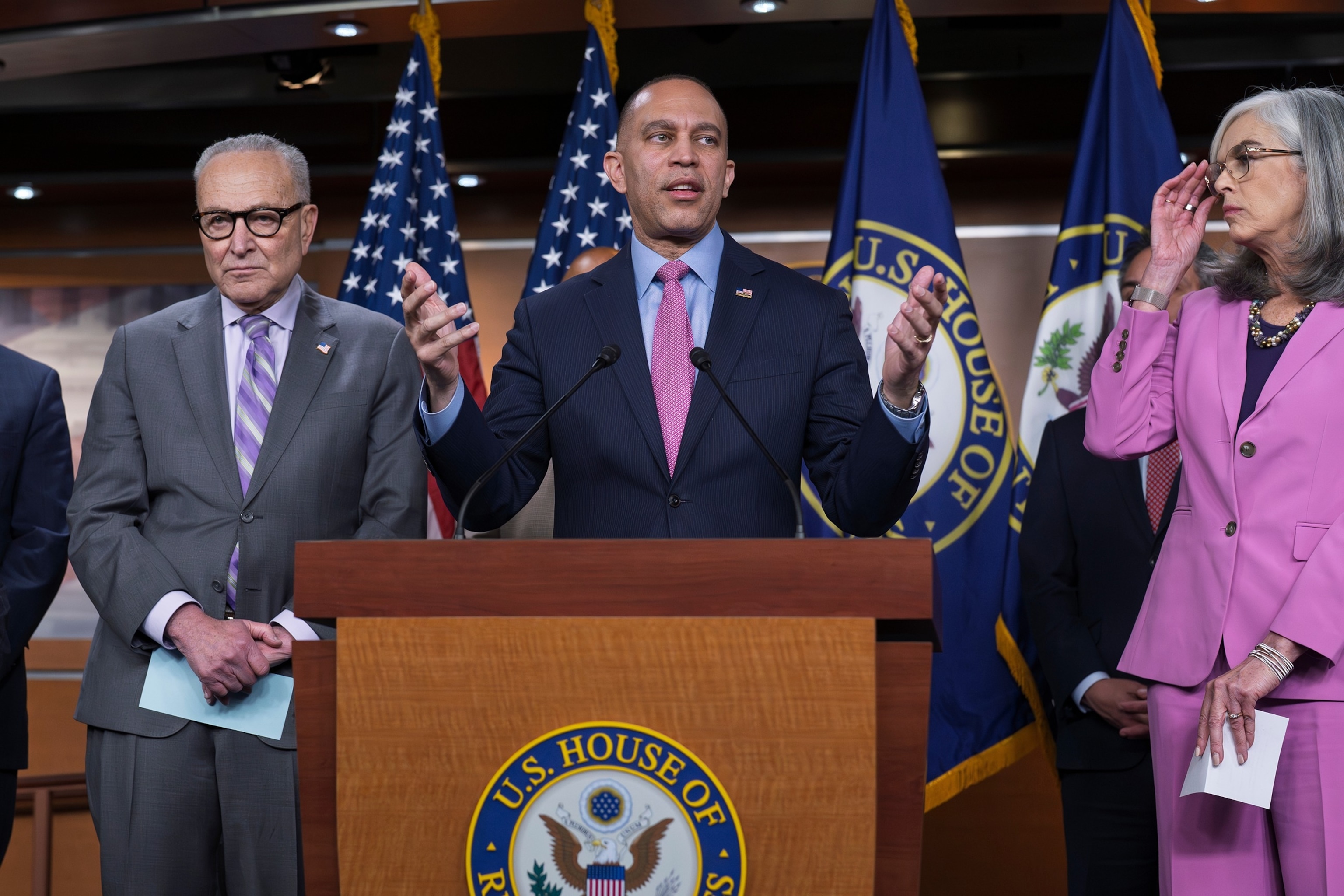
A day after House Minority Leader Hakeem Jeffries and the overwhelming majority of his caucus voted against a funding deal Senate Democrats had struck with the White House, Democratic leaders presented a unified message as they laid out their demands for reform at the Department of Homeland Security — calling on Republicans to “get serious” as lawmakers face a Feb. 13 deadline to fund the agency.
“The House and Senate are completely and totally on the same page in terms of Democrats,” Jeffries told reporters Wednesday. “Leader Schumer and I had a close, positive conversation yesterday about the path forward.”
House Minority Leader Hakeem Jeffries, flanked by Senate Minority Leader Chuck Schumer and Rep. Katherine Clark, House minority whip, speaks to reporters during a news conference at the Capitol, Feb. 4, 2026.
J. Scott Applewhite/AP
Senate Minority Leader Chuck Schumer said they “had a really good and productive meeting, and we’re on the same page.”
As Jeffries and Schumer steady themselves for bipartisan negotiations, both leaders appeared eager to capitalize on the public backlash against the Trump administration’s immigration enforcement actions.
Democrats called to separate the DHS funding following the deaths of Renee Good, a mother of three who was fatally shot by an immigration enforcement officer in Minneapolis on Jan. 7, and became more urgent after the death of Alex Pretti, an ICU nurse, who was killed in a shooting involving federal law enforcement in Minneapolis on Jan. 24.
Sixty-two percent of Americans say current efforts by ICE to deal with unauthorized immigration go too far, according to polling conducted by Ipsos Jan. 30 to Feb. 1.
Democrats lay out 10 key demands for DHS funding
In a letter Wednesday to Republican leaders, Jeffries and Schumer laid out 10 key demands from Democrats on DHS funding, including calling for judicial warrants before agents can enter private property, a ban on Immigration and Customs Enforcement wearing face masks, requiring the use of body cameras and new laws for use-of-force standards.
“Furthermore, there are steps that the Trump administration has the power to take right now to show good faith, including fully ramping down the surge in Minnesota and removing Secretary of Homeland Security Kristi Noem from her position,” Jeffries and Schumer wrote in the letter.
In remarks earlier Wednesday, Sen. Patty Murray, the top Democratic appropriator in the upper chamber, said “Democrats are at the table. We are focused on getting a bill, but it has to be a bill that reins in the abuses that we are seeing by ICE and CBP.”
Still, bipartisan negotiations did not commence Wednesday, and Speaker Mike Johnson sent the House on recess a day early on Wednesday afternoon.
Senate Minority Leader Chuck Schumer joined by House Minority Leader Hakeem Jeffries and House Homeland Security Chairman Bennie Thompson, speaks at a press conference on Department of Homeland Security (DHS) funding at the Capitol, Feb. 4, 2026.
Kevin Dietsch/Getty Images
“The bottom line is we’re ready to sit down and negotiate,” Schumer said earlier. “If [Republicans are] not serious and they don’t put in real reform, they shouldn’t expect our votes. Plain and simple.”
In earlier remarks, Schumer and Jeffries seemed unsure whether they’re negotiating with President Donald Trump or congressional Republicans — with Schumer reporting that Senate Majority Leader John Thune told Democrats to talk to the White House.
“Both are afraid of their shadows, and they’re getting a lot of blowback and pressure from their left,” Thune said of Jeffries and Schumer, according to Bloomberg, with Thune adding he hadn’t received an offer from Democratic leaders as of Wednesday morning.
“Thune is scared of his own shadow,” Jeffries told reporters early Wednesday afternoon. “We are negotiating because we want to try to achieve an outcome, but the changes that are enacted with respect to the way in which the Department of Homeland Security is conducting itself need to be bold, meaningful and transformative.”
The GOP response
Johnson said that Democrats “want to have a judicial warrant on top of the immigration judge warrant. And we can’t do that,” noting time constraints.
Speaker of the House Mike Johnson speaks to reporters after the House passed legislation to reopen and fund the government at the Capitol, Feb. 3, 2026, in Washington, D.C.
Aaron Schwartz/Getty Images
Johnson has signaled a “good faith” willingness to compromise on body cameras, but was adamant that Republicans would not support a ban on face masks for agents.
“When you have people doxing them and targeting them, of course, we don’t want their personal identification out there on the streets, and so we’ve got to work through this in a meaningful way, in a thoughtful way that comports with common sense,” Johnson said Sunday.
Exit ramps
So far, Democrats have not put their proposal into legislative text.
Republicans have also not crafted any legislation so far to address next week’s deadline.
“Let’s hope that over the next two weeks, we can negotiate and get this done,” Johnson told reporters on Tuesday. “[Democrats] say they want a real negotiation with President Trump and Republicans over immigration enforcement policy, and we are happy to have that debate.”
The Capitol is visible through the Cannon House Office Building, Feb. 3, 2026.
Mariam Zuhaib/AP
Jeffries told reporters that he is a “hard no” on a continuing resolution for Homeland Security through the end of the fiscal year.
“We need to resolve this issue by Feb. 13,” Jeffries said. “American citizens are being killed in the streets. Children are being kidnapped. Houses of worship, schools and hospitals are being stormed. We need to get this done and get this done immediately.”
Democrats predicated that Republicans are setting the stage for a shutdown.
“Mike Johnson has articulated unreasonable positions,” Jeffries said. “He’s actually supporting the notion that masked and lawless ICE agents should be deployed in communities throughout America. That’s Mike Johnson’s position. That’s contrary to what the American people believe should be taking place.”
Johnson told reporters that he was heading to the White House later Wednesday to talk to the president.
“We’ll see how it all develops,” Johnson said.
What is the impact of shutting down DHS next week?
The DHS appropriations bill funds far more than ICE, despite ICE getting most of the attention in this current standoff. The bill also funds Transportation Security Administration, FEMA, the Coast Guard and the Secret Service, among other federal agencies.
While there is some FY2026 funding for ICE, the agency received a $75 billion infusion of funding over the next decade through the already-passed “Big Beautiful Bill,” so a lapse in funding at DHS would not cease operations there.
“What they’ll be shutting down is FEMA operations, as we’re cleaning up from the winter storm. They’ll be shutting down TSA, which is obviously necessary to keep the country moving through our airports. Coast Guard operations,” Johnson said of Democrats’ actions. “I mean, so many important functions in the Department of Homeland Security is what will be adversely affected by these partisan games. Let’s hope and pray that they don’t do that. Let’s hope that over the next two weeks, we can negotiate and get this done.”
CALGARY — Grinning after going into the Olympic break with a Battle of Alberta win, Ryan Huska felt relaxed enough to speak freely.
Asked who he picked to win the Olympic tourney, the Calgary Flames coach said “Canada, of course,” before adding a kicker.
“You know, you watch 97 play here, and I can’t stand it,” he smiled.
“But as a fan, my God, is he something to watch. Like, it gets hard when you’re on a bench, trying to coach against him, but you see the talent and the way he can play the game… it’s exciting for us now, when you’re not involved in it, to be able to cheer for players like that.”
Indeed, 18,000 in attendance got exactly what they wanted with an injury-free game Wednesday that saw Connor McDavid stopped on all eight shots, as the home team won before the Oilers captain goes from Flames killer to national hero.
Wednesday’s 4-3 win over the Oilers felt a lot like the last game before Christmas, with players laughing and joking afterward as the weight of a trying season was lifted from them for the next three weeks.
Out-goalied once again, the Oilers were victimized by a 36-save performance from Devin Cooley, whose first provincial rivalry also included his first NHL assist, not to mention sweet revenge for a beatdown against the Oilers he endured years earlier in San Jose.
“The last time I played these guys was with San Jose in the regular season, and we lost 9-1, and they kept me in because the guy on the bench had never played an NHL game before,” smiled Cooley.
“They finally took me out after eight goals, and then he went in and the first shot they scored back door, and I felt really bad for him. That was not fun. So I’m glad I was able to get some redemption. I don’t know if those guys remember that game, but I remember it for sure, and I’m glad that tonight went a lot better than that.”
“It was way longer than my stick, so I thought I would give it a shot,” smiled Huberdeau, who punctuated his tenth of the year with a wide-eyed grin, shocked his new twig did the trick.
“And obviously the first shot went in, so I think I’ll probably use it for the next few games. It was nice to find the back of the net, but I think it’s pretty funny that right after that he scores too. So he got two goals tonight. That should be his goal.”
The 19-year-old rookie did indeed finish a beauty stretch pass from MacKenzie Weegar with a nifty short-side snipe that says plenty about how excited the team is about the future of a kid who left after the game for the minors so he can play in the AHL All-Star Game.
He’ll be back soon thereafter.
“I thought he played well again,” said Huska of the Russian who has scored twice in the last three outings, and added an assist Wednesday.
“He’s been consistent with his game since he’s been up this time, and he’s added something offensive that I don’t think we really have a lot of. His goal, when you look at it, he picked that up off his foot while he’s basically full stride. And then to shoot the puck the way he did in that situation… a talented player. That’s why we really believe in this young man, and we know he’s going to be a really good player. It’s just continuing to work with him and help him grow along the way.”
Then there was Dr. Feelgood, Ryan Lomberg, who broke a 3-3 tie early in the third by banging in a rebound a few minutes after the Oilers tied the see-saw affair.
“It’s the Battle of Alberta, the best rivalry in hockey, so it’s always easy to get up for this one,” said Lomberg, grinning ear to ear.
“I obviously love scoring on them and watching them lose.”
When asked about what he saw on his goal he punctuated his toothy chat with a reference to enjoying Swiss Cheese on his Pizza 73.
Asked if that was a reference to another shaky performance from Oiler goalie Tristan Jarry, he smiled: “Attaboy.”
A good chunk of excitement was derived from a mid-game tussle between Joel Hanley and Ty Emberson that offered up a surprising number of haymakers that had the fans on their feet as the two took turns popping one another’s helmets off with solid connections.
Capping the fight with pats on the back for one another, the crowd got louder.
The stage is now set for the best on best to jump on their trans-Atlantic flights and the rest of the league to enjoy time off.
“There’s a lot to like and it was an entertaining game, too,” said Huska, whose team needed something to smile about.
“Our power play scored a couple goals. We had a really big penalty kill when it mattered. A good fight by Hanley, Lomberg scores a goal… there’s lots to like in this game tonight. Young guys played well, so it was a good way for us to end before the break.”
Restaurants across B.C. that use a company to manage tip collection and staff wages say it has, without stating why, stopped distributing money and some restaurants are reporting that they are out thousands of dollars.
Everyday Payments is described as “delivering real-time employee payouts. Businesses using the service span hospitality, food service, beauty, wellness, and commission-based industries.
“Leveraging the AnyDay platform, the solution combines a powerful employer portal with a flexible mobile app and payment card for cardholders; simplifying fund management, improving visibility and control, and enabling faster, more predictable access to earnings.”
Eric Griffith, owner of Alta Bistro and Alpha Cafe in Whistler, told Global News that when he logged in to the system last Wednesday morning, he knew something was wrong.
“We’re missing $4,550,” he said.
Story continues below advertisement
“But I thought, ‘OK, this has to just be an error. They’ll resolve it. They must know that this has happened.’ Well, the emails go out, try to contact support, whatever, and it was just no response until the weekend.”
Griffith said business owners started realizing they were not alone.
“Monday, there was a press release from the company, which is what they emailed us as well, saying there’s some type of compliance issue. We’re working through it, and there’s a reconciliation, but no answers to any questions as to why this happened,” he said.
“What is the intention? When is the money coming back?”
Griffith said they started using the program as it saves time and administrative work and keeps track of all the money and staff tips.
“So this piece of technology was very useful and working well, absolutely well,” he said.
“The staff were happy. I was happy because I was saving time, and also it was just easy.”
However, with so much uncertainty now, Griffith said he doesn’t know what to do.
“So if it’s 5,000 to me and it’s $100,000 to someone else, it’s still like relative impact, right, which is ultimately hurting the business, the ability for the owners and businesses to pay the staff, and then, I mean, for me, it comes down to paying my suppliers and other things, right?,” he added.
Story continues below advertisement
“That money becomes a hole, right? So, yeah, I don’t want to think.”
Canada restaurant outlook 2026
Matthew Upton, one of the owners of The Broken Seal restaurant in Squamish, told Global News they are missing $12,000.
Get weekly money news
Get expert insights, Q&A on markets, housing, inflation, and personal finance information delivered to you every Saturday.
“It’s huge,” he said.
“That’s over two weeks’ worth of payroll. It’s half of what our ends is. It’s a huge effect for us.”
Upton said the last week has been very challenging, trying to get in touch with someone at Everyday Payments. He said he was on hold for four hours on Friday, four hours on Saturday and four hours on Sunday and never got a response from anyone until Monday.
“It’s very concerning,” he said.
Story continues below advertisement
“It’s, I think, as a whole, the hospitality industry is not an easy industry to be in, and when there’s unknowns, we have such small margins, so keeping as much money in our bank account is the most important thing. So when you have large amounts come out, it’s definitely daunting, for sure.”
Ian Tostenson, president and CEO of the BC Restaurant & Foodservices Association, said he has heard the same issues from restaurants all over the province.
“I have just read two emails in the last five minutes,” he told Global News.
“One restaurant group lost $50,000, one restaurant group is out $15,000 — one’s in Prince George, one’s in Vancouver.”
Trending Now
Bill Gates ‘regrets’ ever knowing Epstein, ex-wife Melinda recalls ‘muck’ in marriage
Jill Biden’s ex-husband William Stevenson charged with murder in wife’s death
Tostenson said in the case of one Vancouver restaurant, close to one million dollars was taken out of the “wallet” that Everyday Payments manages on behalf of employees to distribute tips.
“This is really, really serious, and there’s a lot of concern in the industry, because these funds go into a third party for the purposes of paying out and distribute the gratuities to our hard-working employees,” he added.
“And they’ve the company that manages that, Everyday Payments, for some reason that we don’t know, have taken the money and emptied all the wallets. I think this is in the millions of dollars, to be perfectly honest with you. This is really serious.”
Story continues below advertisement
Global News has reached out to Everyday Payments.
Initially, a form message was received, stating, “As you can imagine, Everyday People are inundated. Note that card creation and loading are temporarily paused while they work with DC Bank to resolve a service interruption affecting new card loads.
“Existing cardholders are not impacted and can continue using their cards as normal, but additional loads cannot be processed at this time.”
Later, a spokesperson for the company said in an email that they are aware of the concerns and they understand why the timing has been stressful for some restaurants.
“We are reviewing inquiries relating to a short transition period at the end of January, during which operational adjustments were implemented to move the platform to a fully prefunded processing model,” the statement read.
“During this period, some merchants experienced delays or changes in the timing of debits and loads.
“Importantly, funds were not removed from merchant accounts or cardholder wallets other than through established funding and settlement processes.”
Tostenson said the issue began after the company merged with another, and each appears to be pointing the finger at the other.
” Anybody is trying to reach out to the companies, all they’re doing is getting standard administrative messages back,” he said.
Story continues below advertisement
“And in the meantime, we’re scrambling to make sure that our employees are whole, so we’re having to find the money that’s gone to make sure we pay our employees. I’ve never seen anything like this.”
Tostenson said the guidance from the industry now is for businesses to check their wallets online and see what money is in there.
He also confirmed that police reports have been filed in Whistler and Prince George, but no one has heard from the company.
“The question that everybody wants to know is, where is my money?” Tostenson said.
The engines are still 1.6-litre V6 turbo hybrids, as they have been since 2014, but one of the two electrical motors that recovered energy has been removed.
The total amount of electrical energy has been increased by a factor of three, but the battery is more or less the same size. If the battery is fully depleted, the engine loses 350kw (470bhp), leading to potentially dramatic speed differentials.
Drivers will be backing off towards the end of straights – and being careful about when they apply the throttle – to ensure the most efficient energy usage, even on a qualifying lap.
The cars are also smaller and lighter, have less downforce and have ‘active aerodynamics’ – where both front and rear wings open on the straights to increase speed and the possibility for energy recovery.
Norris said the new car “certainly feels more powerful and quicker” on the straight.
“The biggest challenge at the minute is battery management and knowing how to utilise that in the best way,” he said.
“It’s not simple. You can explain it in quite simple terms. It’s just you have a very powerful battery that doesn’t last very long, so knowing how to use it in the right times, how much energy, how much of that power you use, how you split it up around the lap…
“The biggest challenge is how you can recover the batteries as well as possible, and that’s when it comes down to using the gears, hitting the right revs.
“Obviously, you’ve got some turbo lag now, which we’ve never really had before. All of these little things have crept back in, but I don’t think that changes too much.
“In a perfect world, I probably wouldn’t have [all] that in a race car, but it’s just F1. Sometimes you have these different challenges.”
His team-mate Oscar Piastri said the cars were “not as alien as I think we might have feared” and insisted he “didn’t think F1 had lost its identity at all”.
The Australian added: “There’s going to be some things to get used to but in terms of some of the fears that maybe we had before we got on track, a significant majority of those have been alleviated now.
“There’ll be some differences, but I think fundamentally they’re still the fastest cars in the world.”