The demands of white ball cricket with wides called even as the ball whispers past the leg bail forced Starc to get the ball closer to the bat. He has been a match-winner in all formats because he is a wicket taker rather than a run miser. When a breakthrough is needed, who do you call?
Comparisons across generations are indeterminate but fun to debate. The obvious yardstick for lefties is the magnificent Wasim Akram, whom Starc has just surpassed in Test scalps.
Both concede the other is better, but really the two are on the top shelf.
Akram, like Starc, grew more effective with age. Akram’s speed declined as his body no longer tolerated his whipcord delivery stride, but his match experience and batsmen knowledge piled up.
Another leftie, Chaminda Vaas, never had the velocity of that duo but knew how to utilise an old ball, angles, fast cutters and front-of-the-wicket fielding positions on those Sri Lankan dust bowls.
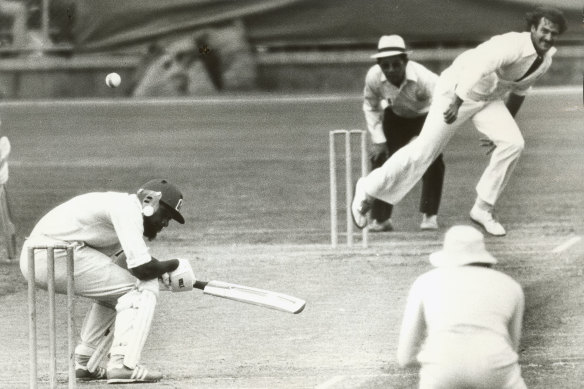
I was fortunate to play with whom I still regard as Australia’s finest paceman – not a leftie, but a role model for all shapes and sizes. Dennis Lillee went from a very fast bowler with a lengthy run-up who let it go at full throttle, to a fast-medium swinger and cutter of the ball. Lillee’s strike rate went up in his closing chapters even though he battled serious knee troubles. Less physical effort for better results.

Dennis Lillee bowls to the West Indies’ Andy Roberts at one of the early SuperTests of World Series Cricket.Credit: Fairfax Photographic
Glenn McGrath’s pace didn’t change much over his career but like any of these bowlers with longevity, their mental reservoir fed the physical body.
Akram used reverse swing on the slow, abrasive decks in Pakistan to devastating effect. Michael Bevan’s instruction to Phil Emery in his lone Test match when he marked centre to face a rampaging Wasim: “If it starts outside off stump, play two feet inside the line; if it starts outside leg stump, play two feet outside the line.” It worked for Bevo.
Of a different generation was the significantly framed Bill Johnston, who reversed course by commencing cricket life as a left-arm spinner then turning to seam and swing to spearhead Bradman’s Invincibles. Only knee problems prevented him from adding to his 160 Test wickets.
Mitchell Johnson brought serious heat but battled the holy trinity gremlins like Starc. And much like Starc, when he got into the perfection zone, he was as dangerous as any leftie this century.

Mitchell Johnson celebrates another wicket, alongside David Warner.Credit: Getty Images
Johnson came back from career-ending Barmy Army sledging – “he swings it to the left, he swings it to the right” diatribe – to win an Ashes almost by himself.
Doug Bollinger blazed bright and brief. Nathan Bracken swung the ball from height, and although perhaps recognised more for his white ball antics was a very good Test bowler with his worrying bounce.
Mike Whitney matured like a fine wine as his body grew less reliable and the cricket intelligence kicked in. He was at a peak performance right at the end. Given a fair run he would have been a 200 Test wicket bowler.
Australia’s premier leftie between Johnston and mobile phones was all-rounder Alan Davidson. A whippy wrist and surprising pace made him Richie Benaud’s go-to man when the going got tense.
Gary Gilmour was an outrageously talented Western Suburbs Club clone of ‘Davo’ whose work ethic favoured the shorter form of the game, and the slim Bruce Reid promised to be the best of his generation – but there was not enough sticky tape to hold him together.
Australia has had some fine lefties. I throw Lillee and McGrath in as examples of age being a benefit to efficacy rather than a hinderance.
Starc is the best left-handed fast bowler Australia has produced, and he beats a talented field.
Both he and Akram have been awesome match-winning bowlers. We are only two Tests into this series but without Starc, Australia would be in serious trouble.

Cameron Green is bowled by Brydon Carse on Friday.Credit: AP
Post Script to the second evening at the Gabba:
What a triggering sight to see Cameron Green backing away from the stumps only to get bowled on Friday, channelling Rodney Hogg at the WACA versus the West Indies in 1984. When Rod returned to the dressing room after being bowled by Malcolm Marshall, he immediately rang his wife and asked her to delete the video recording because he was so embarrassed about the dismissal and didn’t want his (baby) son to ever see it. And he was batting at No.10.