
Chepauk and its colourful legacy of delivering classics
There is an aura about the M.A. Chidambaram Stadium that’s hard to express in words. Terms associated with Chepauk that one first heard on the radio – the V. Pattabhiraman Gate, the Wallajah Road End – surge to your mind as you negotiate the broad gates and cast your eyes on the lush-green, newly laid outfield which cuts a pretty picture.
The refurbished Madras Cricket Club serves as a reminder of the traditional sprucing itself up to keep in tune with the modern. The steepling new stand crammed with blue seats is another example of the necessity of having to embrace the new reality even if it is somewhat at the expense of spectator comfort. Rows of seats almost tumble over each other and negotiating the narrow passage to reach one’s perch towards the end of a row is a huge challenge.
The famous tied Test
Think Chepauk, and the first thought is of the tied Test of September 1986. Nearly 40 years ago, to have to score 348 in a single day’s play, and that too on the final day of a Test, was almost unheard of. That’s the target Allan Border set Kapil Dev’s men on September 22. India made a game fist of it with Sunil Gavaskar, who has lit up the venue with several incandescent efforts, leading the way. The little master top-scored with 90 as each of the top five made at least 39, and at 251 for three, an improbable victory appeared imminent.
Ray Bright, the left-arm spinner, then got into the act alongside Greg Matthews, the maverick off-spinner who preferred bowling with his Baggy Green on. Ravi Shastri held firm and Chetan Sharma weighed in with 23 but when Shivlal Yadav was ninth man dismissed, India needed four for victory with Maninder Singh joining Shastri. The latter was a master at playing the situation. Instead of going for the glory shot that might have brought about his downfall, he first ensured that India would not lose the game, leaving Maninder on strike to Matthews with the scores level.
As the off-spinner pinged the No. 11 on his pad, umpire Vikram Raju’s right index finger shot skywards, upholding the appeal and sending one side into paroxysms of delight. The other’s immediate reaction was disappointment; to this day, Shastri and Maninder insist there was an inside-edge, Raju is adamant there was no contact between bat and ball.
It doesn’t matter anymore, does it? With that one act which brought an end to India’s chase and a riveting Test match, Raju had formalised only the second ‘tie’ in the history of Test cricket. Australia had been involved in both games where the match had ended with the teams dead level in terms of runs scored when the dust had settled and the final wicket had fallen.
Chennai’s knowledgeable crowd
India have endured numerous heartbreaks here, including a one-run loss to Australia the following year in the 50-over World Cup, and a 12-run defeat to Wasim Akram’s men in Pakistan’s first Test in India in nearly a dozen years. Over the years, the Chennai crowd has earned the reputation of being one of India’s most knowledgeable and sporting groups. It lived up to that billing by applauding Pakistan, a gesture the visitors reciprocated by going on a victory lap around the ground that was received with a standing ovation.
Among India’s fonder memories is a magnificent two-wicket win over Australia in March 2001, fashioned by the right arm of Harbhajan Singh and the magical wrists of V.V.S. Laxman which combined to orchestrate one of the greatest comebacks in the five-day game. Out for the count after a three-day walloping in Mumbai, India squared the series in a classic at the Eden Gardens – a Harbhajan hat-trick was matched and topped by Laxman’s 281 and Rahul Dravid’s 180 as they batted out the entire fourth day after the host trailed by 276 in the first innings.
India then completed a fightback for the ages at Chepauk, nailing a modest but tense chase as the shadows lengthened and hearts thudded furiously in one of the great advertisements for the format.
Platform for 50-over WC rampage
It’s here that India kicked off their fabulous run in the 2023 50-over World Cup with a splendid six-wicket victory over Australia. Asked to scale down a modest 199, India were rocked by Mitchell Starc and Josh Hazlewood, who fired out skipper Rohit Sharma, Ishan Kishan and Shreyas Iyer, all for ducks, with just two runs on the board.
There is no gainsaying how the match would have panned out had Mitchell Marsh, at square-leg, not put down Virat Kohli when the batter was on 12. Had the catch been completed, India would have been 20 for four. Kohli made Australia pay by putting on 165 for the fourth wicket with K.L. Rahul as India eventually cantered home with 52 deliveries to spare.
That escape to victory was the start of a spectacular charge through the draw that took the Indians to the final with an all-win record. The title proved elusive with Travis Head lording the Ahmedabad exchanges and casting a collective pall of gloom over the entire nation, which quickly regrouped to applaud Rohit’s team for the exhilarating brand of cricket they had showcased throughout the month and a half of the tournament.
Now, India must again use Chepauk to resuscitate their campaign at the T20 World Cup. Justified favouritism conferred on them coming into the tournament for their consistently commanding run in the 20-over game over the last year and a half, India were untroubled in the league phase despite barely touching third gear. But now, they are within three and a half hours of going out before the knockouts.
Do-or-die game for Surya’s side
The defending champions were dealt a hammer blow by last edition’s finalists South Africa in Ahmedabad on Sunday. Now, another African challenger looms in the form of Zimbabwe, a dark horse if ever there was one, which has punched above its weight and taken down Australia and Sri Lanka in the first stage.
What makes Zimbabwe’s fairytale run even more endearing and remarkable is that they failed to even qualify for the 2024 edition of this tournament in the Americas.
They weren’t expected, understandably but as it turns out now, naively, to advance to Super Eights but they proved that their takedown of Australia was no flash in the pan with a convincing victory over the co-hosts in Colombo to top Group B.
Sikandar Raza has run a tight ship and led by example, while the engine rooms of their charge have been Blessing Muzarabani at the top of the bowling tree and the intrepid Brian Bennett at the top of the batting group. After unbeaten efforts in his three previous outings of 48, 64 and 63 respectively, the 22-year-old Bennett finally had an average (180) to boast when he was dismissed for five against the West Indies in their opening Super Eight encounter in Mumbai on Monday. Muzarabani, the towering 29-year-old quick, has 11 wickets, the joint second-highest in the tournament alongside Marco Jansen, and has gone for only 7.06 runs per over.
Men who could spoil the day
Bennett and Muzarabani are the most obvious threats but the captain is a wonderfully skilled competitor who will undoubtedly fancy his off-spin to wreak damage in the first over of the Indian innings – the hosts have lost a wicket within the first six deliveries four times in their five encounters thus far. He can also give the ball a mighty whack, all of which means that India’s task is anything but straightforward.
Suryakumar Yadav’s men have had just one bad day in the office, but it was a horribly bad one, which has left them now dependent on other results going their way if they aspire to be in the hunt for the semifinals. Of course, the primary requirement for them, after the 76-run lashing at the Narendra Modi Stadium, is to win their two remaining games – the West Indies lie in store at the Eden on Sunday. Before the tournament, it was unthinkable that India wouldn’t figure in the last four but that’s now very much a possibility. The Super Eights is an unforgiving phase though unlike the knockouts, there is at least a nominal second chance.
India’s batting has been the source of much debate and no little censure in the last few days. Much of it has to do with the unrealistic expectations from the outside, expectations that are not in sync with reality. Apart from the opening game against the United States where they found themselves in all kinds of trouble at 77 for six before scrambling to 161, they reached above-par scores, given the nature of the pitches, against Namibia (209), Pakistan (175) and the Netherlands (193).
Ahmedabad was a horror night. First, through defensive fields and bowling changes, India allowed South Africa to escape from 20 for three to 187 for seven. Then, the chase unravelled even before it started with Kishan and Tilak Varma perishing in the first seven balls and the luckless Abhishek Sharma also falling in the PowerPlay.
Hanging by a thread
Abhishek’s travails are too obvious and well documented to bear repetition. Three ducks and a scratchy 15 have pushed him to the brink of losing his place in the XI, with Sanju Samson primed to open alongside Kishan. Abhishek might thus be deprived the chance of working his way back among the runs on what has consistently been the best scoring venue at the World Cup. But he will also understand that there is no place for sentiment and hand-holding anymore, not with India’s campaign hanging by a slender, tenuous thread.
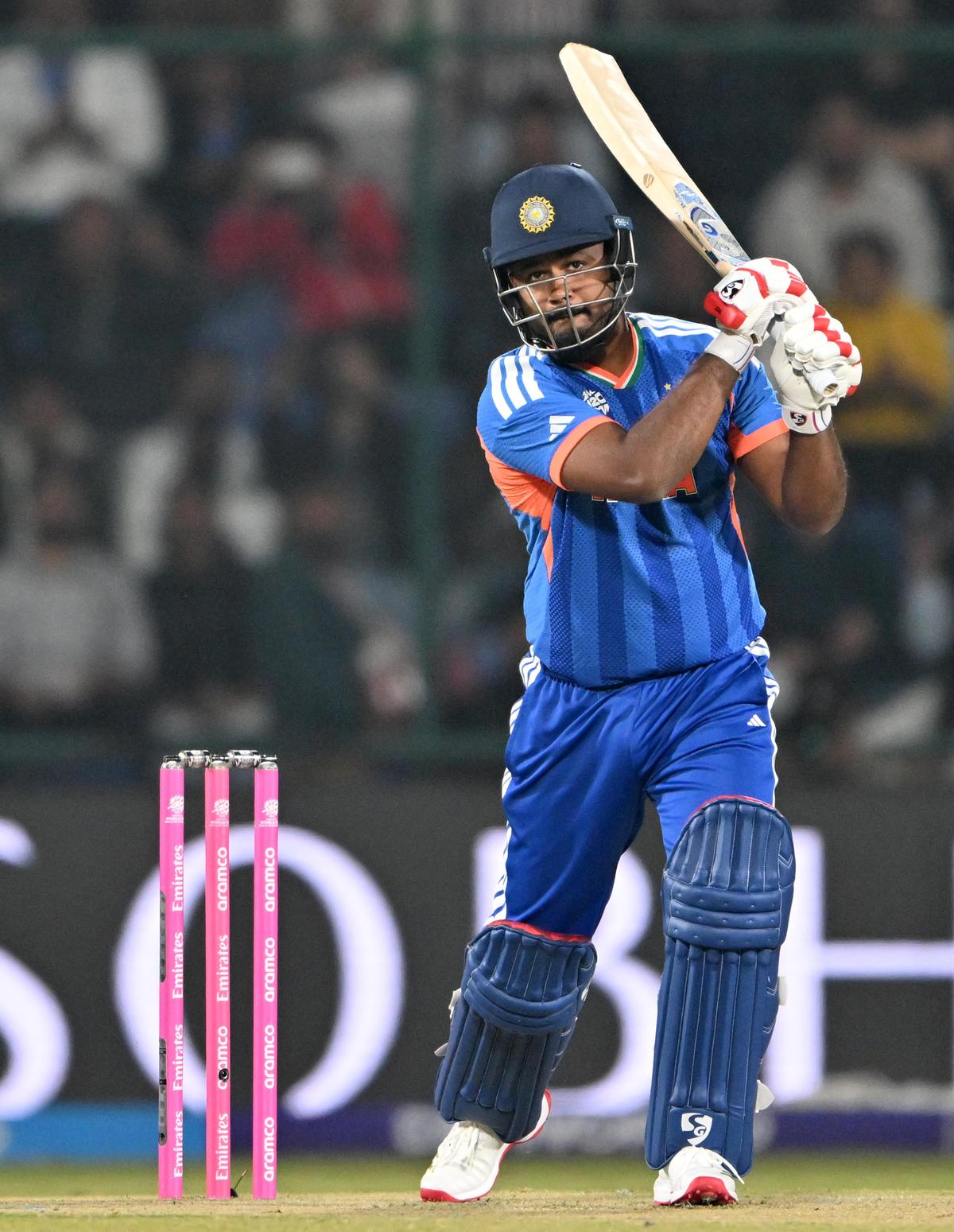
Samson.
| Photo Credit:
R. V. Moorthy
Even had they put it past South Africa, there would have been no scope for complacency or smugness against the Zimbabweans. Now, the Indians have even more reason to be fully switched on. Some two and a half weeks ago, Suryakumar had the opportunity to reprise the magic of Mahendra Singh Dhoni and Rohit and become only the third Indian captain to lift the T20 World Cup. Now, he is in danger of emulating Kohli from 2021 by helming a side that failed to reach the knockouts for the first time in three editions. That’s how quickly things change in the 20-over game.