
Another NRL opening week of rule changes and confusion. Here’s hoping history doesn’t repeat
Across the opening eight games, those numbers have swollen to eight set restarts and 11.5 penalties a game. Now “six agains” apply from the 20-metre line for ruck breaches and defenders being offside. In round one, there was a 35 per cent increase in set restarts.
The six agains issue has always been a question of “what for, and against who?“, asked by fans and players alike as play rolls along and a contest swings drastically one way.

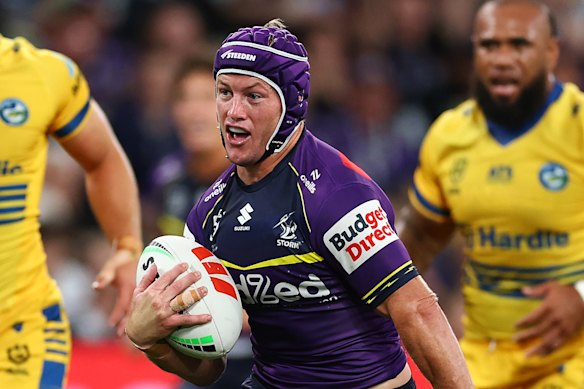
A hooker like Harry Grant thrives in a game full of set restarts.Credit: Getty Images
Melbourne’s Harry Grant had a field day as the Eels were pinged for nine set restarts, while Canberra made more than 70 tackles before Manly were required to do so on Saturday night thanks to seven back-to-back infringements.
That said, given some of the boneheaded play from Parramatta, the Gold Coast and Broncos, each deserved to be thrashed in round one.
And some of the penalties conceded – Angus Crichton and Nathan Brown levering themselves out of a ruck by planting a hand on an opponent’s face stand out – were just as blatant, and deserving of lopsided counts.
But the average 20-point winning margin across the round is the highest for an opening weekend since 2002, when the game was played in fast-forward, as was the case in 2021.

Alex Johnston (30 tries), Tom Trbojevic (28) and Josh Addo-Carr (23) scored four-pointers for fun in 2021.Credit: Getty, NRL Photos
At the end of a thrilling finals series that masked a lopsided regular campaign (Reuben Garrick scored more points for Manly than Canterbury did all year), the NRL conceded the contest was too fast, too haphazard.
In 2021, the average of 7.5 set restarts a game, particularly when defending sides happily conceded them in an opposition’s 40-metre zone, was too much.
Set restarts were wound back, with the work of The Rugby League Eye Test ringing especially loud – in 2021 there was a 43 per cent increase in game time when a team led by 19 points or more.
The NRL regularly trumpets ball-in-play time – up to a record 56 minutes a match last year – in chasing billion-dollar broadcast deals. Ball in play really isn’t that appealing though if only one team has it.
It’s only round one. And last year’s opening week came with an average 18-point winning margin, along with valid concerns about where 70 extra players for expansion clubs are going to be found, before the greatest finals series in the game’s history.

Roosters captain James Tedesco made regular enquiries with referee Wyatt Raymond on Friday night.Credit: NRL Imagery
But even with the fun of golden point and the rambunctious attacking play of front-running teams, four blowouts as players, coaches, fans and commentators grappling with rules new and reinterpreted took the shine off.
When Roosters star Mark Nawaqanitawase flew high for a try assist against the Warriors on Friday, Fox Sports pundits Andrew Voss and Steve Roach alerted plenty to the NRL’s new focus on “disruptors” chasing kicks, including a requirement for attacking players to “use two arms in the air to catch or bat the ball back”.
The try was denied because Nawaqanitawase batted a ball down to Benaiah Ioelu with one hand.
Twenty hours later, Roach and veteran caller Matt Russell referenced the same rule briefing when Cronulla’s Sam Stonestreet seemingly batted the ball down in the same one-handed fashion, yet Will Kennedy’s opening try stood.
The Dragons and Eels were burned by replacing players for HIAs using the NRL’s new six-man bench regulations.
Loading
Parramatta left themselves unable to call on their two bench front-rowers after replacing fullback Isaiah Iongi with playmaker Joash Papalii while Iongi completed, and subsequently passed, his concussion test. The Eels ended up with an extra outside back in their 17, as did the Dragons in Las Vegas with Moses Suli.
It’s a scenario coaches and clubs will wrestle with all year as they work out the tactical toing and froing of the new interchange rules.
The rule change that didn’t get up for 2026 – the change to kick-offs aimed at curbing a scoring team’s momentum – is already being mentioned as the solution if more set restarts deliver more blowouts.
But again, it’s only round one. Maybe leaving the game to sort itself out will actually sort things out.