
Ali Khamenei’s killing continues long US tradition of letting others pull the trigger
The US and Israel assassinated Iran’s supreme leader, Ayatollah Ali Khamenei, in a joint operation in late February. In a post on social media, Donald Trump boasted that Khamenei was “unable to avoid our Intelligence and Highly Sophisticated Tracking Systems”. Trump added that “there was not a thing he, or the other leaders that have been killed along with him, could do”.
The US helped plan the operation, provided key intelligence to identify Khamenei’s location and destroyed Iranian defences to pave a path for his executioners. But the US did not pull the trigger. Israeli warplanes launched the strikes that ultimately killed Khamenei.
While the rationale for this division of labour is unclear, it is not unusual for US assassination plots. Declassified documents, some of which we have published ourselves at the National Security Archive, a research institute at George Washington University, reveal striking details about the long history of the US seeking allies and proxies willing to cooperate to kill.
However, these previous operations offer a clear warning. More often than not, they made matters worse – prolonging wars, fuelling local chaos, straining US relations with the targeted state and creating the conditions for future violence.
Cold war assassinations
During the cold war, the US relied on Cuban exiles and the American mafia in its many assassination attempts against Fidel Castro of Cuba. The failed attempts between 1960 and 1962 contributed to moving Castro closer to the Soviet Union and paved the way for the 1962 Cuban missile crisis, which is widely considered the cold war’s most dangerous episode.
Around the same time, the Eisenhower administration entered into confrontation with Patrice Lumumba, the first elected prime minister of Congo. President Dwight Eisenhower and the then-CIA director, Allen Dulles, came to see Lumumba as unable at best and a communist stooge at worst.
While the US started working on a coup with Belgium, an ally and the former colonial power in Congo, assassination emerged as a policy option. US intelligence officials created the poison that was supposed to kill Lumumba, which was to be injected into his food or toothpaste by a local ally.
When that plot fizzled out, the US government contributed to the manhunt that delivered Lumumba to a firing squad of his domestic enemies in 1961. CIA officials later admitted that, while they were squeamish regarding the use of poison, they had no problem in delivering Lumumba to his enemies – even if this entailed a certainty of his killing.
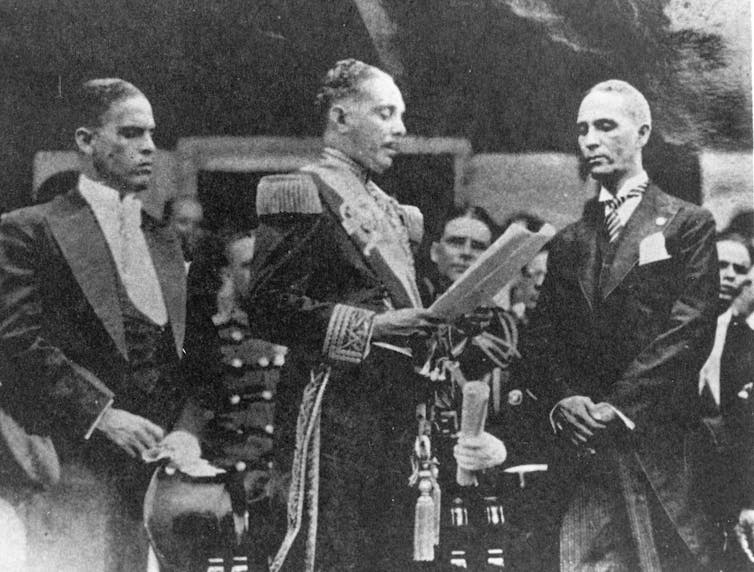
Also in 1961, the CIA armed and supported local proxies – including by reviewing their plans – for the assassination of the Dominican dictator, Rafael Trujillo. Chaos ensued in the following years, contributing to a full-scale US invasion in 1965.
Archivo General de la Nación / Wikimedia Commons
Setting the conditions for a military coup that was likely to lead to assassination was also at the centre of the 1963 killing of South Vietnamese president Ngô Đình Diệm. Henry Cabot Lodge Jr, the US ambassador to South Vietnam at the time, told President John F. Kennedy that the US had planted the seed for the coup and created a fertile ground where it could flourish.
While top CIA officials were initially reluctant to support a military coup, the agency had an operative, Lucien Conein, in close contact with South Vietnamese generals as the events took place. Kennedy was apparently shocked in learning that Diệm had been brutally murdered. To this, his chairman of the joint chiefs of staff, Maxwell Taylor, remarked: “What did he expect?”
Starting in the 1980s, the US government turned its attention to the Libyan and Iraqi leaders, Muammar Gaddafi and Saddam Hussein. The Reagan administration supported the National Front for the Liberation of Libya in its ultimately unsuccessful efforts to overthrow and kill Gaddafi.
And in its confrontation with Hussein, the Bush Sr administration often called for a “palace coup” that could lead to the elimination of the Iraqi leader – although not necessarily of his regime. This confrontation spilled over into Bill Clinton’s presidency in the 1990s.
The US government supported Kurdish forces – something the Trump administration is considering in Iran – and members of the Iraqi opposition in a series of efforts to mount a coup. Many of these plots were deeply infiltrated and some were dismantled before they could start. A plot against Hussein involving the Kurds in 1996 was marred by betrayals. They all ended in disaster.
‘War on terror’
The “war on terror” after the 9/11 terrorist attacks and the opportunities that new technologies such as armed drones had created meant the US became engaged more directly in the assassination of terrorist leaders. And yet, even at the height of the war on terror, the US at times showed an unwillingness to pull the trigger itself.
Israeli investigative journalist Ronen Bergman has reported that the Bush Jr administration agreed to cooperate with Israel to kill Hezbollah commander Imad Mughniyeh in 2008. But they agreed to do so on three clear conditions: the strike should be kept secret, Mughniyeh alone would be killed and Americans would not do the killing. Mughniyeh was killed by a car bomb placed in his SUV by Mossad agents with key American assistance.
Trump has shown a proclivity for assassinations with what appears to be little concern for the implications of his actions. In his first term, again in collaboration with Israel, the US did pull the trigger in the assassination of Iranian general Qasem Soleimani. This act escalated matters with Iran and made it more likely that a war would materialise in the future.
With Khamenei, the US preferred to let Israel do the actual killing. The assassination is likely to make Khamenei a martyr and provides the Iranian regime an avenue for cohesion when its internal legitimacy was under severe strain. Collaborating to kill can lead to tactical success, but the costs are often grim.