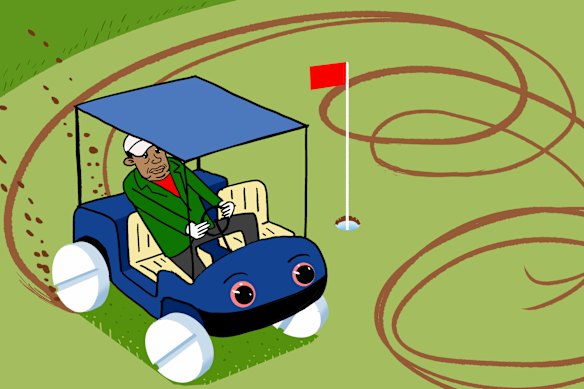

Tiger deserves compassion, but golf’s refusal to hold him accountable diminishes the sport
There’s a picture, taken from the bodycam of a Martin County Sheriff’s deputy, which tells you what you need to know about the devolution of Tiger Woods.
The holder of 15 major championships and a sporting legacy that once seemed indestructible, 50-year-old Woods is sitting on the bumper of a patrol car in the Florida sun, sweating profusely, his pupils dilated, two – allegedly – hydrocodone pills having just been removed from his pants pocket.
Across the state line in Augusta, the azaleas are blooming. From the last week of March, The Masters is still a fortnight away. Woods was supposed to be there. Instead, he was booked temporarily into the Big House, on charges of DUI, property damage, refusal to submit to a lawful urine test and careless driving after his Range Rover clipped a trailer on a two-lane road and rolled.
His breathalyser test reads 0.00; there’s no booze in this story. Only pills. Allegedly.
By late last week, Woods’ private jet had, apparently, landed in Zurich, where Woods is reportedly now a resident of one of Switzerland’s elite treatment facilities.
This was Tiger’s fourth vehicle incident in 17 years, his second DUI arrest in nine, and at least the third occasion on which prescription opioids have been confirmed or credibly suspected as being the cause of or main contributor to Woods’ impairment behind the wheel.
In 2009, Ambien and Vicodin, after the fire hydrant and the tree and the unravelling marriage. In 2017, hydrocodone, hydromorphone, alprazolam, zolpidem and THC were found in his bloodstream when Florida police found him asleep at the wheelwith two flat tyres.
In 2021, driving at almost twice the speed limit in LA before the crash that all but obliterated his right leg, when no sobriety test was administered and no blood was drawn, and the LA County Sheriff called it an accident, not a crime.
Each time, the grim pattern ostensibly repeats itself. Tiger stuffs up. The world recoils. Golf’s governing bodies offer platitudes and studied inaction. Woods “rehabilitates”. The narrative resets. And repeats.
Woods has undergone seven back surgeries, and more than 20 operations on his right leg since almost losing it in 2021. That’s in addition to procedures on his knee and Achilles tendon. Chronic pain is real and any opioid dependency that shadows that pain is a medical condition in itself, not a character defect.
But the question golf’s administrators have dodged for nearly two decades now is whether Woods has brought the sport into disrepute. And if so, do any of those custodians of the game intend to do anything about it?
The answer to the first part is embarrassingly obvious. The Court of Arbitration for Sport has defined bringing a sport into disrepute as conduct that lowers its reputation in the eyes of ordinary members of the public to a significant extent.
A five-time Masters champion arrested for DUI for the second time a fortnight before the Masters with opioid pills allegedly found in his pocket, and bodycam footage of failed sobriety tests circulating globally, satisfies that threshold by any sensible measure.
More pertinent is why nobody acts, ever.
Let’s begin with the PGA Tour. Tiger is anything but a regular tour player. He hasn’t teed it up in anger since 2024. But Woods is the chair of the Future Competition Committee and the vice chair of the PGA Tour Enterprises Board. Even if he’s no longer an active player of competitive consequence, he’s one of the most influential people in the sport at the boardroom level. And nobody in the game moves the needle like he can.
Section VII.C of the PGA’s Player Handbook prohibits “Conduct Unbecoming a Professional”; a deliberately undefined phrase that encompasses behaviour reflecting unfavourably on the Tour, its members, its tournaments, or its sponsors.
The available penalties run from fines to suspension to permanent disbarment. The PGA Commissioner possesses almost complete discretionary authority and can impose provisional suspensions at any time he believes the Tour’s reputation would be undermined.
And yet no PGA Tour player has ever been publicly suspended solely for off-course criminal conduct. Every known suspension in Tour history falls into one of these categories: (a) on-course misconduct; (b) failed drug and doping tests; (c) unauthorised competition through involvement with LIV Golf; and (d) gambling violations.
The Tour’s response to Tiger’s recent arrest was unsurprisingly supine: “Tiger continues to have our full support as he takes this important step.”
Three-time Masters champion Nick Faldo called that statement “weak”. That was generous.
Then there is the Augusta National Golf Club itself, epicentre of the sporting universe this week. The Masters is the only men’s major run as a private invitational. Past champions hold lifetime invitations. Augusta National has never formally disinvited one; Angel Cabrera, the 2009 champion, teed it up in 2025 after two and a half years in an Argentine prison for domestic violence.
On Woods, chairman Fred Ridley’s statement offered a masterclass in saying nothing: Woods’ withdrawal was framed as his own decision, Augusta’s support was unconditional, and his “presence” would still be “felt”. You get the feeling that but for his sojourn to Zurich, Tiger would have been welcome this week.
To be fair, that tone must be contrasted with predecessor Billy Payne’s blunt 2010 rebuke after Woods was unmasked as a pants man without comparison: “Our hero did not live up to the expectations of the role model we saw for our children”. Indeed.
The deeper structural problem is golf’s fragmentation. The sport has no single governing body with the authority or incentive to act alone. The PGA Tour and the four major championships are each governed independently. All possess mechanisms to exclude players for misconduct. The legal mechanisms exist to bar players for disreputable conduct. None has ever been exercised against a player for off-course criminal behaviour.
Compare that to the DP World Tour, which won a 2023 arbitration case establishing its right to fine and suspend players for unauthorised competition through involvement with LIV, and has extracted millions of dollars in fines from Jon Rahm alone. Golf’s governing bodies can enforce discipline aggressively when they want to. They simply do not want to enforce it against Tiger Woods.
Woods, for his part, has pleaded not guilty through the same lawyer who navigated his 2017 DUI to a reckless driving plea and first-offender diversion. He must be presumed innocent of the crimes with which he is charged. That’s a different issue.
There’s something almost Shakespearean in the recurring arc of Tiger Woods; the greatest golfer of his generation, arguably of any generation, brought low not by a rival or by age but by the same pills that manage the pain from the body he broke in pursuit of greatness.
We can hold two truths simultaneously: that Woods deserves compassion, and that golf’s refusal to hold him accountable diminishes the sport. The PGA Tour’s conduct unbecoming provisions exists for precisely this kind of moment. Augusta National’s absolute discretion is precisely the tool that could send a message; but Tiger is in Switzerland, so crisis averted…
Golf’s governing bodies have all the power in the world, and the lack of any fortitude to use them. But the azaleas will bloom, regardless.
 Darren Kane is a sports columnist for The Sydney Morning Herald.Connect via X or email.