
Separatist lawyer fires back at claims Alberta independence petition breaches treaty rights
Article content
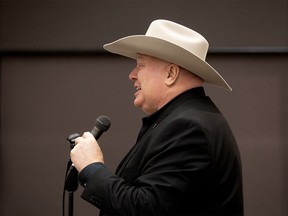
Alberta separatist lawyer Jeffrey Rath urged a judge to throw out a trio of legal challenges from First Nations opposed to a provincial independence referendum, during submissions in which he called one lawyer’s arguments “vexatious,” compared a previous court ruling to an “angry email,” and accused a chief of sharing a racist meme.
Advertisement 2

Article content
Rath, the lawyer for separatist petitioner Mitch Sylvestre, spoke on Day 3of hearings into a series First Nations’ legal challenges aimed at stopping a vote on Alberta separation.
Article content
Recommended Videos
Article content
Justice Shaina Leonard has heard arguments this week from three nations challenging the legality of the proposed referendum — which supporters claim recently reached the 177,732 signatures required for a fall vote on leaving Canada.
Sturgeon Lake Cree Nation, Athabasca Chipewyan First Nation and the Blackfoot Confederacy argue Alberta separation would breach their treaty rights. They fault Alberta for removing a section from the Citizen Initiative Act that prohibited referendum questions on unconstitutional questions, as well as the province’s chief electoral officer for approving Sylvestre’s separatist petition.
Court of King’s Bench Justice Colin Feasby concluded last year that Alberta could not separate from Canada via a citizen initiative — a ruling that prompted the UCP government to pass legislation which removed the constitutional screening mechanism from the province’s initiative law.

Your Midday Sun
Article content
Advertisement 3
Article content
Rath, though, insisted that asking a question of Alberta voters impacted treaty rights not “one iota.”
“What we say is this process is nothing more than a legislatively mandated process of communication between the citizens of Alberta and their elected officials.”
“Nobody has suggested for one iota of a second how those rights could in any way be infringed by citizens communicating with the legislature.”
Claims lawyers misstated law
Rath, an Indigenous law lawyer, piqued Leonard’s curiosity by suggesting Alberta’s referendum legislation does not require the government to hold a vote if a petition reaches the required threshold of signatures. He made the remarks as part of a larger argument that any court challenge is premature.
Using an earlier example given by lawyer, Rath said the government could choose not to hold a referendum on a clearly “offensive” question like doing away with Indigenous constitutional protections.
Leonard said she was under the impression the government had no option but to hold a referendum if a certain number of signatures were validated by the chief electoral officer.
Advertisement 4
Article content
“Wrong,” Rath said. “They (the nation’s lawyers) completely misstated the law in that regard.”
Rath also criticized Feasby’s December decision, which slammed the government’s move to allow separatist campaigners to collect signatures in spite of his finding that citizen initiatives on separation violated the constitution.
Rath compared Feasby’s decision to a sleep-deprived “angry email,” saying he nonetheless had great respect for the judge.
“I think his knowledge of the constitution and the law is encyclopedic. But when a judge doesn’t take a beat to say, ‘Well, hang on a second, the legislature was perfectly within its competence to amend the legislation,’ and instead accuse the legislature of having violated the rule of law?”
‘They want a veto’
Rath scoffed at the idea, advanced by Sturgeon Lake, that the signature gathering process had created conditions that subjected them to “irreparable harm” from both racism and foreign interference from the United States.
Advertisement 5
Article content
He called the harm from “random citizens” saying “untoward” things on the internet “imaginary,” claiming a cartoon Athabasca Chipewyan Chief Allan Adam posted on his Facebook page on the first day of hearings was itself racist.
That led to an objection from Athabasca Chipewyan lawyer Kevin Hille.
“That doesn’t rise to the level of irreparable harm, is my point,” Rath responded.
Adam said the cartoon, which showed a white person with a fork on their tongue, reflected his experience negotiating with and litigating against Canadian governments.
Rath further accused Sturgeon Lake lawyer Orlagh O’Kelly of trying to make the case about U.S. President Donald Trump, accusing her of making “vexatious” submissions that amounted to an “Orange Man Bad” argument.
“It’s embarrassing to these proceedings, and it shouldn’t be considered in any way whatsoever.”
Rath brushed off the idea that treaty rights would not exist in an independent Alberta, comparing the process to the devolution of powers that happened when Canada became a country.
Advertisement 6
Article content
In response to concerns from Athabasca Chipewyan about the imposition of international borders in their territory, Rath noted some Blackfoot nations hold cross-border rights with the United States.
He added of the plaintiffs: “They don’t want to be consulted — they want a veto now. They don’t want this process going forward. They’ve all made it clear time and time and time again.”
Challenges ‘premature’: Alberta gov. lawyer
Earlier Thursday, Alberta government lawyer Neil Dobson argued the First Nations’ legal challenges are too general and too early.
He urged Leonard to consider the narrower issue of whether the nations had been harmed by the chief electoral officer’s decision to issue the separatist petition — not the broad question of whether treaty rights would be impacted by separation.
“What harm is the collection of signatures?” he asked.
Dobson characterized the citizen initiative process as a way for ideas with “sufficient electoral support” to reach the government for discussion and possible legislation — none of which has occurred.
Advertisement 7
Article content
Legislation is something that could be challenged by the nations at the implementation phase, Dobson added, noting treaty impacts would be part of a “much broader” discussion on Alberta’s exit from Canada that would include negotiations on currency, citizenship and the assumption of debts.
“Until we get to the point where the government has to consider these things, it really is premature to be looking at this.”
Leonard plans to reserve her decision, which the nations have asked she deliver before May 2 — the final day signatures can be gathered for the petition.
Read More


Bookmark our website and support our journalism: Don’t miss the news you need to know — add EdmontonJournal.com and EdmontonSun.com to your bookmarks and sign up for our newsletters.
You can also support our journalism by becoming a digital subscriber. Subscribers gain unlimited access to The Edmonton Journal, Edmonton Sun, National Post and 13 other Canadian news sites. The Edmonton Journal | The Edmonton Sun
Article content