
IPL 2026 | Fortresses breached
Between December 1970 and December 2017, the Western Australian Cricket Ground in Perth played host to 44 Tests until it was replaced by the modern monstrosity that goes as the Optus Stadium.
The WACA is one of the most iconic cricket grounds in the world, characterised by terrific pace and great bounce that set it apart from most other Test venues in Australia, possibly with the exception of Brisbane’s Gabba. It was a fast bowlers’ paradise, and therefore it should come as no surprise that of the 11 Tests won by visiting teams — Australia emerged triumphant in 25 — five went the way of West Indies and three were bossed by South Africa.
Asian nations featured in 11 Tests at a ground full of character and excellent cricketing vibes. One would have thought, given their array of pace riches, that Pakistan would have enjoyed at least some success, but all five Tests spread over a 25-year period between 1979 and 2004 ended in losses. Sri Lanka were well beaten in both their appearances, leaving India as the lone Asian team to taste victory at what is the most Australian of venues.
India’s only success at the WACA in January 2008, either side of three defeats, came against all odds. Just 10 days previously, in an acrimonious encounter at the Sydney Cricket Ground marked by a slew of terrible umpiring decisions, all of which went the home side’s way, and by allegations by Andrew Symonds of racist abuse against Harbhajan Singh, India failed to wind down the clock despite a spectacular rearguard action by braveheart skipper Anil Kumble. With less than five minutes left on the final evening, Michael Clarke took three wickets in five deliveries as Kumble watched on helplessly from the non-striker’s end, bowling Australia to a dramatic 122-run win. Allied with their comfortable victory in the first Test at the MCG, it gave the Aussies an unassailable 2-0 advantage in the four-match series.
At the end of the Test where he took great offence as he perceived his integrity to be questioned by an Indian journalist for selectively ‘claiming’ catches that were not, Ricky Ponting issued an unequivocal warning. He said that having won on subcontinent type pitches at the MCG and the SCG, his team would blow India away at the WACA, using pace and bounce as unforgiving allies. Oh, famous last words and all that.
In the wake of the targeting of Harbhajan, who was found guilty of racial abuse and slapped with a three-Test ban by match referee Mike Procter of South Africa, there were calls for India to abandon the tour and fly home to show solidarity with the beleaguered off-spinner. Kumble was firm in his conviction that the team should stay back and fight fire with fire, while making it clear that he and his boys and the BCCI were all solidly on Harbhajan’s side. Saner counsel prevailed and India lined up at the WACA — after a two-day practice game in Canberra — ready to face the ‘wild thing’ that Australia had promised to unleash.
Shaun Tait was rapid and furious, but he could also be erratic and leaky. India’s batters, seasoned and skilled, wouldn’t be cowed down by verbals or searing pace. Tait had match figures of 21-1-92-1, India scored 330 and 294 with Rahul Dravid, Sachin Tendulkar and V.V.S. Laxman all making half-centuries, and pulled off a 72-run heist that must go down as one of their more famous overseas Test wins.
Fortress WACA, as it had been against teams from the subcontinent, had been breached, in telling fashion.
More than a decade on, another Indian team breached an even more formidable bastion, the Gabba, with a motley collection but with ambition in their hearts and fire in their bellies. Somehow, despite losing a slew of influential players for various reasons, India had also overcome the debilitating effects of quarantine and Covid-driven restrictions with equanimity to take a 1-1 scoreline into the Brisbane decider in 2021. Of those who started the first Test in Adelaide, where they had been shot out for an all-time low 36, only three survivors remained – stand-in captain Ajinkya Rahane, batting stalwart Cheteshwar Pujara and Mayank Agarwal. Original skipper Virat Kohli had left home after the Adelaide debacle on paternity leave, while in the infirmary was the entire first-choice bowling group – Jasprit Bumrah, Mohammed Shami, R. Ashwin, Umesh Yadav and Ravindra Jadeja.
Out of compulsion, India handed Test debuts to the Tamil Nadu duo of T. Natarajan and Washington Sundar, neither of whom was in the original squad but had stayed back to discharge ‘net bowler’ responsibilities. The bowling attack, if that is the right word, was stretched thin — Mohammed Siraj was in his third Test, while Navdeep Saini and Shardul Thakur, in his first Test for more than two years, were making their second appearances. India appeared lambs to the slaughter, even in isolation.
Throw in the fact that Australia hadn’t lost a Test at the Gabba for more than 32 years — not since they were beaten by West Indies in November 1988 — and the picture of gloom was complete. India weren’t given a ghost of a chance even by their most passionate supporters.
Post-Adelaide, though, India had shown spunk and character and spirit and bottle scarcely believable. Rahane masterminded a series-levelling win in the second Test at the MCG with a brilliant century, while Hanuma Vihari and R. Ashwin stretched the pain barrier while batting out 42.4 overs to secure a magnificent draw that seemed like a victory in Sydney. We should have seen the coup at the Gabbatoir coming.
Glorious accomplishment
Eking out performances from nearly everyone, head coach Ravi Shastri basked in his most glorious accomplishment as Rishabh Pant’s stunning unbeaten 89 formalised a record run-chase (328) and a three-wicket victory that defied imagination. Miraculously, India had secured the series 2-1 — their second straight series victory in Australia — after having plumbed the depths in Adelaide exactly a month previously. The legend of Gabba was shattered, the myth of Australian invincibility in the Queensland capital laid comprehensively to rest.
Sporting fortresses are designed to be breached because such is the beauty of sport, such is the very nature of the exercise. Carefully constructed, seemingly impregnable edifices can, will and have been stormed, be it Manchester United’s (the other) Old Trafford or Rio de Janeiro’s Maracana. Or, Chennai’s MA Chidambaram Stadium, at one time a Chennai Super Kings fortress, a strong- hold, a bastion but which has now been stormed over and over and over again.
Last Friday’s five-wicket loss to Punjab Kings was the sixth time in succession that the five-time former champions had been conquered in their own backyard. One must go back to March of last year for CSK’s last success at Chepauk, and while the victors will delight at having gone to Chennai and conquered the lion, even the neutrals will have taken note of recent developments with a sense of dismay and anguish.
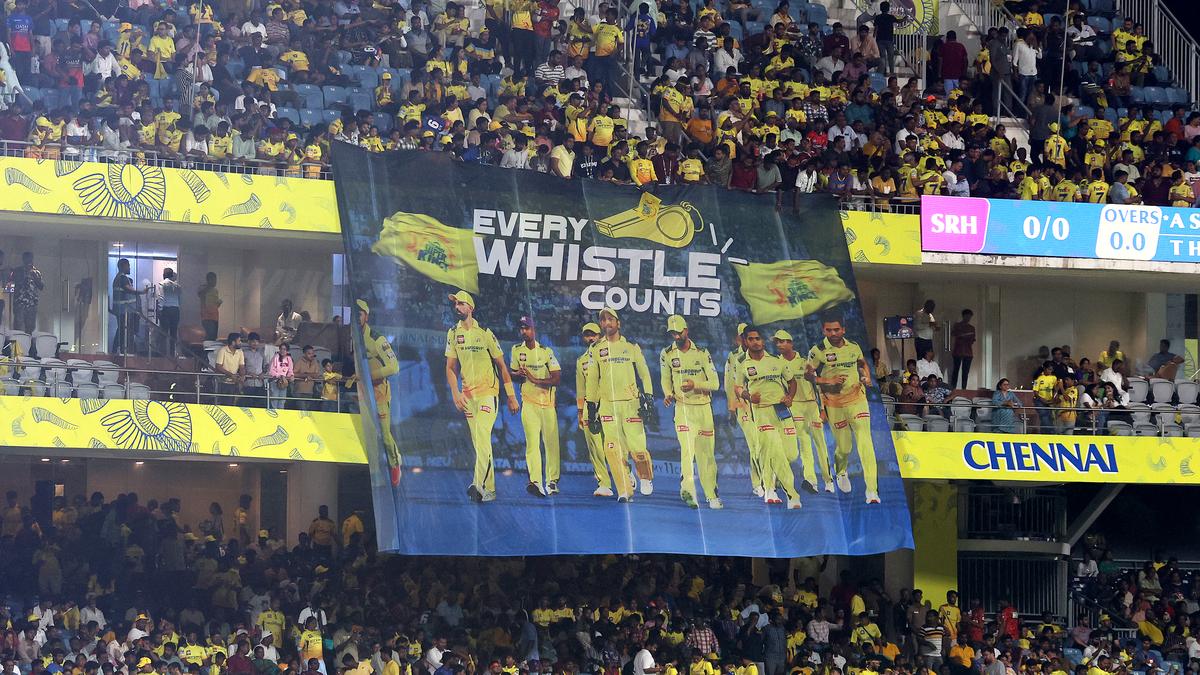
Royal Challengers Bengaluru boast the most vociferous and forgiving fan base, primarily but not exclusively at home, but not even the defending IPL champions can match the Super Kings when it comes to support across the country. Largely because of the Mahendra Singh Dhoni phenomenon, every stadium in every part of the country – and sometimes overseas when the IPL has moved away from India for different reasons – is bathed in yellow when CSK come calling. In a way, every ground must feel like a home ground, much like it must for the Indian team, which is greeted by a sea of blue, be it in Melbourne or Durban, Auckland or Manchester. But at Chepauk, understandably, the yellow isn’t just the dominant theme, it is the only theme.
Why, on Friday, Ian Bishop was standing two feet away from CSK captain Ruturaj Gaikwad, and still the two couldn’t hear each other at the toss, such was the deafening crescendo as the fans roared in approbation and appreciation. The decibel levels sent the metaphorical roof flying when Ayush Mhatre cut loose, when Sarfaraz Khan slipped into his cheeky best and when Shivam Dube applied the finishing touches to an innings that ended on 209 for five, only for Punjab to launch a sensational assault on the target through Priyansh Arya, Prabhsimran Singh and Shreyas Iyer, their captain.
That shattering defeat was far from the ideal way to kick off the home campaign for CSK, winless after their first three games and now sitting on an unenviable six-match home losing streak. Almost incredible, considering that before this unchecked downward spiral, they had won a whopping 51 of 72 matches (70.83%) at the venue.
To boast such a wonderful record in the most fickle and unpredictable of formats was tribute to CSK’s understanding of the conditions and of their ability to piece together the resources that would help them exploit those conditions. In cricket especially, home advantage counts for a huge deal, as evidenced by India going a dozen years without losing a Test series in their own patch (that has since changed, of course, following dismal surrenders in the last year and a half to first New Zealand and then South Africa). CSK elevated making the most of playing at home to a fine art, with Dhoni manoeuvring the marionette with dexterously firm hands.
Now, it’s almost unthinkable that CSK were all but impossible to overcome at Chepauk. For now, the fans will settle for one home victory, for a start, if only to arrest the inexorable slide and to lift the depressing pall of gloom that has settled over the celebrated venue. It’s a dramatic fall from grace for a team that was the first to successfully defend the IPL crown (in 2011), which bounced back from a two-year suspension to add a third title in 2018, and followed it up with grand triumphs in 2021 and 2023.
Every time CSK had a poor season, they hit back strongly 12 months on. Their diehard fans had hoped history would repeat itself after the wooden-spoon finish of 2025, but their start to the 2026 campaign has been anything but encouraging. If they are to hit back from three successive losses, they need to embark on a winning run – at least at home, once their unchallenged stronghold but now a foreboding, unrewarding proposition.