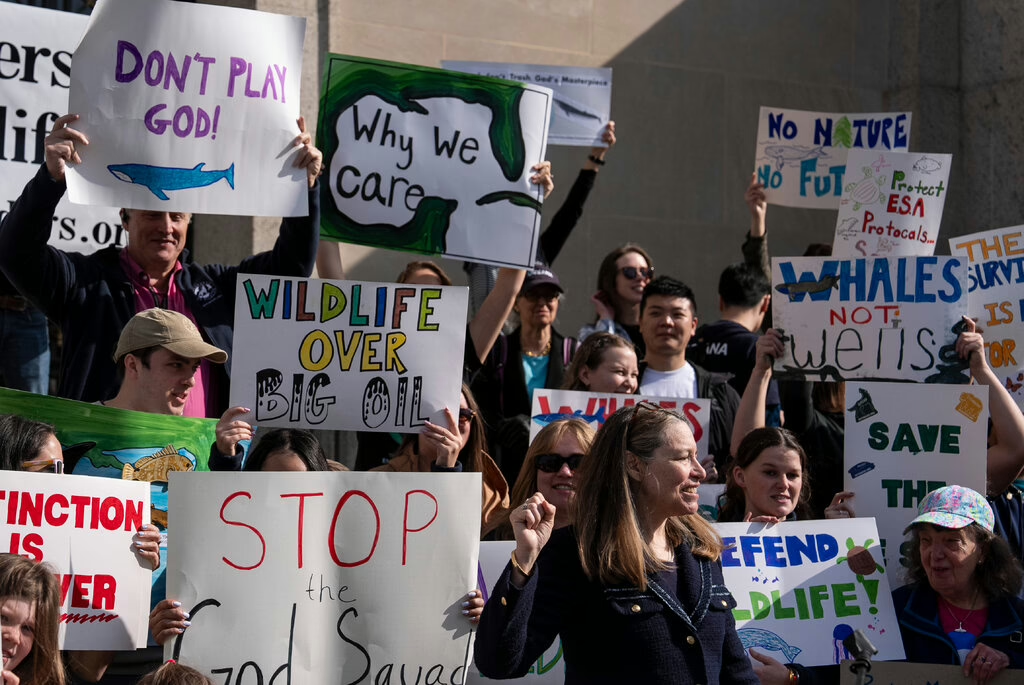

Voices for the ESA: Susan Holmes on Why We Must Defend the ESA
“Good morning and welcome, everyone, local advocates, environmental groups, scientists, faith leaders, students, and the Members of Congress who have joined us.
My name is Susan Holmes, and I am the executive director of the Endangered Species Coalition, a national coalition of 475 conservation organizations dedicated to the protection and recovery of endangered species.
We are standing here today because something dangerous is happening in the building behind us.
For the first time in more than 30 years, the Trump administration has convened the Endangered Species Committee—the so-called “God Squad”—to consider a sweeping exemption from the Endangered Species Act for offshore oil and gas drilling in the Gulf of Mexico.
Let’s be clear about what that means.
It means a small group of political appointees are attempting to override science, silence public input, and decide—out of view of the American people—which species live and which species die. It means that the Trump Administration is willing to sacrifice a species to save the fossil fuel industry a few dollars by allowing its boats to drive faster and more recklessly.
It means playing God with endangered species.
And nowhere is that more stark than with the Rice’s whale.
The beautiful Rice’s whale has evolved over millions of years. Today, there are only 51 Rice’s whales left on Earth. Every single one lives in the Gulf, and everyone is a precious key to recovering the species. And now, instead of strengthening protections for this species on the brink, this administration is considering actions that could push it to extinction.
Also at risk are endangered Kemp’s Ridley and loggerhead sea turtles, manatees, smalltooth sawfish, Rufa red knot, and countless other species that depend on a healthy Gulf ecosystem.
No administration—Republican or Democrat—has ever attempted something this sweeping. No administration has ever flouted process and the law to sidestep the core promise of the Endangered Species Act: that we will not allow species to disappear on our watch.
For more than 50 years, that promise has held.
The Endangered Species Act has prevented the extinction of 99% of listed species. It has helped bring bald eagles back from the brink, restore whales to our oceans, and prove that when we act with determination and respect for science, recovery is possible.
That is the legacy now at risk.
This is not just about one meeting. It is about whether we allow backroom decisions to unravel decades of progress. It is about whether we trade irreplaceable wildlife and ecosystems for short-term industry profits.
And it is about whether we accept a future where extinction is treated as acceptable collateral damage.
We are here to say: we do not accept that future.
We are here to say that decisions about endangered species must be guided by science, transparency, and the will of the American people—not politics and not profit.
And we are here because we know something powerful:
When people come together like this—when we raise our voices, when we stand our ground—we can protect what matters.
We have done it before. And we will do it again.
Because the story of the Endangered Species Act is not just a story of risk—it is a story of recovery. It is proof that extinction is not inevitable if we choose a different path.
So today, we stand not only in opposition, but in determination.
Determination to defend the Endangered Species Act.
Determination to protect the Rice’s Whale, the Gulf, and all the life it sustains.
Determination to ensure that no administration gets to decide the fate of our most endangered species behind closed doors.
I want to recognize the incredible coalition standing here today—national organizations, local advocates, scientists, faith leaders, students, and the Members of Congress who have joined us.
Your leadership matters. Your voices matter. And together, we are sending a message that cannot be ignored.
We will not stand by.
We will not be silent.
And we will not allow anyone to play God with endangered species.”