[ad_1]
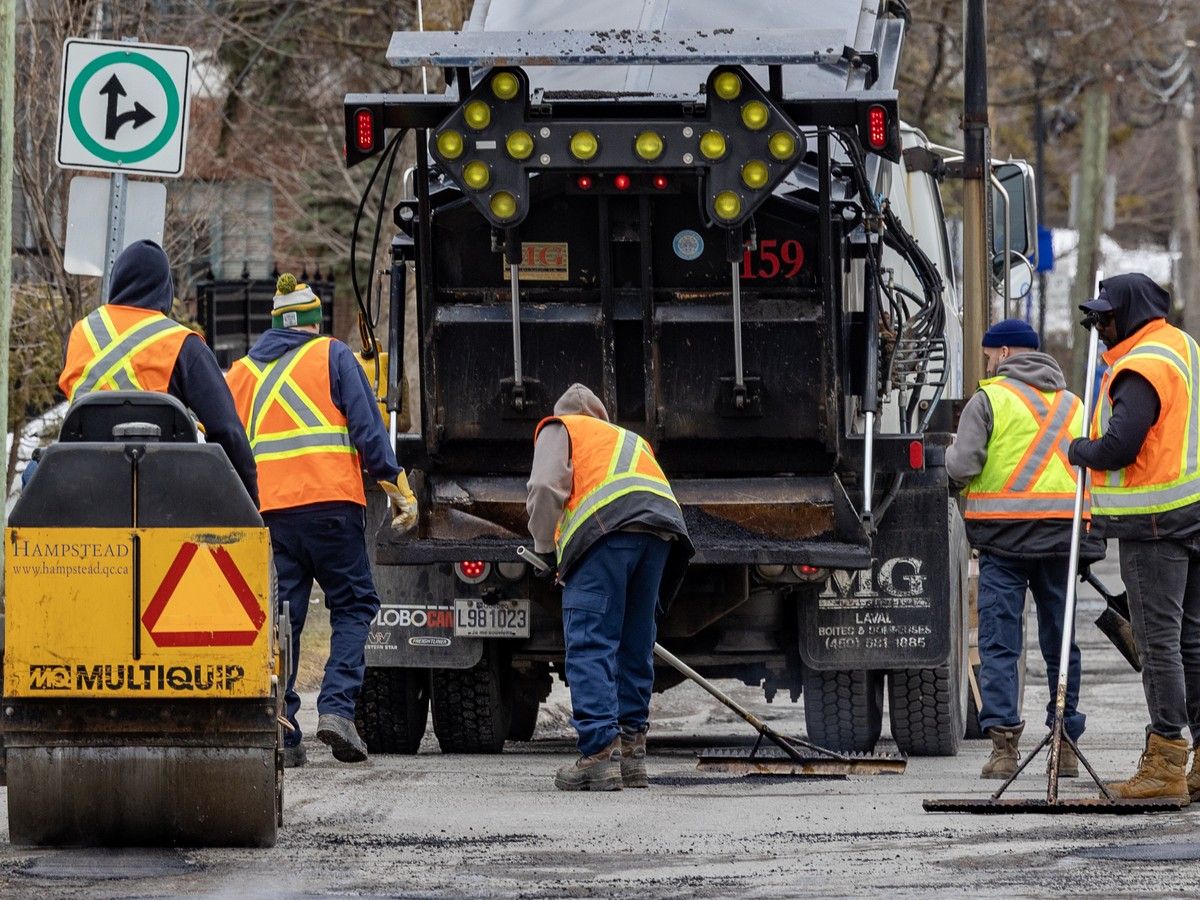
Hampstead’s former mayor is warning his successor the project to repave
Ellerdale Rd.
will be a short-term fix unless the town digs up a concrete slab buried underneath the asphalt.
Named one of the
worst roads on the island of Montreal last year
by CAA-Québec, Ellerdale is laden with potholes, and hubcaps that fall off of cars from navigating the bumpy surface. Cars often veer into oncoming traffic to avoid some of the worst craters.
Last year, the green light was finally given for the road to be repaved after about a decade of miscommunication between the City of Montreal and the Town of Hampstead. While Hampstead is in charge of the state of the road, it is the city that takes care of a 750-mm water main buried underneath the road. Hampstead didn’t want to risk rupturing the aging pipe with roadwork, and sought assurances from the city that it would not be held liable if the main bursts and causes a flood.
Last year, the city confirmed the main won’t need replacement for at least 30 years.
Earlier this month,
Hampstead awarded a nearly $1-million contract
to Roxboro Excavation to conduct the work. However, that contract stated the concrete slab beneath the asphalt must remain in place, but be repaired in places where it is deficient.
Former mayor Bill Steinberg said
because much of Hampstead’s soil is clay, having a concrete base is a recipe for disaster, since the clay underneath the slab isn’t solid, so it causes degradation as it settles.
“When I was first elected (in 2005), there was a big problem on Fleet Rd., even though it was being resurfaced every two or three years,” he said. “We were told that underneath that concrete base a huge cavity had formed, and it was acting as the surface of a drum and amplifying all the vibrations of the road.”
He said the process took two years, but the town elected to remove all the concrete and replace it with crushed stone. The road surface is still in a good state nearly two decades later.
Steinberg said unless the town elects to remove the slab under Ellerdale, he believes the roadwork will be just a temporary fix and crews will have to return “within two or three years” to do the work all over again.
“They’re taking a cheap, fast fix and in the long run, it’s not going to be good,” he said. “I’m not saying it’s going to be back the way it is today, but it’s not going to be acceptable.”
Reached Thursday, Hampstead Mayor Jeremy Levi said the town consulted engineers, who said the concrete slab is essential to protect the underground water main from the vibrations of cars, trucks and buses.
“The decision to not replace the entirety of the concrete slab was because of what our engineers told us,” Levi said. “The difference between Ellerdale and Fleet is that Fleet has no water main.”
Levi said the town must avoid any major interventions involving the concrete slab because it could cause the water main to rupture. Instead of replacing the entire slab, or removing it, the workers will repair the concrete where there are failings.
“This has nothing to do with financial constraints, cutting corners or not doing this properly.”
He said he’s confident the road will remain in good condition for at least 15 years once the work is carried out.
Reached by The Gazette, engineering professor Éric Lachance-Tremblay said it is very rare, especially outside the island of Montreal, for roads to be built with concrete slabs underneath.
“I work with about a dozen municipalities in my research, and in no case do we have concrete slabs underneath road surfaces,” he said.
He added that the island of Montreal is the exception, as a lot of roads were built with concrete slabs.
“I don’t know why this was done initially, but what is clear is that having concrete underneath asphalt isn’t optimal in the long run,” he said. “It is difficult to maintain and to rebuild when it comes to the end of its useful life. It’s definitely more difficult to remove concrete than crushed stone.”
Lachance-Tremblay said it’s not necessarily true that having a concrete slab would result in a road surface that degrades quicker. Ideally, the town would take the slab out, but that is a huge job that would take much longer and cost much more.
Steinberg agreed, saying he was surprised at the relatively low price tag for the work on Ellerdale, as he had received estimates of $3 million or more to conduct the work.
“But when we did the estimates, that included removing the concrete,” he said.
Lachance-Tremblay said there may be something to the idea that a concrete slab would better protect underground water infrastructure, as concrete is more water resistant than crushed stone.
Speaking for the City of Montreal, Marc-Antoine Bélanger said there appears to be no definitive answer as to why some of the city’s roads were constructed with concrete slabs. It is a phenomenon that was common between the 1940s and 1970s, he said.
“In a context of rapid expansion and the increase in road traffic, concrete was seen as a solid, durable base while crushed stone offers a surface that’s comfortable and easy to maintain,” Bélanger said.
He added that mixing concrete and asphalt is no longer a common practice when redoing roads. However, when work is carried out on such roads, the concrete slabs are often kept in place while the asphalt is redone and the road is resurfaced.
Bélanger’s response suggests the City of Montreal’s approach to concrete slabs is similar to that of the Town of Hampstead with respect to Ellerdale.
Related
[ad_2]