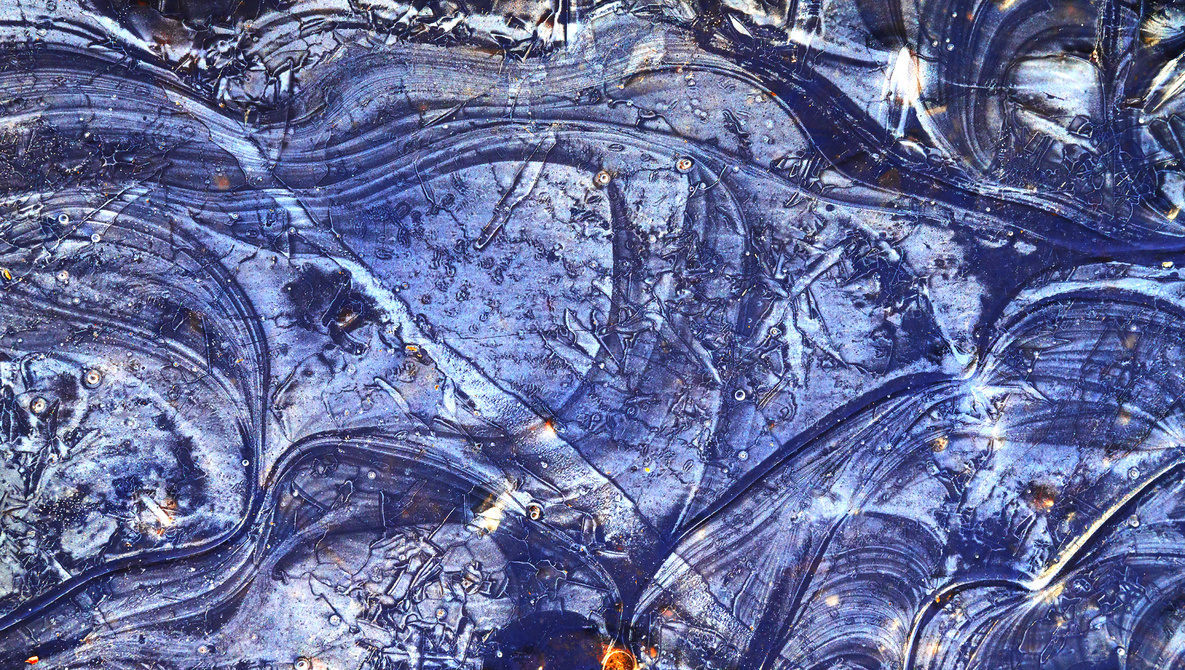
The photograph at the lead of this article was made one cold winter morning when I went out to pick up my mail. There had been a snowstorm the day before, and it had partially melted and refrozen in the night. I used an iPhone and processed the image in Lightroom and then in Photoshop.
Beauty is Everwhere, Don’t Get Visually Constipated
In my university teaching career, one of my main tasks was to teach my students to look beyond what they were seeing and see what was greater than what was there in front of them. Georgia O’Keeffe made a very keen observation about seeing. She said, “No one really sees a flower because that takes time, like having a friend takes time.” A verse from the Bible comes to mind: “Having eyes, they see not, and having ears, they hear not.”
That was very true for many of the students. They had some of the most advanced photographic equipment available, and yet the work they turned in was often just the same: ducks on a nearby pond, an empty park bench, an on-camera flash image from a child’s birthday party, and so on and so on. It is very true for many photographers even today.
A very common complaint among my students was that there was nothing to photograph. We are set out on the southern end of the Great Plains, so truly, if you were wanting to portray mountains and streams, trees and wildlife, the pickings were pretty slim. I often would coach them with a phrase that I see as very true: “Beauty is everywhere, don’t get visually constipated.” In other words, open your eyes to the beauty all around you; you just have to train your eyes to see it.
Your Photograph Should Be Evidence of Who You Are, Not a Weak Imitation of Someone You Are Not!
That’s all well and good, but how do you do that? I had several assignments designed to teach people how to see. One of them was to look for patterns, and the assignment was to make a series of images that show patterns, both repetitive and nonrepetitive.
This image is of a local Shell distributor’s building. I was fascinated by the contrast of the verticals of the metal on the buildings and the vertical pattern of the grain elevator as the background, versus the angles of the construction and the semicircles in the Shell logo. It’s next door to the tire shop where we purchase tires for our vehicles. I got my tires serviced, went back to my house, brought my camera bag back to the location, and made this image.
Look for Things that Have Visual Interest
You don’t have to drive for hours or fly halfway around the world to find interesting image material. You drive past it every day.
In the image above, we had a very violent thunderstorm system move through our area. I knew that storms typically move from a southwesterly direction to the northeast, so when I could see clear sky in the southwest, I got in my truck and drove to a spot I know about ten miles west, parked, and made some photographs.
I drive past these almost every day as I go into and out of my city. It had rained very hard, the storm was breaking up, and there were nice reflections in the puddles of rainwater.
Teach Yourself to See What You Don’t See
Another assignment was to make 24 completely different images of the same object, and they could show the complete object in only one of the images. For instance, in the illustration above, the student would have to work at finding 24 different compositions of the grain elevator and storage bin structure. That required them to really look at what it was they were portraying.
Incidentally, I, as their instructor, did the same assignments they did and had them critique my images just as I would critique theirs. IMHO, that was a very good practice—kind of like in sports, when we were required to run laps and the coach ran with us.
Be Observant
Watch the things around you and photograph things, even if you don’t think you’ll ever use them.
This image rested in my archives for several years, and nothing had been done with it. I was doodling around with it one very cold winter morning when I came to this conclusion: it looked like a space phenomenon to me. Always try to observe what’s around you and look closely at things you might not even have considered earlier.
Pay Attention to What’s Right in Front of You
There’s an old saying: “Familiarity breeds contempt.” Many times, in our hurry to get where we are going, the beauty all around us goes unseen. We have seen it so much that it becomes familiar, and in that familiarity, it becomes unseen.
So what if the sky above became your palette? We have had a marvelous spring, summer, and fall season here in eastern New Mexico with numerous weather systems moving in and out of our area. So much so that there have almost always been fascinating cloud patterns almost every day, and no two of them are the same. We have a tendency not to see the beauty at hand because the human tendency is to want what we don’t have and to ignore what is right in front of us.
I had driven to town to pick up a prescription at the pharmacy, and as I got out of my car to go in, I saw this cloud structure off toward the west. I didn’t begin to recognize what I had until I got home and uploaded it to my computer. Only then did I see the possibilities it held.
These leaves were in my yard earlier this spring. The leaves fold out as very light yellow against a darker green background of more mature leaves. This leaf caught my eye as I was playing with my dogs in my front yard. Many times, you don’t have to go very far to find something interesting to photograph.
Don’t Allow Your Style to Dictate Your Work
Don’t allow your style to dictate what you do and don’t photograph; instead, let your photographs determine and direct your style. I am by nature and inclination a landscape photographer and did general commercial and advertising photography before that.
Many times, that meant I would have to take a product that I really had no personal connection with and make it look attractive, whether it was an engine part, handgun, deep-fried burritos, or even Christmas decorations. The thing I learned in all of that is that the determining factor in making uninteresting subjects appear interesting was in how I looked at them.
And remember, that was in the film days. Photoshop editing wasn’t available, so we had to make things interesting in the camera. Whether it involved an unconventional use of studio lights, a unique point of view, or some other tool, we had to make things visually interesting.
So, while my natural inclination is to photograph a grand landscape or some other scene from nature, I have learned to try to see things in a way that I hadn’t done before.
Photograph the Thing That Fascinates You in the Moment
In my judgment, we do our best work when we portray the thing we are interested in, in the moment. That means we cannot recall something from the past with our camera, nor can we project into the future. Concentrate on seeing what’s in front of you and find a fascination in the moment you are in.