[ad_1]
More than 7.5 million people immerse themselves in lakes, rivers, seas and lidos every year in the UK.
But getting in the water means getting in pollution too for most outdoor swimmers. Raw sewage was discharged into UK waters for 4.7 million hours during 2024. But sewage is only part of the water pollution problem. Rain washing into rivers and streams contains fertilisers, pesticides and animal waste from farmlands, forever chemicals from car tyres, plus drugs from our own bodies. Industry deregulation and privatisation have produced a water crisis.
Dirty Business, a new Channel 4 docudrama highlighting this crisis, is a welcome call for action, though not a surprising one for anyone who swims outdoors regularly.
Through our research, and in our own swimming, we have explored how outdoor swimming is not simply a recreational hazard to be avoided. Within outdoor swimming communities, negotiating risk, responsibility and vulnerability has always been central to this activity.
As one swimmer shared with us: “I have followed [the environmental charity] Surfers Against Sewage for many years. My first glimpse of a condom was as a child, swimming near a sewage outlet.” Through these experiences, swimmers learn to read the water around them, developing skills and knowledge that help them to keep swimming through it all.
Read more:
Why wild swimming is better for your mental wellbeing than open-air pools
Feminist philosopher and social theorist Donna Haraway writes about “staying with the trouble”: sitting with difficulty rather than looking away from it. For the swimmers we spoke to and swam with, this is exactly what getting in the water means. The swimmer’s body becomes a site where ecological crisis is felt directly.
One swimmer described how his understanding shifted: “My awareness of pollution massively increased as I started to swim. You realise [Lake] Windermere is polluted, Grasmere is polluted. Your eyes open to it. Your nose opens to it.”
Writing about surfing in the UK, cultural theorist Clifton Evers and health and wellbeing professor Cassandra Phoenix describe the sport as “polluted leisure”. Swimmers encounter this contradiction directly. They feel pollution in the water against their skin, in the smells of their swim spots and in the residues left on their bodies, kit and memories.
Read more:
England’s sewage scandal hinges on lack of water industry regulation – new docudrama reveals how profit drives pollution
To swim with the trouble of polluted waters is not to accept their degradation. Our research has consistently shown that outdoor swimmers refuse to look away. To continue swimming alongside pollution, swimmers draw on situated, embodied knowledge of their swim spots. They monitor sewage outflow maps, keep their heads above water or decide to stay on shore if the water smells wrong.
Through navigating pollution, outdoor swimmers are reminded that the health and wellbeing of our bodies is bound to the quality of our waters and is folded into wider relations of cause and consequence. Swimmers, like everyone in modern society, are implicated in the agricultural systems, consumer habits and infrastructural demands that contribute to polluted waters.
When we swim alongside microbial life, fish, algae, our waste and agricultural runoff, we experience what Haraway calls “response-ability”: not just the capacity to respond, but the obligation to do so. Indeed, as feminist cultural studies researcher Rebecca Olive has argued, taking care of our waters must move beyond aspiration: it must be about action.
Safia Bailey, Author provided (no reuse)
Swimming with the trouble
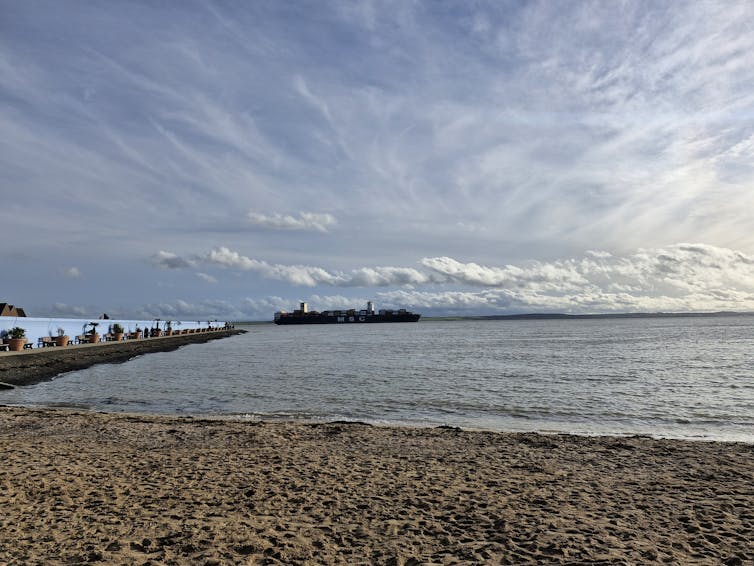
Across the UK, outdoor swimmers are enacting that response ability: through collective action and protest, legal challenges and awareness-raising swims. Some get involved with citizen science and water testing or build progressive alliances that build communities of change, expertise and action.
As a result, bathing water designations are increasing. These are locations protected in law for swimming, and the only sites where investment in water quality has historically been approved and monitored. There are currently around 600 designated sites in the UK. Thirteen new sites were proposed in February 2026.
We often see the processes that bring about these changes led by outdoor swimming communities and others with a deep love for the water. For one swimmer we spoke to, London’s first potential bathing water designation was a “legacy”, an opportunity to care for a river that has given her joy, solace and rejuvenation.
Dirty Business is a demand for systemic change in the water industry, change that swimmers are fighting for. As writer and outdoor swimmer Ella Foote has explained, this crisis must not force us to sit on the shore. To accept that is to accept that shared waters are a sacrifice zone that has been degraded by private interests, abandoned by regulators and made inaccessible to the public.
To swim with the trouble of pollution is to immerse yourself in the relationship between human and ecological health – to feel it on your skin, to carry it home with you and to refuse to look away.
Swimming, sailing, even just building a sandcastle – the ocean benefits our physical and mental wellbeing. Curious about how a strong coastal connection helps drive marine conservation, scientists are diving in to investigate the power of blue health.
This article is part of a series, Vitamin Sea, exploring how the ocean can be enhanced by our interaction with it.
[ad_2]