
The stories of the Iranian footballers granted asylum by Australia, and those who went home
The fourth may have been the impossible decision of whether to stay in Australia and start a new life, free of potential persecution by the Islamic regime, which was angered by the team’s Asian Cup silent anthem protest, but with nothing else she has ever known.
To join captain Zahra Ghanbari, Fatemeh Pasandideh, Zahra Sarbali, Atefeh Ramezanizadeh and Mona Hamoudi in successfully seeking asylum, but be without her mother and her friends and a good, solid football salary that has already helped the 24-year-old immeasurably.

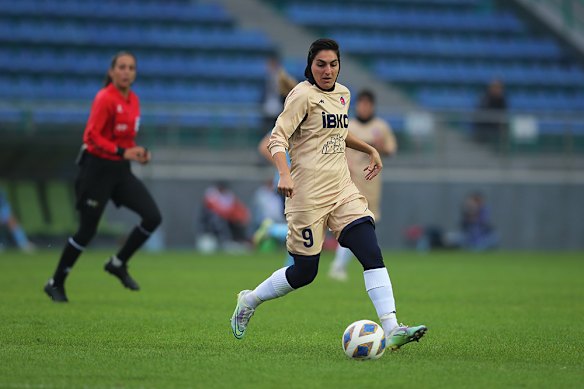
Iranian footballer Zahra Ghanbari during a match.
Khosravi had a particularly hard time deciding what to do, according to a source who spoke with her regularly during the tournament.
“She was like, ‘I have everything in Iran. I know there’s a war and everything, but I don’t know what’s the right thing to do. I don’t know what they’re going to do to us when we get there’,” the source said.
A 2001 baby, Khosravi grew up just as Iran was on the brink of growth in women’s football. When female activists in the White Scarves campaign fought for stadium access (and often broke into what were male-only crowds), they utilised the popularity of football to push for broader social and gender rights.
In April 2006, President Mahmoud Ahmadinejad announced that women would be allowed to attend football matches inside large stadia for the first time since the 1979 Islamic revolution, only for recently assassinated supreme leader Ali Khamenei to reinstate the ban a fortnight later.

Iran’s Atefeh Ramezani during a happy moment.
Change was starting, but there wasn’t yet a local women’s football club for a nine-year-old Khosravi to join. Instead, she started playing futsal – Iran’s premier indoor sport and a form of soccer – but was soon noticed by national junior team officials, who had her back on an outdoor field by the time she was 10.
“We literally incubated her for a few months to just train her soccer skills so she would perform as well as the other kids,” former Iranian women’s international Katayoun Khosrowyar, who was the national youth team coach at the time, told the AFC in 2020.
“She was really skinny, but so fast. Golnoosh always loved soccer, starting when she first set her eyes on a ball, and her mum always supported her. I gave her debut in the under-14s, where she scored her first goal, and since then she has been a starting player.”
Khosravi “had the coolest haircuts, all the cool cleats”, says another Iranian source close to the players, who has requested anonymity to protect the safety of their family.
“She was very fashionable – one of the cool kids – and everyone wanted to be like her or cut their hair like her,” says the source. “But she’s lovely, very graceful. She takes care of her family. She takes care of her mum and her community.
“In Persian culture, when you travel, you always come back with a souvenir for your friends and family. This girl would spend all her money the federation would give the players on souvenirs for friends and family. So imagine when she’s got older: the souvenirs started becoming like, ‘I’m saving for down payment for a house’.”
Through her football earnings, Khosravi got her family out of the slum and into a house, and her profile rose further in 2019 when, aged 18, she became the youngest Iranian woman to play club football in Europe, spending a season with five-time Turkish champions Konak Belediyespor before returning to Iran with Bam Khatoon.
On Tuesday night, as the rest of the team waited at Sydney airport to board a flight to Kuala Lumpur, it appeared Khosravi might make a last-minute decision to stay in Australia. Home Affairs minister Tony Burke revealed one player had asked to speak with family members in Iran for advice on what to do. “We weren’t sure which way that person would go,” Burke said. “That individual, though, ultimately made their own decision [to leave].”
With her on the plane went a group of players and staff, all with their own stories. Who, despite coming from all over Iran, from a range of socioeconomic backgrounds and different dialects, play for their country as teammates.
Among them is Maryam Yektaei, the Turkish-Iranian goalkeeper and the only player not based in Iran. Yektaei is “a big deal” in Turkey because, along with playing football professionally, she also works as a television news anchor and a doctor in sports health science and athletic performance.

Iran’s Maryam Yektaei during the match against Australia earlier this month.Credit: Getty Images
Heading back to Iran, despite fears for their safety and possible persecution, is Melika Motevalli, the defender who “took care of business on the field” in a way that did not match her smart, quiet off-field demeanour, and whose sister and fellow defender was the same.
Then there is striker Afsaneh Chatrenoor, also 27, who on Tuesday was captured by cameras being led by the wrist by a teammate onto a Gold Coast bus leaving the team hotel bound for the airport.
Loading
Chatrenoor is the captain of domestic club Shahrdari Sirjan and a smart player whose father is a politician. “But a good politician who helped women have their own stadium,” says another source. “And he made sure women were able to come watch games. He did everything the government didn’t want them to do.”
And there is Shabnam Behesht, a co-captain on the night the team did not sing the national anthem, who is all about football and has no time for chit-chat about anything else.
Also, 25-year-old midfielder Fatemeh Makhdoumi, a Kurdish-Iranian who avoided a traditional Sunni arranged marriage by joining the national team set-up as a child.
And Fatemeh Shaban, a 23-year-old midfielder from a strict religious family who started as a quirky kid and soon became the team favourite, finding her voice in football – and an endurance and fight that made it impossible to get past her.
These are but a few of the players whose fates are now unknown. Of the five who opted for a new life in Australia, the longest serving is captain Ghanbari.
The 34-year-old forward joined the senior team as a 14-year-old who loved tricking her older teammates – skills no doubt learned from her brothers. A tomboy “to the max”, she always wore cool kicks and had a hardheaded approach towards becoming successful in a system not welcoming to female footballers.

Iran’s Atefeh Ramezani during a match.
Ghanbari came from the generation that still had to dress like boys so they could train with other boys and male coaches because that’s all that was available. In November 2024, she was suspended by Iran’s federation because her headscarf slipped off during a last-minute goal celebration in an AFC Women’s Champions League match and was forced to apologise before being allowed to rejoin the team.
Loading
And she was a source of inspiration for many other Tehran girls who did not know football could be an option. Now that it is, Ghanbari has seen and benefited from the changes since.
They include lucrative domestic salaries bankrolled by numerous wealthy sponsors.
Her successful club Bam Khatoon, for which half the national team plays and is coached by national team coach Marziyeh Jafari, is based in Bam, a city with a healthy date export business that hands out player salaries as high as a reported $US140,000.
Ghanbari’s father died recently, and she is her family’s sole breadwinner, rendering her decision to stay even more difficult.
The highest profile of those granted asylum is probably Sarbali, the 32-year-old midfielder and the comedian of the team. “Really funny and annoying on the field,” says the source.
“Off the field, she’s just this ball of energy. In the middle of game, she’ll just have to talk to herself, and says really funny things to herself like ‘Why are you being slow? Come on. You’re walking like a donkey. Get yourself together.’ She doesn’t speak English at all, but she mimics it really well. She will make it sound like she’s speaking English and start rapping.
“But she loves her mum. She loves her country. This also was not an easy decision for her in any capacity because she was like a legend in Iran. Gets paid very highly, always getting sponsorship deals and is well respected.”
And then there is Hamoudi, who speaks Arabic and Farsi as well as a little English, and has an aptitude for business. Along with Pasandideh and Ramezanizadeh, “Australia now has five great women”.
“And they are football lovers,” says the source. “They did a lot to help change Iran for all the right reasons. These are the change makers, the playmakers. They’re the heart and soul of the country, because sports and women in sports was something that they tried taking away from us many times.

Iranian footballer Mona Hamoudi attempts to get away from a Sydney FC opponent.
“They want to integrate to society and make a positive impact. I know Australian women have been doing the same over the last few decades. We all are fighting the same struggle, but for them it’s the struggle to wean off this whole Islamic ideology. It’s not part of us.
“Wearing the hijab is mandatory. We have to wear it. So we’ve always had not just the internal pressure on our shoulders, but also the external pressure on us. Most of the girls have short hair. They have to cut their hair to feel lighter under their hijab, which is very heavy. These girls’ profession is football players, so every little ounce counts.
“We’ve always had to fight to get the jerseys or the gear or the kit. Or fight to get better quality of just material. Imagine wearing polyester from head to toe. The sweat doesn’t drain, and you’re just sitting there wearing these extra kilos of clothes. If these girls do play on a team in Australia, just watch the difference. But we were willing to do it and accept it just so we could play.
“These girls would have never decided to stay unless they really had to. They had everything for themselves back home. Great salary, their family, their friends, they have everything there. This decision was not made lightly, and these girls have seen and been through it all in Iran – and Iran is a beautiful country.”