[ad_1]
In February, Leicester Cathedral hosted a British Sign Language (BSL) service celebrating a deaf marriage that took place in the church 450 years ago, in 1576.
The groom was a deaf blacksmith from Leicester named Thomas Tilsey, who made his wedding vows in sign. It was so unusual that the clerk who witnessed the marriage recorded it in full in the parish records. Although the BBC reported that this marriage was “one of the earliest recorded examples of inclusive worship”, by 1576 deaf people had been marrying using sign language for almost 400 years.
These signs were probably not the complex languages we know today as BSL or ASL, but rather what linguists describe as “homesign”: a semi-structured form of signing that develops in small groups of deaf people. However, it was still complicated enough for deaf men and women to rely on friends and family to act as interpreters and structured enough that the 17th century mathematician John Wallis described learning the “language” of deaf signers.
The medieval church’s acknowledgement that signs were equivalent to a spoken language was transformative for deaf people. Sign language recognition unlocked the world, letting deaf people inherit property, go to court and even challenge their hearing friends and family. It is not a straightforward story of inclusion, however, and it is a struggle for equality that continues today, with the British Deaf Association continuing to campaign for the equal access to BSL.
Sign and the law
In 1198, Pope Innocent III issued a decree that deaf people should be able to get married by making their vows in sign language. Since marriage has wide-reaching legal implications, this was a powerful recognition that deaf signers were as capable of consent as anyone else.
These decrees became part of the church law that stretched across Europe, and gradually the principle was applied in other areas too. After the papal ruling, deaf people used sign language to go to court. In England, a court case involving a deaf signer was recorded in 1344, and by the start of Henry VII’s reign it was being routinely taught to legal students that signs could replace vocal speech in property law.
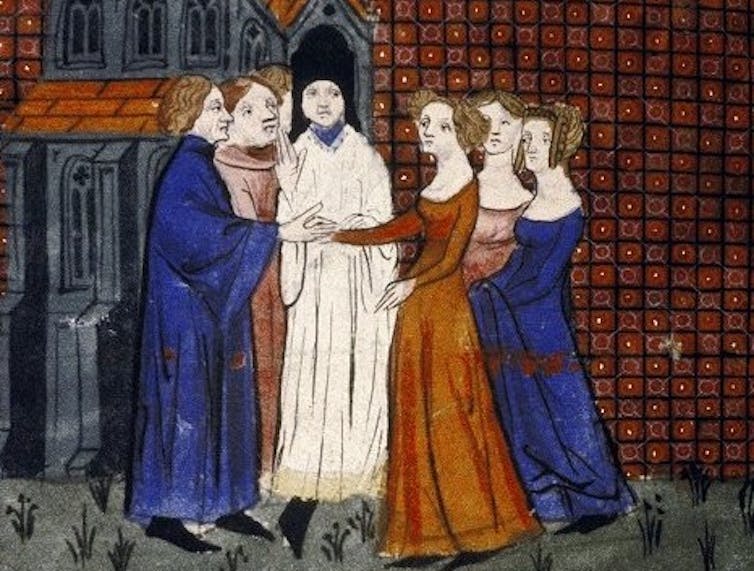
Grandes Chroniques de France. MS/Wiki Commons
.jpg)
In churches across Europe, including England, deaf people could attend Mass or make their confession using signs. These practices were carried into the new Protestant Church of England.
The significance of recognising sign languages as equivalent to a spoken language can not be overstated. It challenged a long legal tradition, first seen in ancient Rome, that decreed people who were deaf and did not speak were cognitively impaired and should be treated like infants in legal situations.
Since deaf people could neither hear to understand, nor express their consent, lawyers across Europe argued well into the early modern period that they could not make contracts or even be held responsible for crimes.
As late as the 17th century, the barrister Michael Dalton claimed in a legal handbook that “if a man born deaf and dumb killeth another that is no felony, for he cannot know whether he did evil or no”. This reflected a long tradition, often attributed to Aristotle, that speech was necessary for intelligent thought, and was evidence that humans were superior to animals.
Perhaps the greatest test of how far sign language was recognised came when deaf people challenged their hearing family. Another deaf marriage, this time in Jacobean Essex in 1618, involved just that. The groom was a young deaf man called Thomas Speller, who had moved to a nearby village to train as an apprentice, fallen in love with his master’s daughter – Sarah Earle – and wanted to marry her.
Thomas’ mother, Winifred, objected – perhaps because the marriage would mean an end to a significant annuity. She did everything she could to stop the marriage. She complained that Sarah was a fortune hunter, that Thomas was being forced into the marriage against his will and that he was not capable of making informed consent.
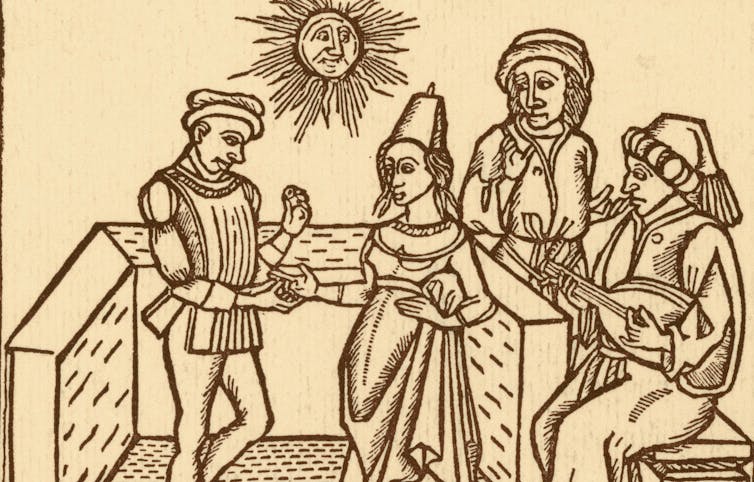
Granger Historical Picture Archive
The local bishop launched an investigation, but it was only when Thomas and Sarah travelled to London to see a representative of the bishop that the case was concluded. A secretary recorded that Thomas told the bishop’s lawyer that he wanted to marry Sarah, and he did so in sign language. His mother’s concerns were put aside, and a marriage license was issued for the pair to get married. They did so a few weeks later in London, with Thomas using signs to marry Sarah. And while it was unusual – the parish clerk noted “we had never seen the like before” – without Thomas’ mother in the picture, it went off without a hitch.
A couple of decades later, in Bedfordshire, another deaf man – George Blount – married against his parents’ will. This time the problem seems to have been that he married a former family servant, someone they held in low esteem, describing her as “one of our menial servants of unclear parentage”. When George’s father, Giles, believed that he would have to support any children from the marriage he wrote to his local magistrate, claiming that the marriage was invalid since George was not capable of consenting.
Again, there was an investigation, and the witnesses from the wedding and the vicar were interviewed: they all reported that though George couldn’t say the words of the wedding ceremony, he showed his “willingness” to marry and was declared “full of understanding”. The case was rejected, and George and his wife moved away from his parents, going on to have a long and apparently happy marriage.
Despite these success stories, prejudices about deafness and intellectual ability continued even as sign language allowed some men and women to assert themselves. Returning to the marriage of 1576 celebrated in Leicester Cathedral, we can see something of that. Before Thomas Tilsey was allowed to marry, he had to prove to the Mayor of Leicester, to the town council and to the bishop that he was intellectually capable of understanding what marriage was.
In addition, Tilsey’s friends and family had to vouch for him. When it came to the wedding ceremony itself, he had to use pre-approved signs which closely mimicked the service in the prayer book and could be understood by anyone. This was much closer to miming than the signs used by most deaf people.
[ad_2]