
Net zero will transform Britain’s economy – our map reveals the most vulnerable places
Here’s an uncomfortable truth: even as Britain makes the welcome transition to net zero, some communities will lose jobs and face economic disruption. And the places most exposed are overwhelmingly the same places that were hit hardest by the wave of industrial job losses in the 1980s.
That’s the striking pattern revealed by our new research mapping vulnerability across all 365 local authorities in Great Britain. Many places already struggling after decades of industrial decline are poised to face disproportionately sharp economic shocks as decarbonisation reshapes the employment landscape.
Our research shows this pattern clearly: many of the highest-risk areas sit within what are often called “older industrial towns”. They include the boroughs of Kirklees (largest town Huddersfield) and Sandwell (West Bromwich), along with Wakefield, Rotherham, Walsall, Barnsley and Doncaster.
These communities were once anchored by industries such as steel, chemicals, heavy manufacturing and mining. As those sectors contracted from the 1980s onward, these places experienced deep job losses and long-term economic scarring.
Today, the same areas remain heavily reliant on manufacturing sectors that are once again undergoing radical change – this time driven by climate policy, alongside globalisation, tariffs and high energy costs. In these places, decarbonisation is colliding with existing economic forces, raising the risk of further job losses and industrial decline.
Why old industrial towns are at the sharp end
To map this exposure, we created a net-zero vulnerability index, a tool designed to identify which local economies are most exposed to job losses, restructuring and industrial change triggered by decarbonisation. We draw on measures of economic complexity (how diverse and adaptable a local economy is), relatedness (the ease with which industries can evolve into new ones), reliance on at-risk sectors, and working-age population.
A map of the net-zero vulnerability index:
A higher score indicates greater risk (shaded light green or yellow). Data can be arranged by: LAD, local authority districts; PCON, Westminster constituencies; LEP, local enterprise partnerships; CA, combined authorities. (Source: Tom Cantellow, Ed Atkins, Sean Fox)
What the index shows is not simply that these old industrial towns have carbon-intensive jobs. It shows that many have low economic complexity — meaning their local economies tend to be based on a small number of sectors and workers’ skills are less easily transferable to emerging industries.
For example, in North Lincolnshire, 25% of the working population are employed in manufacturing, compared to a national average of 7%, and often in chemicals or cement production or other high emissions industries. A reliance on these industries risks residents becoming locked into carbon-heavy work, and limits the diversity of skills needed to transition to newer and more green industries.
Places you might not expect
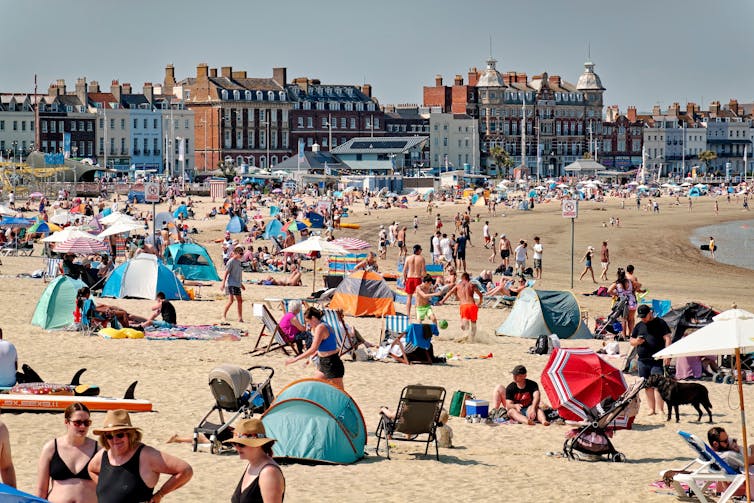
The findings also highlight less obvious cases. Rural and coastal authorities such as Shropshire, East Suffolk and Dorset rank highly because their economies rely on low-paid, less complex sectors — including hospitality, retail and seasonal work — which offer limited resilience to broader shocks. If workers need to adapt quickly to new green jobs, these labour markets offer fewer pathways.
Andrew Harker / shutterstock
Meanwhile, major hubs traditionally seen as vulnerable — Aberdeen, for example — do not rank as highly as public debate might suggest. That’s partly because the risks of oil-and-gas decline are distributed across commuting patterns and supply chains, and partly because the region has already begun diversifying into offshore wind and energy services.
Discussions of economic shocks often focus on headline job losses. Our index instead looks at the proportion of working people in each area who are exposed, highlighting where disruption will have a greater impact on the local economy.
This distinction matters because an area can have highly vulnerable industries yet employ relatively few people in them. By analysing industrial risk alongside workforce exposure, we identify places where the scale of potential disruption — not just its intensity — is greatest.
The result is a list of 32 local authorities most in need of support to navigate the transition. Most sit in England’s Midlands and north, along with several in Wales and Scotland. What unites them is not current emissions levels, but long-standing economic fragility.
An uneven playing field
Net zero will bring vast economic benefits to many. Yet, our work exposes a crucial tension at the heart of the net-zero transition: its impacts play out in a landscape already shaped by 40 years of uneven growth. Many communities identified as vulnerable have been grappling with low wages, declining opportunities and outflows of young talent for decades.
Net-zero policies are not causing these challenges, but they risk intensifying them if they ignore the geography of vulnerability. This helps explain why climate policy has become politically contentious in some regions.

Go My Media / shutterstock
Overall, the British public still supports the goal of net zero, but there is often far less support for the policies needed to get there. Capitalising on this tension, Reform has pledged to scrap “net stupid zero” policies and suggested the revival of coal mines, while the Conservatives have vowed to do away with the 2050 net zero emissions target, claiming it is impossible “without a serious drop in our living standards or by bankrupting us”.
At the core of the anti-net zero message is how “green” policies will make people and communities poorer. Such claims have an important resonance in the wake of a cost-of-living crisis, spikes in energy bills, and an increased sense of economic precarity for many – particularly in already-struggling regions.
Continued public support for net zero depends on acknowledging where its costs will fall. Confronting these risks is essential to making climate policy more durable.
What next?
The net zero transition can create new, secure, well-paid jobs and help the UK establish itself as a “clean energy superpower”. But without targeted intervention, the benefits and costs will always be shared unevenly.
Our research highlights a clear opportunity: many of the most vulnerable local authorities sit within parts of the UK which have devolved powers over skills, transport and local economic strategy. Devolved governments in Scotland and Wales, and regional bodies such as the Greater Manchester Authority can play key roles by funding retraining, improving infrastructure, and creating new types of jobs for those who will be negatively affected by net zero.
Our net zero vulnerability index gives policymakers a map of where support is most urgently needed. The challenge now is to use it — to ensure the transition to a green economy becomes a story of national renewal rather than a replay of uneven decline.

Don’t have time to read about climate change as much as you’d like?
Get a weekly roundup in your inbox instead. Every Wednesday, The Conversation’s environment editor writes Imagine, a short email that goes a little deeper into just one climate issue. Join the 47,000+ readers who’ve subscribed so far.